Editorial Board
MusicWeb International
Founding Editor Rob Barnett Editor in Chief
John Quinn Contributing Editor Ralph Moore Webmaster
David Barker Postmaster
Jonathan Woolf MusicWeb Founder Len Mullenger
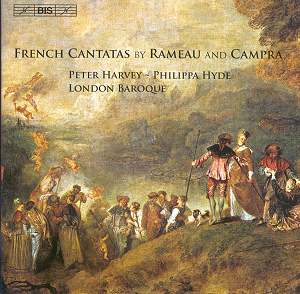
Jean-Philippe RAMEAU (1683–1764) Les Amants Trahis (c. 1716) [21.58] Aquilone et Orithie (1704) [13.34] Thétis(1704) [10.27] Aire à boire (1707) [2.27] Andre CAMPRA (1660–1774) Les Femmes [14.01] Peter Harvey
(baritone); Philippa Hyde (soprano)
London Baroque (Ingrid Seifert and Richard Gwilt (violins),
Charles Medlam (bass viol), Terence Charlston (harpsichord))
rec. October 2004, St. Martin’s East Woodhay, Hampshire. BIS BIS-CD-1495 [64.05]
The cantata was the common currency of the baroque opera
world. Even when not engaged in operas, singers needed pieces
to show off their prowess when performing for patrons. Such
performances would have been far more frequent than the full
operatic stagings. After all, singers had a lot of patrons
to try to impress.
Similarly performer-composers like Handel saw such cantatas
as vehicles to show off their own skills. Composers also
used the quasi-operatic scenes in the cantatas to experiment
with ideas which could later be re-cycled in full operatic
form.
Rameau’s first opera, Hippolyte et Aricie was
first performed in 1733, when the composer was fifty. But
the previous thirty years of his composing career had been
full of smaller works. Amongst these were numerous cantatas.
London Baroque have now recorded three of these along with
one by Rameau’s older contemporary, Campra.
The cantatas Aquilon et Orithie and Thétis were
written in 1704 and feature an obbligato violin solo. Aquilon
et Orithie is a retelling of the myth where the god of
the North wind - Boreas in Greek myth, Aquilo in Roman myth
- falls in love with Oreithyia, Princess of Athens. She is
resistant to his charms so instead of persuasion he uses
force and in a rage, kidnaps her. This works and she yields.
Thétis was a Nereid fated to bear a son mightier than
her father, Achilles. Both Zeus and Jupiter are rivals for
her heart. First Neptune calls up a mighty storm to engulf
Mount Olympus. Then Zeus, on Olympus answers with thunderbolts.
All in vain, as Thétis decides not to marry a god after all
and follow the dictates of her own heart.
The final Rameau cantata on the disc is Les Amants
trahis, written around 1716. This features some challenging
writing for the bass viol. The cantata is a mini-comedy
featuring two shepherds suffering the trials of love. One
laments his misfortunes in love whilst the other takes
the odd setback in his stride.
Finally the performers include a short duet, Aire à Boire,
written in Burgundian dialect. This comes from a collection
called Air serried et à boire from 1707.
The principal performer in these cantatas is the baritone
Peter Harvey. In opera, it can often be the haut-contre and
soprano voices who come to the fore and show off. So it is
a pleasant change to find this disc devoted to the baritone
voice. Harvey has a lovely warm voice which is focused and
flexible. He is at home in this idiom, bringing charm and
necessary virtuosity to the music. He shapes each scene as
a drama, alive to the opportunities Rameau gives him as he
experiments with potential operatic forms.
In Les Amants trahis and Air à boire Harvey
is joined by soprano Philippa Hyde. Though Hyde never gets
a solo but simply duets with Harvey, her contribution is
certainly welcome.
Violinist Ingrid Seifert makes an apt counterpart to
the voice in the obbligato violin part in Aquilon et Orithie and Thétis, while
Charles Medlam makes admirably easy work of the virtuoso
bass viol part in Les Amants trahis.
The disc is completed by Campra’s cantata Les Femmes,
a charming piece of rococo entertainment in which the protagonist,
fatigued by the vicissitudes of love, decides to renounce
women and retire to the depths of the forest. But, of course,
we know that he won’t stay there. Harvey and London Baroque
capture all the charm of this delightful, light-hearted piece.
Whereas in the Rameau we can sometimes get the feeling that
the composer is experimenting and straining for greater things,
in the Campra we feel he is content to simply entertain.
Which he does, admirably.
This is a charming, well performed disc. Anyone interested
in exploring French baroque music further should buy it immediately.
Peter Harvey and London Baroque perfectly capture the feel
of the intimate, chamber nature of the performances, giving
us a perfectly apposite flavour of performance away from
grand spectacle.
Robert
Hugill
Please support our advertisers below by clicking on the logos for further information.

























 Peter Harvey
(baritone); Philippa Hyde (soprano)
Peter Harvey
(baritone); Philippa Hyde (soprano)