Editorial Board
MusicWeb International
Founding Editor Rob Barnett Editor in Chief
John Quinn Contributing Editor Ralph Moore Webmaster
David Barker Postmaster
Jonathan Woolf MusicWeb Founder Len Mullenger
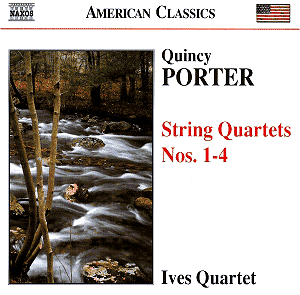
Quincy Porter (1897-1966)
String Quartet No.1 in E minor (1922-23) [19:19]
String Quartet No.2 (1925) [14:29]
String Quartet No.3 (1930) [16:23]
String Quartet No.4 (1931) [15:19] Ives Quartet:
(Bettina Mussumeli (1st violin);
Susan Freier (2nd violin); Judi Levitz (viola);
Stephen Harrison (cello)).
rec. St Stephen’s Church, Belvedere, California, 21-26
May 2006. DDD NAXOS 8.559305 [65:30]
I
had not heard any music by Quincy Porter prior to hearing
this CD. In fact, as far as I was concerned, he was quite
simply a name. I would not have known whether he wrote avant-garde
music or jazz or even songs for the shows. However this CD
has stopped me in my tracks. Firstly, it reveals a composer
who writes great music. Secondly it introduces a musician
who, at least on the basis of this CD, deserves to be better
known well beyond the USA. And lastly his Nine Quartets represent
a cross-section of the composer’s achievement over some five
decades. They allow us a unique insight into his personal
development in the context of mid-twentieth century music.
A
few words about the composer may be helpful. Quincy Porter
was born in New Haven, Connecticut on 7 February 1897. He
was fortunate to study at Yale University where his teachers
included the eminent Horatio Parker. Further study with Vincent
d’Indy and Ernest Bloch in Paris ensured a solid foundation
of compositional skills. In addition to writing music he
was a teacher. He taught at Vassar during the 1930s and latterly
became Dean and finally Director of the New England Conservatory
of Music. He was to return to Yale as professor and taught
until his retirement in 1965. He died the following year.
A
brief study of his catalogue reveals a wide variety of music
across a number of forms. We noted his nine string quartets,
but there are also two symphonies, a number of concertos
and a deal of other chamber music. However there are no operas
or major choral pieces: it was only quite late that he came
to write songs.
It
is difficult to place Quincy Porter in the pantheon of American
composers. It could be convenient to place him in a theoretical ‘New
England School’ which would include Porter, Donovan, Piston,
Sessions, Moore and Randall Thompson. This somewhat artificial
arrangement would be subject to much debate and discussion
amongst musicologists. However Howard Boatwright sums the
relationships up well. He writes that Porter was “less traditional
than Donovan, less neo-classical than Piston, less complex
than Sessions, more sophisticated than Moore and more eclectic
that Randall Thompson. Porter’s music went its own way.”
As
a stylistic guide it would be fair to say that Porter inclined
to neo-classicism rather than modernism or romanticism, although
as Richard Whitehouse points out, he managed to avoid the
adulation of Stravinsky and Hindemith that influenced so
much American music.
It
was in the nine String Quartets that Porter found his true
voice. He had developed a great love of playing chamber music
and was a competent viola player who knew much of the common
repertoire: he played for most of his life and wrote a concerto
for the instrument. It was out of this intimate understanding
of the ensemble that these Quartets evolved.
The
four Quartets recorded here are all extremely well wrought.
The part-writing is grateful to the soloist: the music is
written with a subtlety and sensitivity that is totally satisfactory.
There is no effect for effect’s sake – he does not write
to shock or impress.
The
essential style of these Quartets makes “extensive use of
chromatic harmonies and sophisticated rhythms in an essentially
melodic context.”
These
four quartets were written between 1922 and 1931 and represent
a journey from a derivative First to a stylistically mature
Fourth by way of a Bartókian Second and a folk-music tinged
Third.
I
note that the complete edition of String Quartets is currently
available on an Albany CD [918] played by the Potomac String
Quartet. This includes a number of other, shorter chamber
pieces. This is issued on two CDs and represents great value
for money. However I have not heard them and cannot pass
judgement between editions.
The
Ives Quartet is based in San Francisco and here make their
Naxos debut. The playing is stunning and subtle. As I pointed
out above, I do not know these works, but just two hearings
reveals a stunning performance, hidden depths and fine expression.
This is a Quartet that is perfectly at home with this fine
music.
The
sound quality is exceptional and of course the programme
notes by Richard Whitehouse are extremely helpful.
I
have only two concerns. I am not sure why Naxos felt that
it was necessary to put the works in anything other than
chronological order (the disc order is 3, 2, 1, 4) and will
Naxos actually bring out a second - and perhaps even a third
- volume?
If
the answer to the second question is ‘Yes’ then I heartily
recommend this series. But if ‘No’ then I guess that I must
suggest an investment in the Potomac String Quartet edition – at
least you can guarantee owning all nine quartets – and it
is a well-received recording with great reviews.

























 Ives Quartet:
(Bettina Mussumeli (1st violin);
Susan Freier (2nd violin); Judi Levitz (viola);
Stephen Harrison (cello)).
Ives Quartet:
(Bettina Mussumeli (1st violin);
Susan Freier (2nd violin); Judi Levitz (viola);
Stephen Harrison (cello)).