When a CD or DVD
arrives with the eye-catching words ‘World Premiere Recording’
I always feel a tingle of excitement and anticipation. In such
situations, unless I have heard a live performance, it is a
question of starting from first base with no recourse for comparison.
On the other hand, when a gap is being filled in a composer’s
discography I will know into which particular period the new
work falls, and thus have some idea what to expect. Such situations
have manifested themselves with works by Rossini and Donizetti.
But in the first decades of the ‘primo ottocento’, as the first
half of the 19th century in Italian opera is referred,
every major city in the states of Italy boasted two or even
three theatres presenting opera. Opera was the popular entertainment
among the population whatever, their social status. The audience
expected new works and each theatre impresario would commission
several each season guaranteeing at least three performances
to each. Impresarios clamoured and competed for new works. As
I explain in part 1 of my Rossini Conspectus
Rossini was lucky when aged 19, a German composer reneged on
his contract at the Teatro San Moisè in Venice and he was asked,
at short notice, to replace him. His first staged composition,
La Cambiale Di Matrimonio found favour and quickly led
to more work. All of this was aided by his facility for speedy
composition. Other composers were not so lucky and either went
hungry on a regular basis or pursued alternative careers constantly
hoping for a breakthrough. Their names are many and often their
music is eminently worthwhile whilst rarely getting a hearing.
Thanks to Opera Rara examples of Severio Mercadante’s music,
one of those near forgotten composers is readily available on
disc. Included are complete recordings of his operas Orazi
E Curazia (ORC 12) and Emma D’Antiochia (ORC), each
on three CDs, as well as a single disc shared with music of
yet another near forgotten composer, Pacini (ORR 236). Best
of all as an introduction to Mercadante’s music is the single
disc entitled Mercadante
Rediscovered.
Saverio Mercadante
was born illegitimate in Bari. At age eleven he went to the
College di St. Sebastino in Naples where he attracted the interest
of Rossini, four years his elder. His first opera L’apoteosi
d’Ercole (1819) was well received, but it was with his seventh
Elisa e Claudio presented in Milan two years later that
his fame spread. Work took Mercadante to Spain and then Portugal
where his Gabriella Di Vergy was presented at the Teatro
San Carlos, Lisbon in 1828 after which he settled in Italy presenting
Emma D’Antiochia in 1834 and Zaira in 1836. Mercadante
then went to Paris at the invitation of Rossini, but his I
briganti was a failure despite a cast including Grisi, Rubini
and Lablanche. Contact with Meyerbeer’s Les Huguenots
influenced and encouraged him in an expansion of style found
in his later works. Many followers of Opera Rara’s extensive
list of Donizetti operas will know that the two composers were
born within two years of each other. They will also know that
Mercadante twice succeeded to paid positions that Donizetti
coveted; that would have given him the financial security for
which he sought and yearned. But the similarities do not end
there. Whilst Donizetti first made waves with his seventh opera,
Zoraida
Di Granata at the Teatro Argentina, Rome, on 28 January
1822, Mercadante had had similar successes with Elisa e Claudio.
In his extensive and scholarly essay on the singers from the
premiere of Maria Stuarda Regina di Scozia, and its reception
at the Teatro Communale in Bologna, Dr. Jeremy Commons whilst
presenting favourable evidence makes no extensive claims as
to its reception. However, it has to be admitted that the work
was not staged after 1825.
The bel canto composers
of the primo ottocento acquired a great love for British history.
It provided opportunities galore for dungeons, castles, murders
and plots. There were few more appealing subjects than Mary
Stuart and Elisabeth I. Donizetti’s Maria Stuarda focuses
on their relationship whilst Mercadante’s Maria Stuarda Regina
di Scozia, as the name implies, focuses on the lady’s earlier
exploits.
I find Mercadante’s
music in Maria Stuarda particularly impressive in its
ensembles of which there are several in this selection of highlights.
These seem to me to be as nearly as complex and melodic as those
in early Rossini and nearly comparable with what the latter
achieved after Il Barbiere and in his Naples opera seria.
They provide an admirable vehicle for the soloists and fine
conductor in this generous selection of highlights. Of course,
bel canto is about the quality of individual singers as much
as anything else and Opera Rara live up to their deserved reputation
of finding and fielding some of the best practitioners of the
art. As Maria, Judith Howarth is a relative newcomer to their
roster and sings with welcome expression, colour and vocal flexibility
in the eight minute extended extract from Maria’s aria Chi
mai temir (tr. 8). I emphasise the word ‘extract’ because
these are highlights and there is a cut. This fact is made clear
in the printed full libretto and English translation. This is
complete but shows the parts included in these highlights in
blue. This very generous policy of providing the full libretto
has the advantage of making every nuance of the plot abundantly
clear. Judith Howarth’s skills can also be heard in duet with
the equally flexible but appropriately more sonorous tones of
Jennifer Larmore in the trousers role of Olfredo (trs. 2 and
9) and the equally strongly sung and trousered Primate of Manuela
Custer. Jennifer Larmore’s singing in the long scena and solo
aria Ah! che finor fu vano (tr. 8) is a veritable tour
de force. Her voice is strong and secure as well as sonorous
with no spread of the tone when she puts pressure on the voice
for the lower notes. Add the wide range of the tessitura, her
good diction and appropriate vocal decorations, and this portrayal
represents a formidable achievement and is among her best on
record. Larmore’s tonal characteristics are well contrasted
with those of Manuela Custer in the role of Carlo, Primate of
Scotland and constitute a brilliant piece of vocal casting by
Opera Rara. Having extolled Larmore’s many virtues I must add
that Custer also exhibits those appropriate to her role and
with particularly impressive chest tones (tr. 3). The men play
their part in the quintet (tr. 5) and the act finales (trs.
6 and 10) where Colin Lee’s plangent tenor is heard to good
effect as well as the carefully positioned chorus who contribute
vibrantly.
Robert J Farr
























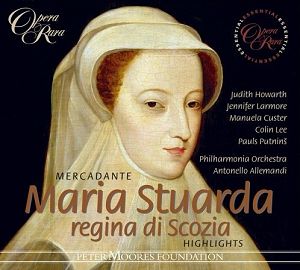

 Maria Stuarda, Queen
of Scotland – Judith Howarth (soprano); Olfredo, Earl of Lennox
– Jennifer Larmore (mezzo); Ormondo, Royal Prince – Colin Lee (tenor);
Carlo, Primate of Scotland – Manuela Custer (mezzo); Ferrando, Commander
of the Royal guard – (baritone)
Maria Stuarda, Queen
of Scotland – Judith Howarth (soprano); Olfredo, Earl of Lennox
– Jennifer Larmore (mezzo); Ormondo, Royal Prince – Colin Lee (tenor);
Carlo, Primate of Scotland – Manuela Custer (mezzo); Ferrando, Commander
of the Royal guard – (baritone)