During the LP era,
Nicholas Maw’s music was reasonably
well served in terms of commercial recordings.
These culminated in two outstanding
recordings of what I regard as two of
Maw’s finest works, Scenes and
Arias (now re-issued on Lyrita
SRCD.267 reviewed here)
and Life Studies (now
re-issued on NMC Ancora D085 - review).
Up to that time, however, Maw had composed
comparatively little, but the prolonged
gestation of the monumental Odyssey,
which was recorded several years ago,
seems to have fired Maw’s muse again,
with evident results. His list of works
grew steadily and still does, and recordings
of a number of his major works were
eventually released - among others by
ASV, Nimbus, Sony and – more recently
– Hyperion. It all means that his present
discography is far from negligible,
although a number of works still await
recording. I have long been wishing
for a recording of his four string quartets.
So, the present release partly fulfils
this wish, at long last. I hope that
Somm and the Coull Quartet will not
need too much persuasion to record the
other three.
The String Quartet
No.3, completed in 1994 to mark
the Coull Quartet’s 21st
anniversary, is a substantial work in
five movements played without a break.
The last of these is an imposing Passacaglia,
as in Britten’s final string quartet
also recorded here. The first movement
Moderato grazioso displays some
almost childlike, though definitely
not childish, innocence. It’s a fine
example of what I have always considered
Maw’s inborn lyricism. The next movement
Larghetto pesante may be regarded
as the first slow movement, described
as "a folk dirge" by the composer.
There follows a pair of Scherzos, the
first one Presto volante played
mostly muted being a ghostlike Nocturne
and the second Allegro marcato
described as "a stamping dance"
but maybe, more seriously, a brutal
gesture of revolt. A short reprise of
the Larghetto pesante leads into
the impressive, and often deeply moving
Passacaglia. This concludes with a veiled
reminiscence of the opening movement.
Maw’s Third String Quartet is an emotionally
and expressively varied work of substance
and splendour.
The two works by Britten
recorded here roughly come from both
ends of his composing life. The Three
Divertimenti are the three completed
movements of a suite that was to consist
of five movements: musical portraits
of some of his friends. The suite, Go
play, boy, play
with the added and slightly ironic subtitle
Alla Quartetto Serioso, was never
completed. The existing movements were
revised and first performed in February
1936 and "received with sniggers
and in a pretty cold silence".
The opening March is a rather sardonic
and at times unpredictable one, not
unlike the slightly earlier Alla
Marcia (1933), which eventually
found its way in the opening sequence
Parades in Les Illuminations.
The Waltz and the Burlesque, too, have
their share of irony. No wonder that
the first performance raised some eyebrows
amongst some of the British musical
establishment of the time. This youthful
work undoubtedly displays Britten’s
consummate instrumental mastery; something
that was to stay with him throughout
his composing life.
The Third String Quartet
is a much better known work, were it
only because there exist several recordings
of it - by the Lindsay and the Maggini,
to name but the ones I have on my shelves.
Britten’s String Quartet No.3
Op.94 is obliquely connected
to his final opera Death in Venice.
It briefly reuses some of the opera’s
material. Like Maw’s Third String Quartet,
Britten’s piece is laid-out in five
movements: three rather developed movements
separated by two Scherzos. It too ends
with a rather desolate Passacaglia,
that – to these ears at least – sounds
as an "Intimation of Mortality".
I must admit that some of Britten’s
late works - Sacred and Profane,
Death in Venice and –
to a lesser extent – Phaedra
- still leave me with a painfully unanswered
question: Is the economy of means noticeable
in these works the result of a lifelong
search for economy or has the composer
simply dried-out in his last, illness-stricken
years? Curiously enough, the Third String
Quartet was never part of this questioning
of mine. Do not ask me why, because
I am afraid that I will not be able
to provide a suitable, reasoned answer.
Might it be because I rather unconsciously
feel that Britten dares open his heart
in this work, and voices his own personal
concerns with death as a result of the
severe heart disease he suffered in
his final years? Whatever the answer,
I firmly believe that the Third String
Quartet is not only a worthy successor
to the earlier ones, but one of Britten’s
finest and most sincere works.
The Coull Quartet’s
carefully prepared and entirely committed
readings are just superb. The recording
is very fine. As already hinted earlier
in this review, I would have preferred
to have another of Maw’s string quartets
rather than the pieces by Britten but
the pairing of these apparently different
pieces works remarkably well. This fine
release is a must for all Maw admirers,
who – like me – still keep their fingers
crossed and wait patiently for the forthcoming
(I hope) recordings of Maw’s other quartets.
This, however, is one of the finest
discs I have heard recently.
Hubert Culot
see also NICHOLAS
MAW: A RECENT DISCOGRAPHY AND MUSIC
REVIEW by Hubert Culot (dates from
2001)
























 for details
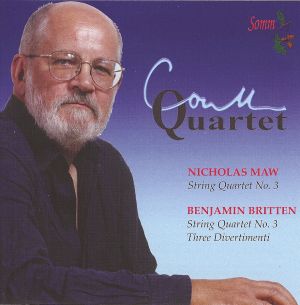
 Coull Quartet