Make a small donation(£1, £2, £5) here Classical CD and DVD reviews. MusicWeb is not a subscription site and it is our advertisers that pay for it. Please visit their sites regularly to see if anything might interest you. Purchasing from them keeps MusicWeb free.

Classical Editor: Rob Barnett                               Founder Len Mullenger


CD REVIEW


Site Map

More Reviews

How to find a review

Classical CD Review Archive

Book Reviews

Film Music Reviews

Jazz CD Reviews

Nostalgia

Comment

Norman Lebrecht Weekly

Arthur Butterworth Writes

Phil Scowcroft's Garlands

Classical blogs

Reviewers Logs

Announcements

Don't Go Here!

Community

Bulletin Board

Web Ring

Reviewers

Helpers invited!

Resources

How Did I Miss That?

British Composers

British Light Music Composers

Other composers

Indexes
   Label
   Masterwork

Discographies

On-line Music
[Download sites]

Themed Review pages

Our Classic Classics

Online books
MWI Classical
     Encyclopaedia

Gilder Dictionary of
     Composers

MWI Pop
     Encyclopedia

Other Complete Books

Programme Notes


British Music Society
Performers
The BBC Proms
Musical WWW pages
Classical Music Online

Recording Companies and Retailers
Agents and Marketing
Publishers
Non-Classical Web pages
Orchestra Web Sites
Newsgroups
Web News sites etc


Editorial Board
Classical Editor
   
Rob Barnett
Seen & Heard
Editor and Webmaster
   Bill Kenny
MusicWeb Webmaster
   Len Mullenger
Assistant Webmasters
   Patrick Waller
   David Barker

PotPourri
A pot-pourri of articles

MW Listening Room
MW Office
Helping MusicWeb
Advice to Windows Vista users  
Questionnaire    
Site History  
What they say about us
What we say about us!
Where to get help on the Internet
CD orders By Special Request
Graphics archive
Currency Converter
Dictionary
Magazines
Newsfeed  
Web Ring
Translation Service

Rules for potential reviewers :-)
Do Not Go Here!
April Fools

Would you like a hyperlinked weekly summary of the CDs we have reviewed?
Click for further details

Sample: See what you will get

alternatively Crotchet


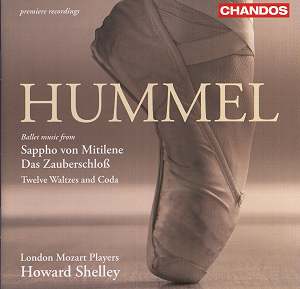
Johann Nepomuk HUMMEL (1778-1837)
Sappho von Mitilene, ballet suite, Op. 68 (1812) [46:48]
Das Zauberschloss, ballet suite [19:13]
Twelve Waltzes and Coda (1817) [9:38]
London Mozart Players/Howard Shelley
rec. St. Silas the Martyr Church, Kentish Town, July 2006
CHANDOS CHAN 10415 [75:39] 


To the extent most of us today are familiar with Hummel, it's primarily as a piano composer: his sonatas and sonatinas still serve as teaching pieces, while his piano concertos have received more recent recorded attention. To encounter him as a composer of symphonic ballets, then, comes as a bit of a shock. The two ballet scores represented here were apparently composed for the dancer-choreographer Giulio Vigaṇ, the brother of Salvatore Vigaṇ, for whom Beethoven wrote The Creatures of Prometheus. Stylistically, these scores are also something of a surprise. Where Hummel's linear piano writing and clean textures constitute an exemplar of Classical clarity, these ballets incorporate both forward- and backward-looking elements, now juxtaposing them, now blending them. 

Thus, the opening tutti of Sappho von Mitilene is firm and proclamatory in the Classical manner, but the brass is more prominent than it would be, say, in Beethoven - indeed, throughout the score, the brasses sound unusually "present" in supporting chords. The Allegretto (track 6) has a recognizably Classical structure, its recurring march theme alternating with more smoothly lyrical material, and the drone bass of the Pastorale (track 9) underlines a kinship with country-dance models. "La furia" (track 11) supports busy string and woodwind activity with a rigorous rhythmic framework. On the other hand, the horn solo in the Larghetto (track 8) suggests Weber, while the English horn in Madame Vigaṇ's solo (track 4) evokes an operatic aria. The oboe's graceful, sinuous waltz in the Andante maestoso (track 11) foreshadows similar melodies in the great Romantic ballets of Tchaikovsky and Delibes. 

From the start, Das Zauberschloss veers explicitly into the programmatic and pictorial, with its pastoral woodwind duets and ominous fanfares. Later, a series of courtly-sounding dances evokes medieval models while serving a function analogous to that of "characteristic dances" in the big popular ballets, while the score's closing section fairly bristles with forward energy. The Twelve Waltzes and Coda anticipate the symphonic waltzes of the Strauss family. After an opening trumpet fanfare, calling the listener to attention, there follows a series of brief dances, each less than a minute in length, capped by a rousing coda. 

Don't let all the discussion of various stylistic fingerprints obscure the fact that this well-wrought, substantial music is unfailingly tuneful and engaging. These scores are not "light" or "Pops" fare, but transitional works in the development of ballet which repay listening. 

Howard Shelley realizes both the Classical and Romantic aspects of this music superbly, firmly etching its rhythmic and harmonic contours while allowing the broad singing melodies room to expand lyrically, though his generous rubato in the clarinet's rustic theme of the Twelve Waltzes and Coda belies its presumed purpose as dance music. The tuttis, especially in the codas, go with a hurtling, airborne momentum. The London Mozart Players sound surprisingly large as recorded, but their playing is refined and suave; the oboe makes particularly delicate, piquant contributions. 

Chandos provides its favored long resonance, which may produce harsh or opaque results on some equipment. The ambience doesn't obscure important musical detail, however, and the "big" recorded sound reinforces the impression of these as robust, Romantic scores. 

Stephen Francis Vasta



Advertising Rates
Visitor stats
MusicWeb International
has over 21,000 Classical CD reviews on offer


Gerard Hoffnung Concerts &
The Bricklayer Story

Naxos Classical

Australian Eloquence CDs on Buywell.com


New Releases

Hyperion
New Releases


Guild Music


MusicWeb sells the Polish
catalogue CDAccord
£10.50 post free W-W


MusicWeb sells the
Arcodiva catalogue
£12.00 post free W-W


Price Reduction: £11.00
post-free
world-wide
Try it and see - Sale or Return


MusicWeb can now offer you discs from the following catalogues:
Prices include postage

[Acte Préalable £13.50]
[Arcodiva £12.00]
[Ashgate Music Books]
[Avie from £6.25]
[British Music Society £13.49]
[CDACCORD from £10.50 ]
[ClassicO £12.50]
[Hallé from £11]
[Hortus £14.99 ]

[Lyrita ONLY £11.00 ]
LYRITA Sale or Return
[Onyx £12.00
]
ONYX Sale or Return
[REDCLIFFE £11 ]
[Tactus £11.50 ]
[Talent from £12.00 ]
[Toccata Classics £12.50 ]

MusicWeb Recommended Recordings 2008

DISCS OF THE YEAR 2007


Return to Review Index


Reviews from previous months
Join the mailing list and receive a hyperlinked weekly update on the discs reviewed. details
We welcome feedback on our reviews. Please use the Bulletin Board.  Please paste in the first line of your comments the URL of the review to which you refer..


You can purchase CDs and Save around 22% with these retailers: