Editorial Board
MusicWeb International
Founding Editor Rob Barnett Editor in Chief
John Quinn Contributing Editor Ralph Moore Webmaster
David Barker Postmaster
Jonathan Woolf MusicWeb Founder Len Mullenger
Richard
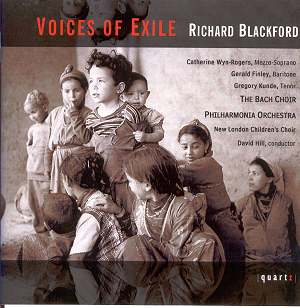
BLACKFORD (b. 1954) Voices of Exile(2001, orch. 2005) Catherine
Wyn-Rogers (mezzo); Gregory Kunde (tenor); Gerald Finley
(baritone)
The Bach Choir; New London Children’s Choir
Philharmonia Orchestra/David Hill
rec. Abbey Road Studios, London, April 2005 QUARTZ
QTZ2018 [60:44]
“In 1992 I recorded a 15-year old girl refugee
in the Kalighat slum area of Calcutta
... Although at the time I did not know it, I felt that one
day I would write a work that would incorporate Kamla’s beautiful
song and the stories of others like her.”
A commission from the Bournemouth Symphony Chorus
and Orchestra provided the composer with an opportunity to
compose a large-scale choral-orchestral work on the subject
of exile, one of our century’s plagues. Apparently, Voices
of Exile was originally composed for soloists, chorus,
children’s chorus and ensemble, whereas the orchestral version
heard here was completed in 2005.
This substantial score is laid-out in five parts
framed by a Prelude and an Epilogue sharing some of the same
thematic material as well as words by Tony Harrison, who
had already collaborated with the composer. The layout is:
Prelude, Part I – Memories of Home, Part II – Journeys, Part
III – Prison, Part IV – Exile, Part V – Freedom, Epilogue.
Blackford chose from a huge range of texts
written by refugees who suffered exile and prison and/or
who were forced to flee from their countries for whatever
reason, but who nevertheless cherished some fragile hope.
The Prelude opens with a tentative, hesitant
solo violin darting melodic fragments over a low pedal and
accompanying the tenor in a beautiful aria setting Harrison’s
moving poem Poetry after Auschwitz. Here the image
of a tiny candle symbolises fragile hope and this will also
be recalled in the Epilogue.
Part I – Memories of Home opens with the Bengali
folk song recorded by the composer in Calcutta in 1992, heard
on tape, with the chorus weaving contrapuntal lines around
it. The words “Exile has no frontiers” are then heard simultaneously
in various languages. A Tibetan poet (Gergyi Tsering Gonpo)
then remembers the beauty of the scenery of the country that
he was compelled to leave, when Chinese forces invaded.
There follows a lively, dancing paean in homage to Kinshasa “Kin
the Beautiful” on a colourful, though nostalgic poem by Mabiala Molu from
Zaire - formerly, Belgian Congo and now Democratic Republic
of Congo. The final words (“Cry for your heroes/Cry!”),
that conclude Part I,are
answered by the lament of a Somali singer, again heard on
tape, leading into a setting of a poem by Abdirhaman Mirreh from
Somalia in which the poet tells how he left the country at
night (“The moon didn’t shine/It helped us”). The voice of
the Tibetan poet is heard again on tape reading the first
lines of his poem Crossing the Frontier in a sort
of melodrama while the baritone sings its English translation.
There follows a Passacaglia for chorus and children’s choir
on a poem by Erich Fried (Austria) telling how the holocaust
happened. “It has happened/And it goes on happening/and will
happen again/if nothing happens to stop it.” The repetitive
character of the words is perfectly mirrored in the Passacaglia,
which allows for unity through variations. A fugue for chorus
and orchestra on a few lines by the Somali writer Mirreh about
the aircraft that parts him from his country concludes Part
II.
Part III – Prison: the voice of the Chilean poet
Maria Eugenio Bravo Calderara is
heard on tape reciting the first lines of her poem Private
Soldier. This is then taken-up by the mezzo-soprano.
The poet recounts her time in prison, when she received assistance
(“The rollup, the painkiller/The biscuit, the secret note”)
from some anonymous person (“I never knew your name or where
you were from/But I know what you are called/Human...”).
This is followed by an almost operatic scena in
which the prisoner confronts the ghost of his torturer (General Jeno Saidu “in ragged camouflage jacket/Automatic slung over his
shoulder/A little drum in his hand”), in a setting of an
extract from a text by the Nigerian poet Ken Sano-Wiwa.
There’s some wry humour (I dare not say ‘black humour’) here
that rubs shoulders with plain horror. About halfway into
this scene, the poem parodies Blake’s Jerusalem, echoed
by a brief quote from Parry’s setting. Part III ends with
a beautiful a cappella setting of a deeply moving
poem by Oktay Rifat (Turkey).
Part IV – Exile: a setting of a poem by Himzo Skorupan (Bosnia), in which
he muses on the house that he left and that is now occupied
by a stranger. This is followed by another episode in which
a Macedonian folk-song sung and recited in the original language
and in English translation is heard on tape accompanied by
wordless chorus. This is a simple but quite effective device.
Then comes one of the most deeply moving episodes of the
entire work: a beautiful setting of a text by Samia Dahnaan (Algeria) who affectionately remembers her grandmother Yemma.
Part V – Freedom: The chorus sing an excerpt
from Yannis Ritsos’ Exile
and Return. There follows another operatic love duet
(mezzo and tenor) on a love poem by Mohammed Khaki from Kurdistan
(“In my dreams/I come to your tent... My arms entwine you
as honeysuckle”). The complete forces unite for the first
- and last - time in the whole work for a grand setting of
a poem by Antonio Joaquim Marques
from Angola (“And when tomorrow comes/Peace shall descend
upon the land/With my plumage of soothing breeze”). The Epilogue
then follows with a varied restatement of material from the
Prelude, again with tenor and violin, the latter suggesting “a
candle’s flame, a fragile hope”, ending with “a defiant crescendo”.
Anyone who has heard Blackford’s earlier
choral work Mirror of Perfection (available
on Sony SK 60285) will know what to expect. Blackford’s music
is fairly traditional, and aligns him with some of his illustrious
predecessors - one is sometimes reminded of RVW, Howells,
Bliss, Mathias and Will Todd. The music never ventures onto untrodden paths
and I suspect that it will sound rather innocuous to some,
especially when dealing with such serious concerns. It is
light years away from, say, the music of Nono’s Il Canto sospeso also
dealing with exile and imprisonment. However its sheer conviction
is unquestionable, and everyone concerned obviously enjoys
Blackford’s eminently
singer-friendly vocal writing and splendid orchestral flair.
It must also be said, that – with the exception of the folk-songs
heard on tape – the composer does not make any attempt at
writing fake folk-music, but rather remains true to his own
personal brand of British choral-orchestral mainstream.
Voices of Exile is a vibrant, sincere and generous plea for
more humanity in our troubled world.
Hubert Culot
Editor's note: there are two different covers
for this release.
Please support our advertisers below by clicking on the logos for further information.

























 Catherine
Wyn-Rogers (mezzo); Gregory Kunde (tenor); Gerald Finley
(baritone)
Catherine
Wyn-Rogers (mezzo); Gregory Kunde (tenor); Gerald Finley
(baritone)