Editorial Board
MusicWeb International
Founding Editor Rob Barnett Editor in Chief
John Quinn Contributing Editor Ralph Moore Webmaster
David Barker Postmaster
Jonathan Woolf MusicWeb Founder Len Mullenger
Ludwig van
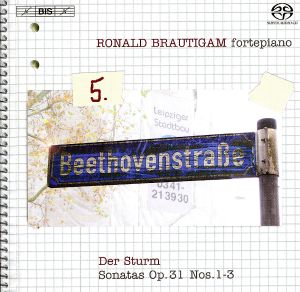
BEETHOVEN (1770-1827) Complete Works for Solo Piano: Vol. 5
Sonata No.16 in G major, Op.31 No.1 (1802) [23:14]
Sonata No.17 in D minor, Op.31 No.2 ‘Der Sturm’ (1802)
[22:18]
Sonata No.18 in E flat major, Op.31 No.3 (1802) [21:13] Ronald Brautigam
(McNulty fortepiano after Anton Walther)
rec. Österåker Church, Sweden, August 2005 BIS BIS-SACD-1572 [67:49]
Ronald Brautigam continues
his excellent chronological traversal of the Beethoven Sonatas
with the three gems Op.31. The works all come from the troubled
summer of 1802 and the best known is probably the central
D minor, nicknamed ‘Der Sturm’, or ‘The Tempest’ as we know
it, after a remark supposedly made by the composer to a pupil.
Brautigam’s performance is one of the few I can recall that
give some credence to the title; Jando and Kovacevich also
spring to mind.
It’s
not that there’s anything remotely controversial about the
readings, I’m glad to say. It’s more that Brautigam is continuing
to give us the notes, free of distortion and mannerism of
the sort that seem to be creeping into Schiff’s ECM cycle – try
the first movement of his recent ‘Moonlight’ to see what
I mean. Brautigam simply enjoys choosing a sensible tempo,
often brisk but never aggressively so and combining superb
articulation and grasp of dynamics, just lets the music unfold
naturally. Of course, he is helped immeasurably by Paul McNulty’s
little masterpiece of an instrument, which Brautigam has
been using for some years and which has surely shaped and
influenced his approach. The tonal palette is amazing for
a piano that looks relatively small and fragile, and time
and again the characteristic ‘zing’ of the tone just seems
top suit the music so perfectly.
Throughout the D minor I
was brought up short, as if hearing the music for the first
time. The voicing of that opening arpeggio, which becomes
almost a motto figure in the work, lacks the massive sustaining
power of a Steinway but takes on a different timbre here,
with that raspy, coloured edge that then quickly fades. The
rapid passagework that follows is brilliant in every sense
and the attack on the sforzando chords is nothing
short of hair-raising. He maintains a clear line in the adagio
and even those little ‘timpani’ rumblings that permeate the
movement, which one might suspect would be weakened here,
have plenty of presence and effect. The finale is a thrilling
tour-de-force of dexterity but never in a ‘look at me’ fashion – Brautigam
could never, it seems to me, be this sort of artist.
Things
get even better in the cheeky little E flat sonata, a piece
chock full of gruff humour and post-Haydn japes, what Roeland
Hazendonk’s note calls ‘the musical equivalent of a puppy
breaking loose in an over-enthusiastic run through the fields’.
Brautigam’s playing is brimming with character, from the
grace and lightness of the vivace scherzo, the lovely
song-like menuetto to the hell-for-leather finale, marked
typically presto con fuoco and really played that
way. The piano copes amazingly with some of the things Brautigam
throws at it – listen to those explosive fortissimo chords
in the scherzo, and any thoughts of a dainty little
antique are blown away!
The
deceptive G major sonata is just as good as the rest, with
too many excellent things to list – though I especially loved
Brautigam’s handling of the embellished sextuplet lines in
the adagio, surely another case where the light action
helps the pianist serve the music perfectly.
As
you have gathered, I love this disc and it’s hardly been
out of the player since it arrived. This series is gathering
critical praise as it unfolds and even though we are only
at Volume 5, I can but add my thanks to BIS, Paul McNulty
and Ronald Brautigam for giving us such stimulating and thought-provoking
Beethoven. I’ve said in the past that it feels as if the
composer were in the room with you, and looking at the booklet
photograph of Brautigam, he’s even beginning to resemble
the great man in looks. Roll on the rest!

























 Ronald Brautigam
(McNulty fortepiano after Anton Walther)
Ronald Brautigam
(McNulty fortepiano after Anton Walther)  [67:49]