In late 1869 du
Locle, Verdi’s friend and representative in Paris who had been
travelling in Egypt, told Verdi that the Khedive (Viceroy) of
Egypt wanted Verdi to write an opera. This was required to be
on an Egyptian theme and was for performance at the new opera
house in Cairo built to celebrate the construction of the Suez
Canal. The theatre had opened in November 1869 with a performance
of Rigoletto conducted by Verdi’s former pupil Emanuele
Muzio. The Suez Canal was officially opened on 17 November 1869.
Verdi at first turned down the request repeating his refusal
when in Paris the following spring. But Du Locle was not deterred
and sent Verdi a synopsis by Mariette, a French national and
renowned Egyptologist in the employ of the Khedive. Stimulated
by the synopsis, and also, perhaps, by the fact that Du Locle
had been authorised to approach Gounod or Wagner if he continued
to prove reluctant, Verdi wrote to Du Locle on 2 June 1870 setting
out his terms. These included a fee of 150,000 Francs, payable
at the Rothschild Bank in Paris on delivery of the work. His
terms were accepted making Verdi the highest paid composer ever.
Throughout the process
Verdi was keen to achieve the greatest historical accuracy.
He asked Du Locle to gather information from Mariette about
the sacred dances of the Egyptian priestesses. He was intent
on a Grand Opera of spectacle and ballet following the Paris
Opéra pattern. Aida is one of Verdi’s most popular of
operas with its blend of musical invention and dramatic expression.
It is a work of pageant with its Grand March (Gloria all’Egitto)
and ballet interludes. It is also a work involving various personal
relationships. Of these relationships, the rivalry between Aida,
daughter of the King of Ethiopia working incognito as a captured
slave of Amneris, daughter of the King of Egypt, is intense.
Both love Radames, victorious leader of the Egyptian army. He
loves Aida but is given the hand of Amneris in reward for his
exploits as army commander. But even more complex is the relationship
of Aida with her father who arrives as an unrecognised prisoner.
A range and variety of complex possibilities of the father-daughter
relationship occur throughout Verdi’s operas, but nowhere more
starkly than here where the father puts tremendous emotional
pressure on his daughter to cajole her lover into betraying
a state secret. This betrayal will cost the lives of the two
lovers.
Verdi had Aida
ready in time for the premiere in Egypt in January 1871,
but Bismarck had engineered a Franco-Prussian confrontation
in autumn 1870. The French army was defeated at the Battle of
Sedan and the Emperor Napoleon III captured. With the siege
of Paris by the Prussians the scenery constructed there could
not be got out and shipped to Cairo. Aida was not premiered
until Christmas Eve 1871. It is an opera requiring big spinto
voices with the capacity to convey the drama and emotion through
the voice.
In the year of this
recording Maria Callas became acknowledged ‘queen’ of Milan’s
La Scala, appearing in no fewer than five productions including
the justifiably famous Visconti production of La Traviata
conducted by Giulini. She had not sung Aida since 1953 in
which year she appeared at Covent Garden in the role. She seemed
to recognise that the role was a size too big for her voice
although her new svelte figure would have made her appealing
on stage as it did for her Violetta. Her vocal limitations are
all too obvious in this recording as are her strengths in characterisation
and particularly in representing Aida’s relationship with Amneris
and her father. Compared with Tebaldi’s vocal security on her
1952 recording for Decca
in O patria mia (Naxos CD 2 tr. 6; Regis CD 2 tr. 8)
Callas’s singing is insecure and at times ugly. But she scores
in the visceral excitement and drama of her confrontation with
Gobbi’s Amonasro (Naxos CD 2 tr. 7; Regis CD 2 trs. 9-10). The
situation is not dissimilar in Aida’s scene with Amneris in
act 2 Fu la sorte dell’armi (Naxos CD 1 tr. 11; Regis
CD 1 trs. 17-18), which follows her more vocally secure and
dramatic rendering of Rittorna Vincitor. Both Gobbi,
with his lean but incisive baritone, and Fedora Barbieri with
her full-toned voice, sing their roles with full dramatic awareness
and consummate characterisation.
The role of Radames,
like that of Aida, calls for a big voice. Walter Legge wisely
eschewed calling on the lyric-voiced Giuseppe Di Stefano who partnered
Callas on many of these La Scala recordings and cast the Met’s
standard spinto Richard Tucker in the role. Tucker had missed
out when RCA had selected the more elegantly-toned Jussi Björling
for the role alongside Zinka Milanov, Fedora Barbieri and Leonard
Warren in a recording that also appears on Naxos
in another Obert-Thorn remastering. Whilst Tucker has the spinto
power for the role, I do not find his coarse and rather throaty
vocal emission particularly appealing and his characterisation
is pretty penny plain. His opening Se quell guerrier io fossi
…Celeste Aida (Naxos CD 1 tr. 3; Regis CD 1 trs. 3-4) is a
good example of his singing.
In my review of
the parallel contemporary issues of Rigoletto by Naxos and Regis I had much to say
about the relative playback qualities of the two recordings.
The Regis appeared considerably brighter, a quality I attributed
to the fact that its shorter timing raised the overall sound
by at least a quarter tone whilst the Naxos was more natural
and related to other versions of the contents I had to hand.
In this Aida the timings are very similar, but the outcome
is not that different from the Rigoletto comparison with
the brighter sound of the Regis being compared with the greater
aural depth of the Naxos. I have come to know and trust Mark
Obert-Thorn’s remasterings for their balance, capacity to bring
out the voices and orchestra in a natural ambience and their
overall veracity. Whilst the Regis might give better dynamism
via a personal CD player or I-Pod, I do most of my listening
via my reference speakers. There the Naxos recording comes over
as more natural and appealing. The track listing on the Naxos
issue is far superior with little to choose between the notes
and welcome singer biographies.
If you are a Callas
fan a live recording of her performances at Covent Garden in 1953
under Barbirolli is available on the Testament label. She is in
far better voice than here and the extra frisson of the live occasion
is an added advantage. Although the recording quality of that
live performance has its limitations, and Serafin does his best
to convey the drama and pageantry in this recording, it is not
one of the best of the La Scala series.
Robert J Farr
























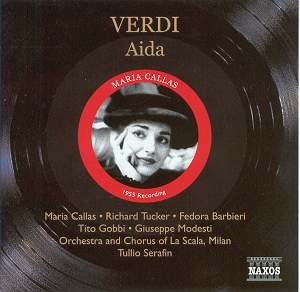

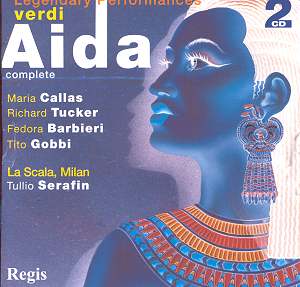
 NAXOS HISTORICAL
GREAT OPERA RECORDINGS 8.111240-1 [67.49+78.18]
NAXOS HISTORICAL
GREAT OPERA RECORDINGS 8.111240-1 [67.49+78.18]