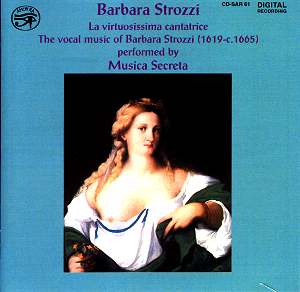
This disc was originally
released by Amon Ra in 1994 and has
now been re-launched. It emerged about
five years after a Hyperion disc of
Barbara Strozzi’s solo songs - Glenda
Simpson with the Camerata of London
- a disc I shall be referring to again
later. They recorded nine songs. We
have fourteen on this present album.
They have only one piece in common;
that is ‘Amor dormiglione’. So there
is almost no doubling up. The Hyperion,
if you can find it - it is no longer
in their catalogue - was CDA66303. It
appeared on both CD and tape. Although
there have been a few other discs comparatively
little playing time has ever been devoted
to her, and yet this is especially good
music. So why is it unperformed? Is
it because it is by a woman? If so,
then this, oddly enough you may think,
was not the attitude taken at the time.
Barbara’s father was
a well-known poet and the whole family
moved in the artistic circles of Venice.
That does not mean that she gave concerts
and recitals in the main centers. Instead,
at Venetian social gatherings and music
parties in the 1640s and 1650s Barbara
and her female friends, who also feature
on this disc, would have stepped forward
and performed settings she had made
of poetry by some of the cognoscenti,
certainly male, who were sitting in
front of her. I will return to the texts
shortly. She had much of her music published,
all in her own name - unlike Fanny Mendelssohn
two hundred years later - and needed
to as that was her main source of income.
Top quality female
vocal groups were not at all unknown
in Italy at this time. For example there
were ‘concerto della donna’ of Ferrara,
for whom Luzzasco Luzzaschi published
his 1601 collection of madrigals in
three parts. Sixteen of these madrigals
were recorded by the same singers also
for SayDisc's Amon Ra label in 1991
(SAR58). These were performed by ladies
of nobility, a trend which had been
developing for twenty years and which
was picked up by Monteverdi in his early
1584 Canzonette (Naxos 8.553316).
This present disc offers
us a mixture of solos, duets and trios
with continuo accompaniment from theorbo
and/or harpsichord … and a very welcome
variety it is too. The texts are often
about love, its consequences and its
difficulties but not all. For example
the opening ‘Merce di voi’ is all about
the composing process; did she write
this text herself? The translators,
including Deborah Roberts the soprano
who has also written the extremely interesting
programme notes, offer us "Thanks
to you my fortunate star/I fly among
the blessed choirs/and crowned with
everlasting laurels/perhaps I shall
be called the new Saffo/." All
texts are meticulously and clearly provided.
In ‘Canto di bella
bocca’ we hear praise for performers.
Remember Strozzi was both. "How
sweet to hear a lovely mouth delightfully
sing verses of love/Pretty, charming
voice, with rapid divisions it entices
you…". The words here have been
delightfully expressed in both the melody
and harmony. This brings us to the subject
of word-painting so very prevalent in
this song with its "musical lips"
and "harmonious breath" and
its "rapid divisions". But
we find it elsewhere, sometimes subtle,
as in the "frenzied teeth"
mentioned in ‘Mordeva un bianco lino’.
This curious little piece is subtitled
‘from the stars the tears of scorned
lovers was learned the art of paper-making’!
Other word-painting is more obvious
and standard, such as the yearning "Oh
dolci, oh cari, oh desiati baci"
which is "Oh sweet, oh dear, oh
desirable kisses" with its lyrical
wondering line. There is also a fine
duet ‘Anima del mio core’. What a beautiful
and dramatic beginning ‘Soul of my heart"
with its downwards tri-tone leap.
The style of this opening
and elsewhere in the songs is in the
prevailing ‘arioso’ language. This is
a cross between recitative and aria,
moving between the two opening in a
free style, almost a seco-recitative
and evaporating effortlessly into a
little triple time section "Fountain
of life", then back again. The
voices wind around each other and then
lead, sometimes imitated and sometimes
echoing each other. As with the contemporary
instrumental Canzonas, sections are
short and often contrasting and only
sometimes recapped. Strozzi’s melodies
are her own and studded with unusual
intervals, as heard in ‘Sete pur fastidioso’.
They are always those of a singer/composer
who is thinking of an ecstatic line
ranging over the entire voice and suiting
perfectly the vowel on which it is heard.
As for the performances,
everything is quite delightful, the
three female singers are experienced
in this music and negotiate all of its
turns and ornaments with accomplishment.
They have good diction and are excellently
balanced between themselves. That said,
I do wish that recording engineers would
take the recording of continuo instruments
more seriously and give them more prominence
in the overall stereo picture. I would
also have liked a little more passion
from the singers. To hear ‘Amor dormiglione’
sung by Glenda Simpson is a revelation.
She throws herself into the text rolling
her Rs with relish and has a twinkle
in her eye and a touch of anger in "Arise,
Love, sleep no more … Do not be useless,
love" and so on. In comparison
Suzie le Blanc is bland and very English.
All in all a fascinating
release of music that is well worth
studying and taking seriously.
Gary Higginson
























 for
details
for
details
 Musica Secreta (Deborah Roberts (soprano);
Suzie le Blanc (soprano); Mary Nichols
(alto); Kasia Elsner (theorbo); John Toll
(harpsichord)
Musica Secreta (Deborah Roberts (soprano);
Suzie le Blanc (soprano); Mary Nichols
(alto); Kasia Elsner (theorbo); John Toll
(harpsichord)