Now this is something
of a rarity. The video market for Die
Frau ohne Schatten has tended to be
dominated by the excellent Götz
Friedrich/Solti Salzburg Festival production,
but those who know Sawallisch’s wonderfully
fluent and intelligent EMI set from
1988 will be keen to experience this
DVD version, filmed while the Bavarian
Opera’s forces were in Japan by special
invitation. Interestingly, both productions
took place in the same year, 1992, and
both conductors admit to a very special
affinity with this opera. In Sawallisch’s
case, the booklet tells us this was
to be his last season in charge at Munich,
and Die Frau was the obvious candidate
for his farewell production after twenty
one years in charge, as it is his favourite
Strauss opera and the one had also conducted
as his very first production with them,
a neat ‘full circle’. The icing on the
cake was the added fact that this was
to be the first staging of the work
in Japan.
In many ways this
celebration of marital bliss suits what
the director, Professor Ennosuke Ichikawa,
chooses to do with it. The fairy-tale
setting, replete with allegory and rather
dense symbolism, lends itself quite
well to the highly stylized world of
kabuki theatre, and the sumptuous costumes
and lavish yet basically simple designs
give the scene changes an effortless
flow, something which has foiled many
opera houses mounting this opera. How
do you tackle stage directions such
as ‘the earth opens and the river pours
in through the fractured walls’? Or
‘a flaming sword flies from the air
into Barak’s grasp’? Or best of all
‘the fish fly through the air and land
in the frying pan’? Well, I guess it’s
rather like tackling Wagner’s Ring;
the director has to decide what will
be staged as ‘naturalistically’ as possible
and what will be done with lighting
effects or mere suggestion. Ichikawa
doesn’t short-change us in this department,
and the sword scene is brilliantly effective,
as is the earthquake which ends Act
2. I suspect the notoriously picky librettist
Hugo von Hofmannsthal (1874-1929),
who acknowledged a debt to influences
from the Far East, would have approved.
It is only one
director’s concept, and it’s worth saying
that Friedrich’s more naturalistic Salzburg
staging has many fine moments, some
of which are even better than here,
such as The Emperor’s falcon house scene
in Act 2, but the many camera close-ups
sometimes undermine the complex on-stage
effects and we occasionally glimpse
stagehands and bits of machinery. Here,
everything flows as smoothly as the
swathes of silk employed by the costume
designer – but then what else would
we expect in a new state-of-the-art
Japanese theatre? To be sure, their
censor had problems with aspects of
the score, most notably the three deformed
brothers, who the director makes sure
we hardly see, as well as aspects of
the portrayal of women and certain erotic
undertones, but these do not become
a problem in the context of the overall
approach. It’s worth noting here that
during the orchestral interludes, the
Salzburg video cuts to the pit, whereas
here the camera stays on the coloured
backdrop. In fact, the only shot of
Sawallisch conducting is during the
prelude to Act 3.
If you know Sawallisch’s
studio set, you’ll see from the above
that the cast is completely different.
This opera needs luxury casting and
no-one here really disappoints, though
the Solti is stronger in some areas.
The standout performance, for me, is
Lipovšek’s Nurse. She is still
a great Straussian, as witnessed by
her Clytemnestra in the recent Zurich
Elektra, but here in 1992 she really
is vocally at the peak of her powers;
indeed, she also sings this part on
the Solti DVD so was obviously coming
to this Bavarian production fresh from
the summer Salzburg Festival, excellent
preparation if ever there was The voice
soars and copes with every cruel demand
placed on it, and even in heavy make-up
and costume she conveys the Mephistophelean
scheming of the character convincingly.
The other women are also strong, with
Luana DeVol ( a name new to me) touchingly
vulnerable as The Empress and Janis
Martin, who I admit I only really knew
through her excellent Senta in Solti’s
Flying Dutchman, excellent as the irascible,
shrewish Wife, supposedly based in part
on Strauss’s other half Pauline.
All the best tunes
in this piece go to the noble character
of Barak the Dyer, a sort of blood brother
to Jokanaan, whose stoicism and near-saintliness
is sometimes hard for a modern audience
to swallow. All is forgiven with the
music Strauss endows the character with
and Alan Titus makes the most of it.
Again, I have to confess to not really
following his career much after his
sensational debut in Bernstein’s Mass,
but he’s every bit as good as Solti’s
Robert Hale and vocally perhaps slightly
stronger and firmer, though this is
nit-picking. Particularly moving is
his glorious Act 3 aria ‘Mir anvertraut,
dass ich sie hege’ – for those who know
the orchestral fantasy based on themes
from the opera, it’s the big trombone
tune towards the end. Titus really is
up to the part and it was a pleasure
re-acquainting myself with his artistry.
Peter Sieffert’s Emperor is not quite
as heroic as I would have liked, though
he phrases intelligently. The voice
is slightly quivery at first (nerves?)
and not as ringing or firm as Thomas
Moser for Solti, to say nothing of Domingo
for Solti’s CD set or Kollo on the Sawallisch
studio version. It’s not a serious problem,
but he fails to rise to the occasion
in his great ‘hunting song’ in Act 1
and seems to be saving himself for later,
when the voice appears to gain in clarity
and sheer tone. All other parts are
strong, including Herbert Lippert’s
Young Man, more repeat casting from
Solti’s Salzburg run.
Sawallisch’s conducting
oozes love of the score, yet he resolutely
resists Solti’s tendency to put the
big moments in neon lights and is determined
to structure it symphonically. A good
example is the above-mentioned Emperor’s
song, where Solti’s whooping horns and
trumpets blare out thrillingly but here
seem a tad subdued until we hear the
tune transformed magically to the strings
in Act 2. Sawallisch also relishes the
many chamber-like sonorities that temper
the thicker orchestral passages, and
he’s especially convincing in the important
interludes, where themes are echoed
and introduced in rich orchestral tapestries.
His first rate orchestra really does
him proud, and the whole thing is captured
in warm and detailed sound.
The picture quality
is also fine, though it’s only in 4.3
format rather than true widescreen.
As ever with TDK, the booklet concentrates
on the production, giving no background
to the opera, cast biographies etc.
It’s a shame, and the lovely photo of
Sawallisch and Ichikawa on the back
cover only made me yearn for an interview
of some sort as an extra. Still, Strauss
fans may well want this, even if Solti
and his glorious VPO perhaps remain
a safer all round recommendation. It’s
a good record of what was obviously
a special occasion for all concerned,
and even if odd aspects of the production
and casting could be questioned, the
intelligent conception and sensitivity
to character does full justice to an
exceptional and challenging masterpiece.
Tony Haywood
























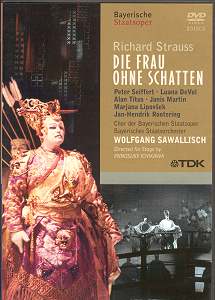

 Der Kaiser (The Emperor) - Peter Seiffert
(tenor); Die Kaiserin (The Empress) -
Luana DeVol (soprano); Die Amme (The Nurse)
- Marjana Lipovšek (mezzo); Der Geisterbote
(The Spirit Messenger) - Jan-Hendrik Rootering
(baritone); Barak, der Färber (Barak
the dyer) - Alan Titus (baritone);
Sein Weib (his wife) - Janis Martin (soprano);
Die Stimme des Falken (The Falcon’s voice)
- Caroline Maria Petrig (soprano); Die
Erscheinung eines Jünglings (The
Apparition of a Young Man) - Herbert Lippert
(tenor)
Der Kaiser (The Emperor) - Peter Seiffert
(tenor); Die Kaiserin (The Empress) -
Luana DeVol (soprano); Die Amme (The Nurse)
- Marjana Lipovšek (mezzo); Der Geisterbote
(The Spirit Messenger) - Jan-Hendrik Rootering
(baritone); Barak, der Färber (Barak
the dyer) - Alan Titus (baritone);
Sein Weib (his wife) - Janis Martin (soprano);
Die Stimme des Falken (The Falcon’s voice)
- Caroline Maria Petrig (soprano); Die
Erscheinung eines Jünglings (The
Apparition of a Young Man) - Herbert Lippert
(tenor)  TDK DVWW-OPFROS [2 DVDS: 183:00]