Editorial Board
MusicWeb International
Founding Editor Rob Barnett Editor in Chief
John Quinn Contributing Editor Ralph Moore Webmaster
David Barker Postmaster
Jonathan Woolf MusicWeb Founder Len Mullenger
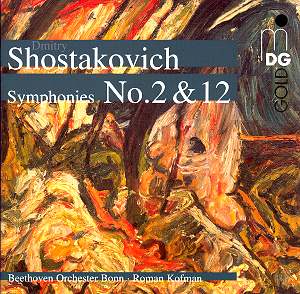
Dmitry SHOSTAKOVICH (1906–1975)
Complete Symphonies - Vol. 6
Symphony No. 2 To October Op. 14 (1927) [18:55]
Symphony No. 12 The Year 1917 Op. 112 (1961) [40:32] National
Ukrainian Choir “Dumka” (Symphony No. 2)
Beethoven Orchester Bonn/Roman Kofman
rec. 16-17 September 2004 (Symphony No. 2); 15-18 May 2006
(Symphony No. 12) MUSIKPRODUKTION DABRINGHAUS
UND GRIMM MDG 937 1206-6 [59:40]
These two symphonies, composed almost 35 years apart, can claim
to be Shostakovich’s two worst efforts in the symphonic genre.
Both were written for political reasons. After the great
success with the first symphony in 1926, he was commissioned
by the propaganda department of the Musical Sector of the
State Publishing House to write a composition for the tenth
anniversary of the October Revolution. He was even sent verses
to set, so his freedom was indeed limited. Initially it wasn’t
intended as a symphony and structurally it is a bit wayward
with a long Largo first movement, pure orchestral,
followed by the half as long second and last movement where
the choir has most of the focus. It might even be regarded
as a one movement composition; not that the composition is
only simple and crude. On the contrary it is one of his most
complex creations: polyphonic, with canon and fugue and a
construction with layer on layer (27 simultaneously played
lines!) resulting in tone clusters. Shostakovich was very
brave and avant-garde here and the cultural political climate
during the first decade of the Soviet Union was liberal enough
to allow this. Things were to change radically after the
1934 socialist realism manifesto. Similarly sobering was
Stalin’s infamous article “Chaos instead of music”, attacking
the opera Lady Macbeth of Mtsensk. Radicalism is one
thing, the result another. Musically the symphony is uneventful,
initially at any rate. Starting practically inaudibly it
grows dynamically very very slowly. It feels like an eternity
before something actually happens. There is a lively, scherzo-like
section where one recognizes the ‘real’ Shostakovich but
then it wanes and it is not until the choral section that
it gains some momentum. This is however political propaganda
at its most blatant and the music is a kind of audio equivalent
to the very rough-hewn posters, statues and monuments that
were part of the communist propaganda armoury. The choir
is required to bawl as much as possible and besides a certain
animal power there is very little of musical interest. At
the suggestion by Lev Shul’gin of the Propaganda Department,
Shostakovich also used factory whistles to herald the arrival
of the choir but they lose their impact in the general turmoil
that prevails. It might be that Shostakovich wanted it this
way – I would have liked this novelty sound to be more prominent.
Roman Kofman and his forces, including the Ukrainian Choir’s
authentic Slavonic timbre and pronunciation, do what they
can and the sound-picture is undoubtedly impressive. That
said, having listened through the work three times I have
to agree with most commentators, including the composer himself,
that it does not belong among the upper 100+ of his opuses.
Things improve only marginally when we come to the twelfth symphony,
also written as a tribute to Lenin. It is in the traditional
four movements and it seems that Shostakovich composed it
out of free will and not as an assignment. It was, however
written to coincide with the 22nd Congress of
the Communist Party and it might be seen as Shostakovich’s
wish to make amends for too often being out of phase with
party ideology. Criticism in general has been devastating,
including from Mstislav Rostropovich, who said: “It is a
shame that a genius wasted time on this”. It is easy to agree.
The immediate predecessor, Symphony No. 11 “The Year 1905”,
has also been castigated for empty rhetoric but that is still
music with stature, while No. 12 is only bombast. To be honest
there are poetic qualities in the second movement, Razliv,
which is the name of a village near St Petersburg, where
Lenin hid on the eve of the October revolution. Here there
is a nobility and a transparency in the orchestration that
sets it miles apart from the brashness of the rest of the
symphony. The short third movement, Aurora is named
after the cruiser from which the starting shot was fired
for the armed uprising. With its pizzicato opening and its
sense of rumbling threat it has its attractive points. However
in the end it’s back to the mediocre which persists throughout
the finale. Again Kofman tries to save what can be saved,
which means that he takes the Razliv movement fairly
slow to make its poetry stand out from the rest. Actually
the title The Dawn of Humanity would be a more suitable
name for this movement than for the empty finale.
I admired Kofman’s reading of Symphony No. 13 Babi Yar a
half year or so ago (see review), even if in the last resort
the simultaneously issued BIS recording under Mark Wigglesworth
got
my vote.
It is not necessary to own these two symphonies. I have no
wish to have everything that Mozart or Beethoven wrote either.
Those who feel differently could do much worse than starting
here.

























 National
Ukrainian Choir “Dumka” (Symphony No. 2)
National
Ukrainian Choir “Dumka” (Symphony No. 2)  [59:40]