Editorial Board
MusicWeb International
Founding Editor Rob Barnett Editor in Chief
John Quinn Contributing Editor Ralph Moore Webmaster
David Barker Postmaster
Jonathan Woolf MusicWeb Founder Len Mullenger
Robert
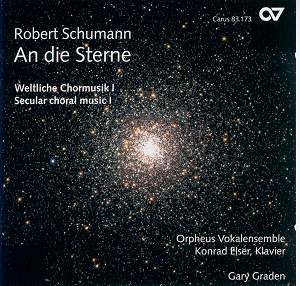
SCHUMANN (1810–1856) Spanisches Liederspiele op.74 (excerpts) [6.50] Drei Gedichte op. 29 [8.19] Fünf Lieder op. 55 [14.58] Vier doppelchörige Gesänge op. 141 [16.56] Vier Gesänge op. 59 [14.12] Bei Schenkun eines Flugels [2.25] Beim Abschied zu singen, op. 84 [4.16] Konrad Elser
(piano)
Orpheus Vokalensemble/Gary Graden
rec. Biblothekssall Ochesenhausen and Bibliothekssal Bad Schuessnried 21-24 May
2006 CARUS 83.173 [68.47]
Schumann
wrote quite a body of choral music and Carus have now issued
the first volume in a proposed survey of the secular part
of this genre. On this disc the Orpheus Vokalensemble sing
an attractive selection of the part-songs.
The Orpheus Vokalensemble is a professional choir, formed
in 2005 at the Landesmusikakademie, Baden-Württemberg. The
group numbers some two dozen singers of various nationalities.
Their name was inspired by the Orpheus Chamber Orchestra.
This is their first disc.
During his ‘year of song’, 1840, Schumann wrote not
only lieder but also choral pieces. These tend to be effectively
lieder for choir, song-like in their construction and melodic
fluency. Following this period, Schumann concentrated on
instrumental writing, returning to choral music later in
the 1840s. It is in this latter period that Schumann started
to explore the polyphonic, instrumental possibilities that
a choir could give him. This disc covers the whole range
of Schumann’s choral output from this period.
The earliest pieces on the disc are the Drei Gedichte,
Op. 29, setting words by Emanuel Giebel and written originally
for solo voices or small ensemble. The first, Ländliches
Lied, is a lively folk-like song for soprano duet; the
second, Lied In meinem Garten die Nelken is a sad,
slow lyrical soprano trio. The best known piece is the third,
the lively, dance-like Zigeuner Leben, which uses
mixed voices. The choir sing these pieces with charm and
delicacy, never forgetting their chamber origins.
The Vier Gesänge, Op. 59, date from later in
the 1840s. These are all song-like, developed choral lieder
with little in the way of polyphonic development. Schumann’s
setting of Nord oder Sud (poetry: Karl Lappe) is rather
strophic in feel and in the earlier parts I would have liked
more differentiation between the individual verses. Am
Bodensee (poetry: Karl August von Platen) is a lively
piece which is also strophic in feel but with the poetic
surprise of a slow final strophe as the poet considers his
love who has gone before him.
As might be expected, Jagerlied is a lively setting
of a poem by Mörike to which Schumann gives a nice throwaway
ending. The group’s final song is a lovely lyrical setting
of Rückert’s Gute Nacht, with a fine solo line. But
Schumann added an appendix to the group, Hirtenknaben-Gesang which
is sets as an unaccompanied folk-song, presented initially
in octaves and then developed in canon.
The Fünf Lieder, Op. 55 were almost written as
companions to the Op. 59 set. But in this group, Schumann
set translations of poems by Robert Burns. He gave his settings
a folk-like character, assuming that Burns had originally
been inspired by folk music.
Das Hochlandmädchen (The Highland Lass)
was intended to sound like an “artless country song”, though
in fact it has a rather more serious atmosphere about it.
At one point Schumann uses
a drone in the basses to hint at bagpipes. Zahnweh (Toothache)
is more dramatic; it is written to be sung with humour. Schumann
makes strong use of unisons for dramatic contrast and the
melody is marked by wide intervals.
Mich zieht es nach dem Dörfchen (I am drawn to the little village)
is a melancholy, evocative song. Die alte gute Zeit (The
Good Old Days) uses the alternation between soli and
chorus to give a very effective refrain; the strict four-part
writing creating a rather old fashioned effect. Hochland
barsch (Highland laddie) gives a lively finale,
again using a call and refrain effect.
Vier doppelchörige Gesänge, op. 141, were written in a short space of time in
October 1849. The texts Schumann used, though secular, are
full of religious imagery and Schumann reinforces this by
writing for the double choir using polychoral techniques.
Only rarely do the two choirs function as two distinct ensembles.
These pieces are the most developed on the disc and
are a tribute to Schumann’s genius. The atmosphere of the
songs takes on a darker timbre. An die Sterne (words:
Friedrich Rückert) moves from its magical opening to a mysterious,
almost mystical world. The choir responds with a lovely clarity
of choral tone. In Ungewisses Licht Schumann uses
an angular melody to achieve word-painting effects, depicting
the wanderer without a certain path. Here, though the choir
sings the music beautifully, I felt the tone could have been
more dramatic and darker and the final verse, when the wanderer
rushes towards the light, lacks urgency.
Zuversicht (words: Joseph Christian von Zedlitz)
is a highly effective melodic song with some rather hypnotic
repetitions towards
the end. The choir sings it with lovely choral control. The
singers give Goethe’sTalismane a confident,
bright choral tone but this continues into the final verse
which I think should be far darker and more intense.
Beim Abschied zu singen is a lovely farewell piece, written originally in 1847
for the Zwickau Schumann Festival. Es is verraten and Ich
bin geliebet come from Schumann’s 1849 Spanisches
Liederspiel, a collection of solo songs, duets and quartets.
Even during Schumann’s lifetime choruses sang these two quartets.
They are both catchy, dance-like pieces and attractively
melodic.
One of Schumann’s last compositions was a serenade written
at the end of August 1853 for Clara's birthday on 13 September.
He set words which he had written in 1840 as a dedicatory
poem accompanying the gift, to Clara, of a grand piano. In
1853 he gave her another grand piano and arrange to have
his setting of the poem sung by a group of four singers. Bei
Schenkung eines Flugels is a lovely serenade with not
a little feel of one of Brahms’s Liebeslieder Walzer.
The Orpheus Vokalensemble are a young group with a light,
bright choral tone. Under Gary Graden’s direction they sing
these pieces with good diction, well moulded phrases, good
ensemble and cohesiveness. Only occasionally do I wish that
we had some rather darker tones and greater intensity of
passion.
This disc makes a highly attractive introduction to
Schumann’s choral music and in the Vier doppelchörige
Gesänge contains a fine performance of one of Schumann’s
greatest choral pieces.
Robert
Hugill
Please support our advertisers below by clicking on the logos for further information.

























 Konrad Elser
(piano)
Konrad Elser
(piano)