Much eighteenth century
music – especially in the hothouse of
London – has a relatively short life.
So means were needed to regenerate interest,
bring in more money and, perhaps not
least, to explore music re-scored, transposed
and/or re-arranged in new lights. Of
course, Handel often borrowed from his
own sources. Indeed material from these
sonatas can be found in his Op. 4 organ
concerti, Op. 7 and Scipione.
In this case it’s The
Brook Street Band (Tatty Theo and Carolyn
Gibley) who have ‘recycled’ six Handel
recorder sonatas for cello and harpsichord
– really only by transposing them and
rendering them performable by cello
and harpsichord continuo. Although he
chose not to compose solo cello sonatas
or concerti, Handel clearly loved the
cello … some of his most sonorous melodies
– in The Ode for St Cecilia’s Day,
Alexander’s Feast and Il Penseroso
ed il Moderato as well as Arianna
in Creta - were for that instrument;
and the cello was used to evoke the
human voice. The reason for this gap
in Handel’s output is as likely to be
that such compositions for the instrument
were not fashionable during the earlier
part of his career, when most of his
other solo sonate were written.
Since the original
recorder pieces were written for accompaniment
by harpsichord (or bass violin), Gibley’s
retained role in these arrangements
is explained. The Brook Street Band’s
intention anyway was that there be more
of a duo feel to the performances. There
is, and it works quite well; the harpsichord
is certainly forward miked and may be
a touch insistent to some listeners
at times. Theo also describes how the
harpsichord part could well have been
played by women in Handel’s time; the
more demonstrative bodily movements
of the recorder being considered indecorous.
More evidence of that
competitiveness in London in the middle
of the eighteenth century comes from
the rather tortuous publishing history
of these Opus 1 pieces. The sonate are
highly likely to date from around 1725,
by which time Handel was well established
in London; although the composer seems
to have assembled them for publication
in about 1730, the first edition - actually
of a dozen sonate - was put out by John
Walsh without Handel’s permission –
and under the imprint of the recently
deceased Dutch publisher, Jeanne Roger.
This was probably done (and not for
the first time) to force Handel into
agreeing to a ‘second’ edition. This
he did, making some additions and changes.
Four of these sonatas were marked for
playing by ‘flauto’, as the recorder
was known then; and a fifth for ‘traversa’
(flute). The latter also appears in
the set known as the ‘Fitzwilliam
Sonatas’: the manuscript is housed in
the Fitzwilliam Museum in Cambridge.
There is a sixth in that same collection
as well.
This second Fitzwilliam
sonata, HWV 377, is the only piece on
this CD to have but three movements.
Of the rest three are in the four-movement
‘da chiesa’ format; the other two have
extra dance movements.
On the whole the paying
of the two-person Brook Street Band
is expressive and lively, if a little
‘contained’ at times: more spontaneity
and extroversion would be welcome. Those
aren’t always missing, though: listen
to the spring in the second allegro
of the F Major to hear an almost singing
– certainly a danced – step. Inevitably,
perhaps, the cello has a distinct, woody
tone; the resulting firmer (never heavier)
touch which the music gets can become
a tiny bit oppressive after a while.
The instrument is an original by Joseph
Hill, 1741 so almost exactly contemporary
with the sonatas’ composition; Gibley’s
harpsichord is after Mietke, 1710, by
Alan Gotto from 1990 and conveys the
cleanliness, airiness even, of the colour
surely intended by Handel when these
sprightly and tuneful pieces were originally
written.
None of this really
spoils the impact made by this music
and its persuasive and technically brilliant
advocates here. Just that some portions
of the faster music - both allegros
from the D Minor sonata, for example
- are more convincing than others. There
are multiple recordings in the catalogue
of the sonate in their original versions
and such discs as Alan Davis and David
Ponsford (Guild 7301) from the
middle of last year should not be missed
– at least for comparison.
This CD is recommended.
It’s something of an artefact: the colour
of the music is inevitably darker than
when recorders are used. One tends to
concentrate on the melodic line more
as a result; and on the superbly deft
harpsichord playing. The whole is pleasing,
very pleasing – a meal with sauces,
perhaps, rather than ‘dips’, though
the ingredients are the same. Varied
tempi, telling pauses and communicative
phrasing all contribute to making this
a nice little set which will grow on
you as you enter into the spirit of
it.
Mark Sealey
























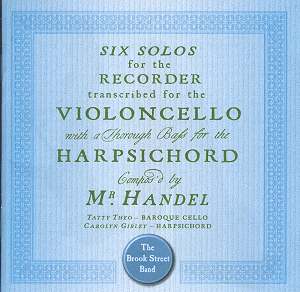
 The Brook Street Band: Tatty Theo (baroque
cello); Carolyn Gibley (harpsichord)
The Brook Street Band: Tatty Theo (baroque
cello); Carolyn Gibley (harpsichord)