Stephen Goss studied
composition with Robert Saxton, Edward
Gregson, Peter Dickinson and Anthony
Payne. With mentors as varied and distinguished
as this, it should come as no surprise
to find that Goss, now Head of Composition
at Surrey University, has developed
a number of academic programmes which
reflect his interests in pluralism,
Post-Modernism, improvisation, performance
studies and the late music of Beethoven.
These interests reflect
the music that Goss has written, inspired
by Charles Jenck’s Garden of Cosmic
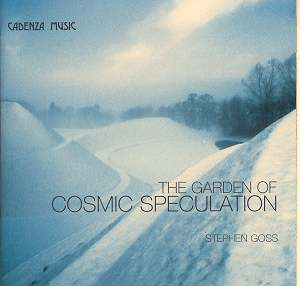
Speculation. Goss’s piece, "The
Garden of Cosmic Speculation" was
first performed in March 2005 at the
University of Surrey as part of the
Guildford Festival. The performers were
members of Gemini, who champion it on
this new disc.
In Jenck’s Garden,
a series of visual metaphors are used
to enable the visitor to contemplate
certain fundamental aspects of the universe.
But the garden is not dull; it is visually
stimulating and full of a sense of fun
and excitement.
Goss’s piece similarly
mixes genres and styles, seriousness
and fun. Quotes, references and ciphers
litter the score, sometimes these are
obvious and sometimes less so. This
is a piece that responds to repeated
listening. For instance, in the gardens
The Snail Mound is a large spiral
earthwork based on the Fibonacci sequence.
Goss transforms this into music that
uses the Fibonacci relationships whilst
referring to Bartók’s Third Piano
Concerto and two pieces by Beethoven.
In The Nonsense, which is named
after a folly in the garden, there is
a half quote from ‘It Ain’t Necessarily
So’, plus an ending which refers to
the day a tree came crashing through
the roof of the folly.
It is a tribute to
Goss’s skill and the skill of the players
that the results sound natural and obvious,
never overly contrived. This is chamber
music of rare skill and played by a
very fine ensemble. Gemini commissioned
the piece as a companion to Messiaen’s
Quartet for the End of Time.
Goss makes references to Messiaen’s
harmonies and textures.
Whilst Goss’s language
is chromatic and dissonant, it is extremely
expressive and his textures are frequently
very open. This is music which sounds
and feels as if it is coming from the
open spaces of a garden - or perhaps
I am getting too fanciful.
The concrete nature
of the inspiration of the piece, the
short duration and varied nature of
the movements mean that this is very
definitely a piece which can be sample
by those who shy away from contemporary
music. But at the same time Goss never
talks down; he never confuses melodic
fecundity with real inspiration.
As a guitarist, Stephen
Goss has won a number of prizes and
awards. So it is understandable that
guitarist Jonathan Leathwood turned
to Goss when he wanted a piece for six-string
and ten-string guitars. In concert Leathwood
played both types of guitar and had
been experimenting with playing both
guitars simultaneously, by placing the
six-string guitar on a table in front
of him whilst holding the 10-string
one normally.
The resulting piece,
Oxen of the Sun, is a fascinating
study in timbres and textures; at times
you find it difficult to believe there
was only one player and just two instruments.
With 16 strings in total available,
Goss thought about Orpheus’s lyre and
wrote a piece which utilises all 16
open strings. He surrounds this with
various explorations of stories from
Ovid and Homer, by way of James Joyce
(‘Ulysses’) and Benjamin Britten (‘Metamorphoses
after Ovid’). The title comes from
Chapter 11 of Joyce’s ‘Ulysses’.
Leathwood sounds impressively
in control of his material and the piece
is by turns enchanting, mysterious and
frustratingly evanescent. At times I
had to turn the volume up to pick out
the details, but that might be the fault
of my headphones. I would love to hear
the piece live - in a very quiet concert
hall.
An ideal insomnia
picks up on the idea of night music,
but Goss’s Night Music movement
is a grotesque and frantic phantasmagoria,
very different from the Bartókian
night musics. The piece is written for
piano, expertly played on the disc by
Graham Caskie. The second movement,
Rockaby, is a lullaby which manages
to quote from Britten and Turnage. The
Hatter references both ‘Alice in
Wonderland’ and that superb Satie song,
‘Le Chapelier’, setting a poem by Rene
Chalupt. Finally, Alter Klang
which refers to a poem by Paul Klee,
but which re-cycles parts of the Adagietto
of Mahler’s Fifth Symphony.
Again, this assemblage
of material could feel arch and over-contrived,
but Goss succeeds in re-forming the
various musics into his own image.
The final piece on
the disc, Park of Idols, is written
for the unusual combination of cello
and guitar. Each piece is an homage
to musicians admired by the performers,
Leonid Gorkhov and Richard Hand. The
references are many and varied: Frank
Zappa, Cornelia Parker’s 1991 artwork
‘Cold Dark Matter’, Shostakovich’s Symphony
No. 14, a Pat Metheney guitar solo,
the Mahavishnu Orchestra, Allan Holdsworth,
Robert Fripp and King Crimson.
This is a highly recommendable
disc; contemporary music which manages
to be approachable but does not talk
down to its listeners. It helps that
Goss has been supported by such a fine
group of performers.
Robert Hugill
























 for
details
for
details
 Gemini: (Ian Mitchell (bass clarinet);
Caroline Balding (violin); Robin Michael
(cello); Julian Jacobson (piano)) (1);
Jonathan Leathwood (guitars) (2); Graham
Caskie (piano) (3); Leonid Gorkhov (cello)
(4); Richard Hand (guitar) (4)
Gemini: (Ian Mitchell (bass clarinet);
Caroline Balding (violin); Robin Michael
(cello); Julian Jacobson (piano)) (1);
Jonathan Leathwood (guitars) (2); Graham
Caskie (piano) (3); Leonid Gorkhov (cello)
(4); Richard Hand (guitar) (4)