Editorial Board
MusicWeb International
Founding Editor Rob Barnett Editor in Chief
John Quinn Contributing Editor Ralph Moore Webmaster
David Barker Postmaster
Jonathan Woolf MusicWeb Founder Len Mullenger
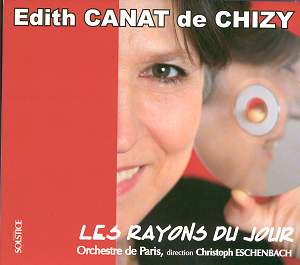
Edith CANAT
DE CHIZY (b. 1950)
Alive (2003)a [13:05]
Wild (2002) [4:38] Formes du vent (2002)b [9:43]
Falaises (2003)c [9:38]
Les Rayons du jour (2005)d [19:29] Ana-Bela
Chaves (viola)d; Emmanuelle Bertrand
(cello)bc; Quatuor Ebèneac
Orchestre de Paris/Christoph Eschenbachd
rec. Studio La Verrière, Paris, April 2005; Théâtre Mogador,
Paris, February 2005 (Les Rayons du jour) SOLSTICE SOCD234 [56:54]
Music
for stringed instruments holds a fairly prominent place in
Edith Canat de Chizy’s output: two string quartets (2001,
2003), three string trios (1991, 1999, 2001), a string quintet Falaises (2003),
a violin concerto Exultet (1995), a cello concerto Moïra (1998),
a viola concerto Les Rayons du jour (2005), Siloël (1992,
string orchestra), Lands away (1999, cimbalom
and strings) as well as some miscellaneous for solo strings
such as Irisations (1999, solo violin), Danse
de l’aube (1998, solo double bass) and Formes
du vent (2002, solo cello). This is not particularly
surprising though, since the composer was trained as a violinist.
What is, to my mind, still more remarkable is that she writes
idiomatically for strings, while deliberately avoiding the
routine. All these pieces manage to be consistently interesting,
challenging and immensely rewarding, both from the player’s
and the listener’s standpoints. Canat de Chizy is a beautifully
equipped musician, whose poetic vision, often triggered by
extra-musical stimuli, be they literary (e.g. poems by Reverdy
or Emily Dickinson) or pictorial (e.g. paintings by Nicolas
de Staël), is perfectly achieved through impeccable craftsmanship
and sheer expressive will, as these fairly recent works amply
demonstrate.
The
second string quartet Alive, inspired by a
poem of Emily Dickinson, is a compact work filled with energy
and invention. The music alternates energetic sections with
some harmonically ambiguous ones, although the music is ultimately
assertive. It explores a wide range of moods and techniques,
as befits a work composed for the 2003 Bordeaux International
String Quartet Competition and tests the players’ technical
achievement and musicality.
The
composer describes her duo for viola and cello Wild as “a
short didactic piece”, which may be true to a certain extent,
but the music is still rather demanding, though not extravagantly
so; this composer’s music never is. Its five-minute duration
is packed with invention.
Formes
du vent for solo cello,
titled after a poem by Pierre Reverdy, is a suite of
concise mood studies, each bearing a title drawn from
other verse by Reverdy. The five clearly delineated sections
provide for varied expression and have an improvisatory
feel about them, although I suspect that everything is
clearly notated. The music is again demanding, but the
technical challenge is never at the expense of strong
expression.
The
string quintet Falaises (“Cliffs”) is for string
quartet and principal cello. The title may be taken at face
value, so that the piece may be experienced as a short tone
poem suggesting in turn the almost motionless flight of sea
gulls, the ebbing of the sea and the meeting point of verticality
(the cliffs) and horizontality (the sea). Actually, cliffs
might be the symbol of music itself in which vertical harmony
sustains melodic lines - or the other way round.
The
viola concerto Les Rayons du jour, named after
a painting by Nicolas de Staël (1914–1955), that adorns the
insert notes, is the composer’s third concerto for strings.
This substantial work falls into three main sections played
without a break, and reflecting the painter’s artistic progress
(Déchirure, Mouvement, Transparence).
There is absolutely nothing programmatic or descriptive about
the music and it can be appreciated without any prior knowledge
of de Staël’s work. The titles of the main sections give
some idea of their musical content. Déchirures is
rather more about blocks that clash against each other, whereas Mouvement is
appropriately forward-moving. In the last section Transparence,
the music progressively thins out before ending on a high
isolated note. This marvellous piece of music is a worthy
successor to Exultet for violin and orchestra
and of Moïra for cello and orchestra, and undoubtedly
one of the finest additions to the viola’s contemporary repertoire.
Performances
are consistently fine, technically assured and fully committed.
Emmanuelle Bertrand’s impeccable technique and musicality
must be emphasised, and so must Ana-Bela Chaves’ splendid
rendering of the viola concerto. The recording is very fine
throughout, although I find it a bit too close in Formes
du vent. This should not deter anyone from investigating
this magnificent release, that – as did its predecessor – serves
this composer’s music in the best possible way. In short,
wonderful music superbly played and recorded.
Hubert Culot
Please support our advertisers below by clicking on the logos for further information.

























 Ana-Bela
Chaves (viola)d; Emmanuelle Bertrand
(cello)bc; Quatuor Ebèneac
Ana-Bela
Chaves (viola)d; Emmanuelle Bertrand
(cello)bc; Quatuor Ebèneac