Editorial Board
MusicWeb International
Founding Editor Rob Barnett Editor in Chief
John Quinn Contributing Editor Ralph Moore Webmaster
David Barker Postmaster
Jonathan Woolf MusicWeb Founder Len Mullenger
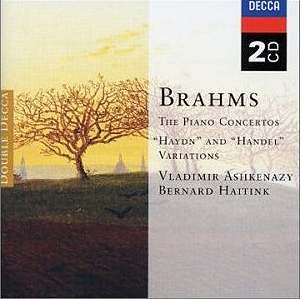
A “Hatto Original” Johannes BRAHMS (1833-1897)
Piano Concerto no.1 in d minor op.15 [48:46]
Piano Concerto no.2 in B flat major op.83 [50:56]
Variations and Fugue on a Theme by Handel op.24 (orch. Edmund
RUBBRA (1901-1986) op.47) [28:39]
Variations on a Theme by Haydn op.56a [16:41] Vladimir Ashkenazy
(piano)
Concertgebouw Orchestra, Amsterdam (PC1), Vienna
Philharmonic Orchestra (PC2), Cleveland Orchestra (Handel
& Haydn)/Bernard Haitink (PCs), Vladimir Ashkenazy (Handel
& Haydn)
rec. Concertgebouw, Amsterdam, May 1983 (PC1) Sofiensaal,
Vienna, October 1982
(PC2) Severance Hall, Cleveland, March 1991 (Haydn), July
1992 (Handel) DECCA 470 519-2 [77:34
+ 67:45]
Piano Concerto no.2 was
issued in 2002 as the work of Joyce Hatto, with the National
Philharmonic Symphony Orchestra conducted by René Köhler,
on Concert Artist CACD 8001-2
Orchestras are not so easy to disguise. Even with the VPO there
are minute imprecisions, a near-blip in the opening horn solo
and so on. Half a minute was enough to confirm the Second
Concerto as what everybody said it was. Not that I doubted
Andrew Rose’s wave-patterns, but there is evidence that not
all “Hattos” contain the same performance. Well, my “Hatto” Brahms
2 is the Ashkenazy all right. But I will deal with the Hatto
aspect when I get to that work.
Haitink begins No. 1 very finely, at a tempo that neither
hurries nor drags, and there is real power in his fortes.
There’s a suspicion,
though, that things slacken a bit during the quieter moments.
When Ashkenazy enters he shows a notable ability to stretch
the tempo without actually losing it. Haitink follows him
metrically, in the sense that they stay together, but when
the orchestra comes to the fore in the secondary material
the conductor doesn’t stretch the tempo, he slows it down.
The result is that Ashkenazy doesn’t have that rock-firm
framework in which to operate that George Szell provided
for no fewer than four soloists on record. Much of what Ashkenazy
does is fine, though his tone as recorded becomes hard above
forte in the upper register. There are certainly some exciting
climaxes.
Haitink begins the Adagio with a fairly flowing tempo. When
Ashkenazy enters he takes a different tempo altogether, much
slower,
and sustained quite magically. Haitink stays with him and
draws a backdrop of hushed beauty from the orchestra. But
when the opening music reappears in an orchestral interlude,
he reverts to his original tempo, obliging Ashkenazy to establish
his own tempo again when he re-enters. In a way this divergence
of opinions produces the most memorable movement in the two
concertos; at least it sounds like a real, spontaneous performance.
Perhaps this is why the artists and producer didn’t remake
it.
The finale follows the pattern of the first movement, the
pianist’s
attempts at something more vital colliding with the conductor’s
more laid-back manner. One feels that either party would
have been better stimulated by a different partner. I’m not
surprised the Hattifiers went elsewhere for this concerto;
not because it’s actually bad – these are musicians of the
highest class even if they were not ideal partners – but
because the actual foibles of the performance may stick in
the mind. Of the two, it was the more likely to be recognized.
The Second Concerto is more unitary in manner, though I get
the idea Ashkenazy is adapting to Haitink rather than the
other way
round. There are still occasional moments of hard tone from
Ashkenazy, but they are less noticeable here. It’s a nice
performance if you like a pretty broad first movement, an
energetic but controlled Scherzo, a mellow Andante and a
Finale which aims more at grace and good humour than anything
climatic. The recording is lively with a touch of glare at
times.
The Hattified version has filtered the treble and slightly
boosted the bass, if hardly enough to give much credence
to the claim
in the booklet that she studied this work with Wilhelm Backhaus.
Ashkenazy’s is a much less rugged sound and so it remains.
There has been some jiggery-pokery with the stereo spread.
Hattification could hardly extend to reversing the sound-picture
of an orchestral recording – cellos on the left and violins
on the right would have aroused comment – but sometimes the
picture is wider, rather polarized around the speakers, at
other times it comes together again. The piano doesn’t always
seem to be in the same place, which it certainly does in
the Decca original. There is no time shrinking or stretching.
Altogether, a clever attempt to make a fine if slightly over-the-top
Decca recording sound like an acceptable and creditable effort
from a low-budget company.
So here is what I said originally:
Whether the concerto
is on quite the same pedestal [as the op.118 pieces which I praised very highly] will
depend rather on your reaction to the first movement. During
the orchestral introduction it seems woefully slow; yet
when Hatto enters, how full of notes the music is even
at this speed. In fact, Hatto’s richly commanding playing
lets us hear details that are often brushed over and the
tempo sounds perfectly natural when she is playing. The
orchestra (a perfectly good one [a notable understatement])
doesn’t quite manage this. Is it because the tempo is wrong
or because the conductor, though evidently an able musician [how
relieved he’ll be!], is not on Hatto’s same level? She
should have recorded it, maybe, with Kurt Sanderling in
his late phase. The remaining movements
are more "normal" in their tempi and Hatto’s
pianism is always to be enjoyed. However, to bring off
a Brahms concerto successfully you do need a partnership
of the highest level and my feeling at the end was that
the music had run its course well without the pair quite
striking sparks off each other. This is a performance I
shall return to, but not a first recommendation. However,
Joyce Hatto is a pianist who demands to be heard [and who doubtless would have been if she
had been as good as Ashkenazy].
So much for the claim
that MusicWeb automatically gave Hatto rave reviews, and
Jonathan Woolf’s review was on similar lines to my own.
Does it make a difference
if we know it is Ashkenazy playing? Well actually, considering
this is the one “Hatto” recording to have emerged so far
with a soloist, conductor and orchestra widely described
as “great”, I think the Hattifiers were extremely clever.
Famous though the artists are, this is not a recording that
created great ripples. Even Ashkenazy’s greatest fans probably
bought it and forgot to take it off the shelf again, not
because it’s bad but because, coming from who it does, we
have a right to expect more. This was early days in my Hatto
reviewing and if I remember rightly I didn’t even know her “story”.
Certainly, the introductory paragraph to my review doesn’t
mention it and I am wondering if the sob-tale in all its
glory had actually appeared on the Concert Artist website
by that time. I took it to be a very creditable affair by
a pianist whose name was barely known to me. And so it would
have been if it had been.
Now don’t think I’m
debunking Ashkenazy. Anyone who doesn’t read reviews and
picks this set up on the strength of the artists won’t be
seriously disappointed. They could do far worse. But they’d
do better still with Gilels/Jochum, Gilels/Reiner (no.2),
Serkin/Szell and quite a few others.
The two items conducted
by Ashkenazy a decade later help to make the offer more enticing.
This is my first encounter with the Rubbra arrangement though
I’ve always known about it. It was made in 1938 and
premièred by Boult that same year. It quickly got the honour
of a Toscanini performance, but only one because he didn’t
like it much, and was recorded by Ormandy in the LP era.
It has occasionally been revived since.
While Schoenberg’s
more celebrated arrangement of the Piano Quintet sounds rather
like a post-Brahmsian modernist having fun at the master’s
expense, Rubbra, in his quietly original way, actually gets
further away from his source and teaches us a good deal about
himself and Brahms. Brahms naturally filled his music with
plenty of contrapuntal interest, but he chose a manner of
orchestration which absorbs it all into a warm glow of sound.
Rubbra, on the other hand, chose instrumental colours which
would pit one contrapuntal line against another. Some felt
that this led to congested results in his first two symphonies.
The Brahms arrangement actually follows the Second Symphony
by two opus numbers and the mere fact that he attributed
an opus number to it shows it was not intended as a money-spinner.
Rather, it may represent a crucial stage in his search for
a style of orchestration which would make all the contrapuntal
lines clear without sounding unduly congested. Quite frankly,
if you tuned into this unawares, and didn’t know the piano
original, you might not even recognize it as Brahms. You
might even recognize it as Rubbra. So, if you want something
as near as possible to how Brahms would have done it, don’t
go here. This is presumably why Toscanini went here only
once. If you want a laugh and a half, go to the Schoenberg
quintet arrangement. Taken on its own terms, Rubbra’s is
a highly interesting experiment.
Fortunately Ashkenazy
does take it on its own terms. I confess to not knowing his
recording of the piano original. There are, however, numerous
features of tempi and general style which sound just right
here but which I would be surprised to find a pianist attempting.
He and the orchestra seem to be enjoying themselves considerably.
The first variation sounds like a polka! I find this very
perceptive from a musician who has never, as far as I know,
conducted a Rubbra symphony and may not even know there are
any.
Enjoyment seems the
name of the game in the Haydn Variations, too. This is the
swiftest, lightest and most Schubertian account I’ve ever
heard. At 16:41 it just beats the next quickest in my collection
which is, wait for it, Klemperer (16:56) (I don’t have Toscanini).
Klemperer obviously gives a very different kind of
performance. At the other extreme Celibidache had already
reached 20:20 in Naples in the 1960s so I tremble to think
what he was doing by the time of his final Munich phase.
In between come Janowski (17:16), Boult (17:25), Sawallisch
(18:39), Hindemith (18:47) and Colin Davis (19:08). This
is not a reasoned selection, they’re just recordings I happen
to have. Some day it would be interesting to go into what
all this means in terms of the single variations. Furtwängler,
for example, used to dig deeply into some of the slower ones,
giving them a Bachian gravitas, while he could be pretty
volatile in the faster ones. Hindemith, although slower,
is actually the closest to Ashkenazy in keeping it light
and simple. I’m not going to throw out the darker-hued versions
but Ashkenazy’s is a completely valid view. It is also about
as far as can be imagined from the Brahmsian style developed
over the years by Bernard Haitink, thus supporting my impression
that the two were not well-paired.
The anonymous notes
are good enough, but fancy not giving individual tracks for
the variations.
Christopher
Howell
Please support our advertisers below by clicking on the logos for further information.
























 Vladimir Ashkenazy
(piano)
Vladimir Ashkenazy
(piano)