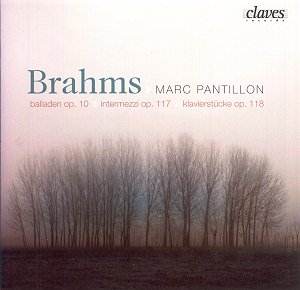
Marc
Pantillon’s programme on this CD takes us from very near the
beginning of Brahms’ career as a composer to very near the end
of it. The four Ballades were written at the age of twenty-one;
the three Intermezzi and the six Klavierstücke when Brahms was
fifty-nine.
Pantillon
gives a finely nuanced performance of the Ballades. The first
is Brahms’ response to the Scottish Ballad of “Edward” as translated
by Herder, a ballad entirely in dialogue between a mother and
the son who has murdered his father. Pantillon brings out very
nicely the implied presence of two voices and his articulation
of Brahms’ use of staccato and of low bass notes conveys an
apt gruesomeness. The altogether more tender emotions of the
second Ballade bring out a sensitive inwardness, which is one
of Pantillon’s strengths as a pianist, though he also characterises
very well the sterner rhythms of the middle section. “What shall
we call this? Demoniacal?” – Schumann is reported to have queried
of the third Ballade. There is something of the sort in Pantillon’s
playing of the opening passages, but he is perhaps most thoroughly
convincing in the rather wistful trio. In the final Ballade
his articulation of the lengthy lyrical melody and its accompaniment
of falling quavers does full justice to the romantic beauty
of Brahms’ writing.
In
writing the first of the Intermezzi, some thirty-eight years
later, Brahms turned once more to Herder and to his versions
of Scottish Ballads. This first intermezzo is prefaced by a
quotation from Herder’s translation of the Scottish ballad Lady
Anne Bothwell’s Lament. Though called a lament –
the occasion of grief being her husband’s absence at the wars
and her dream of his death – the ballad’s words are actually
in the form of a lullaby. Pantillon brings out very nicely the
intrusion of the mother’s anxiety – in a section in E flat minor
– while retaining the overall sense of maternal affection and
consolation. The second intermezzo also has an air of unease,
against an embracing background of calmness – Pantillon does
calmness very well! The third intermezzo is somewhat darker,
a mood of plaintive mournfulness, with only occasional glimpses
of light. Pantillon’s capacity for an expressive softness is
striking here.
The
opus 118 set contains some of Brahms’ very finest writing for
solo piano. The opening intermezzo in A minor is an exuberant,
vigorous piece; the closing intermezzo in E flat minor is profoundly
sad, both dramatic and hushed, disturbing and perhaps a little
disturbed. In between, there is the graciousness and delicate
charm of the intermezzo in A major, the rhythmically forceful
Ballade in G minor, the complex and ambiguous intermezzo in
F minor and the melodic, idyllic Romanze in F major. The whole
is surely one of the great suites of piano music. Over the years
it has had memorable performances from, for example, Julius
Katchen, Radu Lupu and Dmitri Alexeev. I am not sure that Marc
Pantillon’s performance is quite in that class but it is certainly
very fine, intelligent and considered, richly inward and full
of conviction. It is a performance that rewards relistening
and will, I am sure, bear many future hearings.
In
the opus 118 Klavierstücke and elsewhere, Pantillon is at his
very best in the more ruminative passages, where a sense of
rapt tranquillity is expressed in playing of great limpidity
and tenderness. Where greater power and volume is needed, it
would be unfair to say that he is lacking, but true to say that
he isn’t quite as gripping. His tempi are generally on the slow
side, but everything coheres and the musical tension never flags.
Very
good, individual and interesting performances which deserve
to find many listeners. They have the benefit of a superb recorded
sound.
Glyn Pursglove