RECORDING OF THE MONTH


RECORDING OF THE MONTH

BARGAIN OF THE MONTH

VAUGHAN WILLIAMS
A London Symphony
Oboe Concerto
£11 post free World-wide


RACHMANINOV Elegy, Preludes, Piano concerto 3
£12 post free World-wide

CHAUSSON, DEBUSSY
RACHMANINOV
TRios
2CDs £16 post free World-wide

Search
What's New
Classical CD Reviews
Live Reviews
Jazz CD Reviews
Composers
Resources
Contact Us

Every Day we post 10 new Classical CD and DVD reviews. A free weekly summary is available by e-mail. MusicWeb is not a subscription site and it is our advertisers that pay for it. Please visit their sites regularly to see if anything might interest you. Purchasing from them keeps MusicWeb free.
  Classical Editor: Rob Barnett  
Founder Len Mullenger   


BUY NOW 

AmazonUK

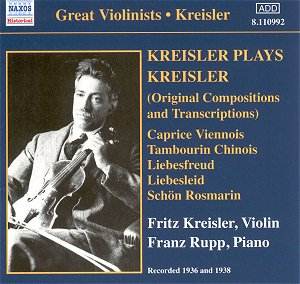
Kreisler plays Kreisler
Fritz KREISLER
(1875-1962)
Caprice Viennois [3.46] Tambourin Chinois [3.29] Liebesfreud [3.15]
Liebesleid [3.37] Schön Rosmarin [1.59] La gitana [3.11] Rondino on a theme of Beethoven [2.30]
Johann Sebastian BACH (1685-1750)
Gavotte from Partita No.3 in E arranged KREISLER [3.18]
Wolfgang Amadeus MOZART (1756-1791)
Rondo from Haffner Serenade K250 arranged KREISLER [7.35]
Fryderyk CHOPIN
Mazurka in A minor Op.67 No.4 arranged KREISLER [2.48]
Johannes BRAHMS (1833-1897)
Waltz in A Op.39 No.15 arranged David HOCHSTEIN [2.20]
Antonín DVOŘÁK (1841-1904)
Humoresque Op.101 No.7 arranged KREISLER [3.43]
Pyotr Ilyich TCHAIKOVSKY (1840-1893)
Andante cantabile from String Quartet No.1 arranged KREISLER [4.34]
Nicolai RIMSKY-KORSAKOV (1844-1908)
Hymn to the Sun from The Golden Cockerel arranged KREISLER [4.04]
Chant Hindou from Sadko arranged KREISLER [3.17]
Manuel de FALLA 1876-1946)
Spanish Dance from La vida breve arranged KREISLER [3.22]
Ede POLDINI (1869-1957)
Dancing Doll arranged KREISLER [2.28]
Cyril SCOTT (1879-1970)
Lotus Land arranged KREISLER [4.06]
TRADITIONAL
Londonderry Air arranged KREISLER [3.45]
Fritz Kreisler (violin)
Franz Rupp (piano)
Recorded in 1936 and 1938
NAXOS HISTORICAL 8.110992 [67.08]


Kreisler plays Kreisler compilations have been popular since the days of LPs and more than one disc bears that title in the current catalogues. What Naxos have done is to collate the fruits of recordings sessions in 1936 and 1938 to form a satisfying programme devoted to original compositions and – the bulk – transcriptions. All these recordings are part of Kreislerian lore and adherents will long have had them, in one form or another, on their shelves. One thing that struck me when I was listening to other similar issues for comparative purposes was how Kreisler’s recordings altered with extraordinary subtlety. Putting on the “wrong” 1930 recording by mistake (with Michael Raucheisen, a Berlin session) it took just a few bars to realise the error. It was nothing to do with the acoustic or the recording quality or even with the pianist, though that may have been a general contributing factor; no, it was the violinist-composer’s rubati, the control of the horizontal aspects of music making that gave such an infusion of life to his multiple recordings of these pieces.

I listened to an EMI release with the same title and to three 78s to make some conclusions about Naxos’ transfers. Broadly Naxos has retained a higher level of surface noise than EMI; in Caprice Viennois EMI captures the piano sonorities with greater depth and clarity. The Naxos is reproduced at a rather higher level than the EMI and strives for a more open sound, with good body of violin tone (as they used to say reviewing acoustic 78s back in 1924). There are some pitching discrepancies as well; successive EMI transfers of Schön Rosmarin do sound rather slow after the brighter Naxos pitching. In the Bach-Kreisler my sympathies are very much with the Obert-Thorn work; I like the open, relatively unfiltered sound he has achieved – it’s airy and that counts for a lot (and precisely the thing I found so disappointingly lacking in a couple of his recent Szigeti-Bach transfers). After a long while listening to Poldini I came to the conclusion – rightly or wrongly – that the EMI is slightly flat and that Naxos’ pitch tightening and brightening is to be preferred.

In conclusion I can recommend the restorative work here; I think the higher ration of surface noise is a price worth paying for the advantages of an open sound, and Obert-Thorn’s pitching decisions seem to me to have been carried out with diligence and authority. The programme is one that every Kreislerian will know and love but I hope younger listeners gravitate toward it and savour his inimitable way with these originals and transcriptions.

Jonathan Woolf



Advertising Rates
Visitor stats
MusicWeb International
has over 40,000 Classical CD reviews on offer

Discs received

Having a problem Donating?


Gerard Hoffnung Concerts &
The Bricklayer Story

MusicWeb can now offer you discs from the following catalogues:
Prices include postage

There will be NO VAT Rises

[Acte Préalable £13.50]
[Arcodiva £12.00]
[Avie from £6.25]
[British Music Society £12.00]
[CDACCORD from £13.50 ]
[ClassicO £12.50]
[Hallé from £11]
[Heritage £10]
[Hortus £14.99 ]

[Lyrita ONLY £11.75 ]
[Nimbus Special prices]
[Northern Flowers £13.50]

[REDCLIFFE £11 ]
[Sheva £11]
[Tactus £11.50 ]
[Talent from £12.00 ]
[Toccata Classics £10.50 ]

Musicweb
Special Offers

Monthly Best Buys


Naxos Classical


New Releases

Hyperion


New Releases


MusicWeb sells the Polish
catalogue CDAccord
£10.50 post free W-W


MusicWeb sells the
Arcodiva catalogue
£12.00 post free W-W


£11.75
post-free
world- wide


Google Ads - for information about privacy matters, click here
Amazon Musicweb International is a participant in the Amazon EU Associates Programme, an affiliate advertising programme designed to provide a means for sites to earn advertising fees by advertising and linking to Amazon.co.uk and Amazon.com


Return to Index

Untitled Document


Reviews from previous months
Join the mailing list and receive a hyperlinked weekly update on the discs reviewed. details
We welcome feedback on our reviews. Please use the Bulletin Board
Please paste in the first line of your comments the URL of the review to which you refer.