When receiving new
recordings of frequently recorded standards
already available in dozens of recommendable
versions, it is tempting to ask: Do
we really need yet another? In the good
old days – the era of the 78s - one
had to be happy with one recording
of Die schöne Müllerin.
In the 1930s it was Gerhard Hüsch
who reigned supreme and not until after
WW2 was there an alternative when HMV
released the Aksel Schiøtz version.
Today there could nominally be thirty,
maybe forty, so the question is justified:
Do we need a new one?
The answer is not a
simple yes or no, rather "it depends".
I imagine there must be several collectors
who like me opens the jewel case and
with a smile of anticipation put the
brand new CD in the player, wondering:
is it one for the reference shelf? However
even a version that doesn’t compete
with the best can be valuable and it’s
only rarely that one finds a definite
"best buy".
The present disc, issued
by the small independent Finnish label
Alba, probably introduces most international
listeners to baritone Elja Puukko. Born
in 1966 he isn’t quite a new-comer but
he has had a long education, first studying
church music and later singing where
most of the great names in Finland have
guided him. He made his debut at the
Sibelius Academy in 1997 when he sang
Schubert’s Winterreise. His everyday
job is as a church musician in Esbo
(Espoo), just outside Helsinki. He is
partnered by pianist Risto Lauriala,
who has made himself quite a name through
a number of recordings for Naxos: Finnish
music (Sibelius, Selim Palmgren and
a mixed disc) but also Josef Suk and
Bach transcriptions. His true metier,
according to the booklet, seems to be
Bach, Beethoven, Brahms and Schubert.
The first impression,
through the four bars of piano introduction
to Das Wandern, is a certain
heaviness, not the playing in itself
but rather a bass dominant recording.
There is a tendency towards bombast
in some places but that is in line with
the overall concept which is dramatic
and intense. Puukko has a clear voice,
youthful in timbre with a dark kernel
that makes his dramatic outbursts thrilling.
In fortes he has an almost metallic
brilliance; not unsuitable for a future
Wotan. One of his teachers was Esa Ruuttunen
– himself a wonderful Wotan at the Finnish
National Opera. All this is finely demonstrated
for example in Halt! (track 3)
or the very energetic delivery of Ungeduld
(track 7), where the sound of the piano
is rather hard. He has the capacity
to sing softly, inwardly with a very
beautiful half-voice. Danksagung
an den Bach (track 4) is a good
example and so is Der Neugierige
(track 6) where especially the middle
section "O Bächlein meiner
Liebe ..." is sincerely done. There
is, though, some slightly hesitant intonation
and the voice is not absolutely steady.
It seems that he is short on breath.
This is no prevailing problem, though.
The last three songs (tracks 18 – 20)
are heartfelt and finely nuanced and
the long Des Baches Wiegenlied
(track 20) shows him at his very best.
It is exquisitely sung.
The overall impression
is of a well-schooled singer with a
beautiful and surprisingly powerful
voice, which seems to be divided into
two halves. Although he works hard on
applying the right dynamics to each
song – and succeeds very well in many
cases – the remaining impression is
of a slight monotony. He can’t quite
produce the light and shade nor can
he colour the voice sufficiently. There
is also a certain rhythmic stodginess.
Comparing him to Herrman Prey in a 1974
Philips recording, the older singer
is lighter and more vivacious, mostly
also at a swifter tempo. Puukko plays
safe by choosing uncontroversal middle-of-the-road
speeds.
The recording is good,
apart from the bass heaviness I mentioned
earlier, and the balance between singer
and piano is fine. Having listened to
this recording three times within a
couple of days I have come to like his
powerful and unfussy approach. It is,
as I said, a thrilling voice that I
will certainly want to hear again, not
least as a corrective to some over-sophisticated
interpretations.
Returning to the inevitable
question: which recording should be
a first choice, my answer is unhesitatingly
Dietrich Fischer-Dieskau on DG with
Gerald Moore, recorded in the early
1970s. I can’t imagine the cycle being
more enticingly sung with the marvellous
lightness of touch that was always F-D’s
hallmark, and his way of colouring the
voice. It is of course backed up by
the inimitable Gerald Moore. For a still
more lyrical approach I can recommend
a Caprice recording with Olle Persson
and guitarist Mats Bergström. I
actually haven’t heard the recording
but I heard them live twice at about
the time the recording was made, and
the use of a guitar as a substitute
for the piano invites the singer to
be even more intimate, more conversational.
So here we have four
different readings, including the Prey
version which is a Papageno’s close-to-Nature
approach.
I wouldn’t choose Elja
Puukko’s recording every time I want
to hear this wonderful song cycle. However
in its own right and within the limitations
Puukko has set himself, it is a fully
valid interpretation.
Göran Forsling



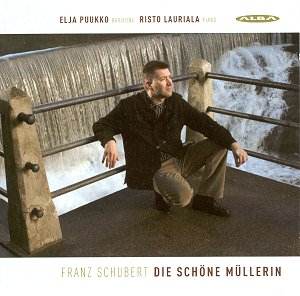
 Elja Puukko (baritone), Risto Lauriala (piano)












