As a student at the
R.A.M. I was almost as ignorant of the
music of Gordon Crosse as I was of just
about everything else. The works of
his which I had heard, mostly through
rare BBC broadcasts, I remember as finding
highly accessible. Creative output is
so often reflected in personality, and
while he was less often to be found
fraternising in the Academy bar than
some, the lessons I had with Gordon
Crosse as member of a whole bunch of
thickies in the G.R.S.M. course were
as interesting and accessible as his
music. He must have despaired at our
opaque lack of intellectual fitness;
but never let on, and always held the
respect of the class.
Rob Barnett’s review
of this disc covers many of the salient
points with regard to the background
to these pieces, so I will largely restrict
myself to a personal response.
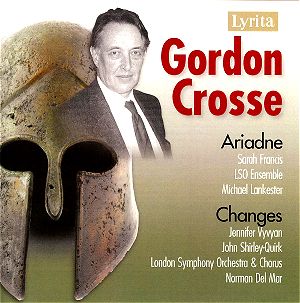
Ariadne, for
solo oboe and a colourful ensemble of
12 players makes a grander and more
spectacular impression than its title
might suggest. The music is intense
and never really lets up, maintaining
a nervous vibration in even the slower
passages: Crosse clearly revels in the
athletic manoeuvrability of the relatively
compact ensemble. The ‘coarse tone’
section in the second movement is a
highly convincing eastern-European/Mediterranean
sounding moment, and with eloquent playing
from Sarah Francis and the whole ensemble
this is a wonderful piece to have lying
around in one’s collection.
Peter Dickinson wrote:
"In 1966 Crosse conquered the Three
Choirs Festival with Changes: a Nocturnal
Cycle [Argo LP ZRG 656]. This fastidiously
chosen anthology of poems was the basis
for a 50-minute choral work extending
the Britten tradition in a personal
way. Apart from its richly imaginative
orchestral textures it shows Crosse
as a melodist too. Its neglect by our
choral societies is simply incomprehensible."
Well, while I might agree wholeheartedly
with Dickinson’s sentiment, I can to
a certain extent understand why such
a demanding work would be a reluctant
choice for choral societies. This is
one of those pieces which requires strength
at all levels, and would always require
a considerable investment of time and
resources to be given full justice.
Full justice is what
it receives on this recording however,
and Lyrita has done everyone a large
favour by making it available once more.
Crosse’s strengths in orchestration
are immediately apparent, and in his
own note to the work he acknowledges
that it is ‘concerned with variety and
contrast’, an aspect which is given
greatest pungence through the use of
the orchestra, which includes a large
percussion section and the full works
from the other sections. Crosse also
admits having to ‘work hard for unity’
in a piece with many short sections,
but in the final reckoning this never
seems to arise as a problem – in any
case, I never had the impression of
a composer trying hard, or becoming
aware of procedural workings-out. In
his own summing up, Crosse in essence
shows what our approach to the work
should be: ‘…with the aim of communicating
enjoyment I tried to enjoy myself. I…
concentrated on opening my ears and
mind to simple ideas.’
These ‘simple ideas’
do sometimes have the ring of Britten
about them. Take the children’s chorus
Matthew, Mark, Luke and John,
which in which the cadences and melodic
shapes of the elder master are unmistakeable.
There are occasional tinges of Tippett
in the orchestral filigrees which pop
through now and again early on, maybe
a whiff of Shostakovich in the choir
in the Bellman’s Song, that
kind of thing: but in essence this is
very much a personal odyssey, and in
any case such associations are always
a response based on personal experience.
This is in no way a shopping list of
references and influences, and I have
certainly come through the listening
sessions invigorated and resolved to
‘swim in wine, and turn upon the toe…’
rather than dwell upon ‘The pear doth
rot, the plum doth fall, The snow dissolves,
and so must all.’
As for the performances,
I can single out Jennifer Vyvyan for
sheer gorgeousness with those high notes
in the Nurse’s Song and beauty
of restraint in The Door of Death,
and it certainly sounds as if the LSO
are playing out of their skins. There
is an intense English straightness about
some of the diction, and I can imagine
the delivery of such lines as ‘Hey nonny
no!’ being done a little less in the
old BBC received pronunciation these
days. That this kind of thing stands
out at all only emphasises the international
drama and strength of the music as it
stands. English it is of course, but,
far from advocating some kind of streetwise
interpretation; the weight of the music
still takes us to places far beyond
well modulated tones and Mr. Cholmondeley-Warner.
For choral societies looking for an
alternative to A Child of Our Time
or Noye’s Fludde I would
say – go for it!
Dominy Clements
See also review
by Rob Barnett
The
Lyrita Catalogue
























 for details
 * Sarah Francis (oboe)