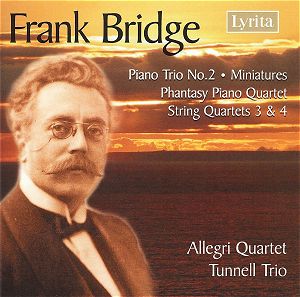
These welcome reissues
of Bridge’s chamber music derive from
two Argo LPs from the 1970s which pretty
much led the field at the time. In recent
years we have been blessed with excellent
performances of Bridge’s chamber music
from the Maggini and Brindisi Quartets,
for example, so that Bridge’s gifts
in that field are much more widely recognised.
These early performances still have
something to say, however, and are by
no means outclassed by their more recent
competitors.
Most of the works on
these CDs owe their existence to the
patronage of Elisabeth Sprague Coolidge,
whose enthusiasm and financial support
was of great benefit to Bridge particularly
at a time when his changing musical
language earned him bewilderment or
censure from the critics.
In the Third Quartet,
Bridge’s later, tonally unstable style
is much in evidence. The opening Andante
moderato – Allegro moderato begins
with a meandering introduction which
is succeeded by a brisker Allegro.
Intervals are wide, themes angular in
outline; the music is restless and unsettling.
A second subject appears on Bridge’s
favourite viola and a crescendo over
the development leads to a fortissimo
recapitulation before the emphatic coda.
The Andante con moto which follows
is played muted throughout and creates
a bittersweet, wistful mood after the
forcefulness of the opening movement.
This in turn is succeeded by a passionate
Allegro energico, in which much of the
earlier musical material is reworked.
A muted close brings the Quartet to
an end.
The Kolisch Quartet,
famed for their interpretations of music
by the Second Viennese School, first
performed the Third Quartet in Vienna
in 1927. Contemporary critics in this
country somewhat disparagingly compared
Bridge’s music of this period to that
of Schoenberg and his followers. There
is indeed something Bergian in the cast
of the harmonies and in the passion
of the writing, but also something identifiably
English in the outline of the themes.
Bridge’s Fourth Quartet
dates from a decade later and followed
a period of serious ill health and something
of a crisis of confidence in his abilities.
The Quartet went through a prolonged
gestation, with several sections being
reworked or abandoned, before Bridge
was satisfied with the result. The harmonic
instability of the Third Quartet is
again in evidence, although the structure
is more recognisably classical in outline,
with a sonata form first movement. minuet
and rondo finale. As in its predecessor
Bridge juxtaposes contrasting themes
and moods and again aims at structural
integration by repeating and reworking
certain themes throughout the work;
here, for instance, the exuberant finale
harks back to elements of the opening
movement and the central minuet.
The Allegri Quartet
prove passionate advocates of the music
and are sympathetically recorded in
a warm Kingsway Hall acoustic. In his
review of the original LP (Musical
Times, June 1973) the late Hugh
Ottaway admired the commitment of the
performances and Bridge’s craftsmanship
while admitting to being unmoved by
the actual music. This seemed to him
to be something of an intellectual exercise;
despite the undoubted compositional
virtuosity, the emotions, he felt, were
not engaged. Latter-day listeners may
beg to differ.
The performances on
the second CD derive from a later Argo
LP and feature chamber music from what
we might call Bridge’s early and late
styles. The Three Miniatures for
Piano Trio are delightful character
pieces, well played and immediately
appealing to amateur or younger players.
The Phantasy Piano Quartet of 1910 shows
a major advance in the composer’s handling
of the musical structure while remaining
within a recognisably tonal musical
language. Common to all the Cobbett-inspired
Phantasy works of the period (by composers
such as Vaughan Williams, Howells and
Ireland) are a number of contrasting
sections within an overall unified form.
The performance of the Tunnell Trio
is excellent though perhaps without
the dramatic sweep and flair of Britten’s
1967 Aldeburgh performance with the
Amadeus Quartet once available on Decca/London.
The main work on this
second disc is the 1929 Second Piano
Trio. This has with some justification
been described as Bridge’s masterpiece.
The musical language is, like that of
the Third and Fourth Quartets, uncompromising
in Bridge’s post-war vein and this led
to some particularly harsh comments
in the press from some of the country’s
more insular critics, some of which
are quoted in the booklet notes. The
performers are fully equal to the music,
giving a relatively restrained performance
of the first three movements to contrast
with their commitment in the exacting
finale. Once again Britten and his distinguished
colleagues Yehudi Menuhin and Maurice
Gendron provide formidable competition
at Aldeburgh in 1963 (courtesy BBC Legends).
With illuminating notes
by Bridge expert Paul Hindmarsh these
discs form a perfect introduction to
the composer’s chamber music and to
one of Britain’s most original and imaginative
composers. Sold as Two discs for the
price of one.
Ewan McCormick
Lyrita
Catalogue
























 for details
 Allegri Quartet (Hugh Maguire (violin);
David Roth (violin); Patrick Ireland (viola);
Bruno Schrecker (cello))
Allegri Quartet (Hugh Maguire (violin);
David Roth (violin); Patrick Ireland (viola);
Bruno Schrecker (cello))