Editorial Board
MusicWeb International
Founding Editor Rob Barnett Editor in Chief
John Quinn Contributing Editor Ralph Moore Webmaster
David Barker Postmaster
Jonathan Woolf MusicWeb Founder Len Mullenger
Buy
through MusicWeb for £23
(UK)/24 (Europe)/25.50 (ROW) postage
paid World-wide.
You may prefer to pay by Sterling cheque or Euro
notes to avoid PayPal. Contact for
details
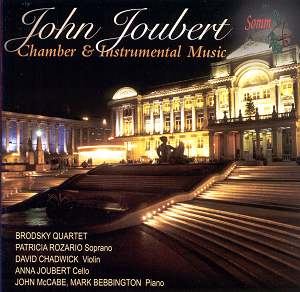
John JOUBERT (b.
1927)
String Quartet No.2 Op.91 (1977)a [24:13]
Landscapes Op.129 (1992)b [22:13]
Piano Trio Op.113 (1986)c [30:43]
Lyric Fantasy Op.144 (2000)d [8:58]
Piano Sonata No.1 Op.24 (1957)e [14:05]
Piano Sonata No.2 Op.71 (1972)e [24:46]
Piano Sonata No.3 Op.157 (2006)e [23:16] Brodsky Quarteta;
Patricia Rozario (soprano)b;
David Chadwick (violin)bc; Ann Joubert (cello)bc;
Mark Bebbington (piano)bcd; John McCabe (piano)e
rec. St. Mary’s Church, Walthamstow, February 2006 (String
Quartet No.2) and Barber Institute, Birmingham, July and
August 2006 (other works) SOMM SOMMCD
060-2 [77:20 + 71:06]
The
works represented here span almost fifty years of Joubert’s
composing life and provide both a good survey of his varied
output for smaller forces and a fine opportunity to appreciate
his progress over the years (Joubert
website). However, what
comes clearly through is a remarkable stylistic consistency
yet
Joubert’s
consummate craftsmanship enables him to adapt his chosen
idiom to a range of expressive aims. This can be heard in
the recent BMS
release with some of his choral music, and
is much in evidence in this release too. His music may safely
be described as traditional 20th century without
being reactionary. This is traditional, superbly crafted
music that nevertheless has many unexpected harmonic and
rhythmical twists.
The
first disc, which features chamber music, opens with the
substantial String Quartet No.2Op.91 completed
in 1977. The first movement opens with a splendid theme that
soon develops into an often animated dialogue full of contrasting
arguments that eventually end rather abruptly. This is followed
by a nervous Scherzo that seems thematically related to the
first movement. The slow movement, the emotional core of
the entire work, develops some of the earlier ideas as well
as the well-known DSCH melodic cell, in homage to Shostakovich,
one of Joubert’s favourite composers, who died in 1975. The
deeply moving movement contains some of his finest ever music.
The dance-like, extrovert Finale eventually dispels much
of the accumulated tension.
Landscapes
Op.129 is a song-cycle
for soprano and piano trio setting poems by various writers
that all have to do with the impact of man on the environment.
The composer describes it as “a ‘green’ festival”, and
all five poems deal with man’s mostly negative impact
on Nature, be it through war destruction or unrestricted
urbanisation: Edward Thomas’s Adlestrop (an abandoned
country railway station), which incidentally has also
been set by Anthony Payne some years ago, Stephen Spender’s The
Pylons (“Now over these small hills they have built
concrete/That trails black wire...”), F.C. Lucas’s Beleaguered
Cities, a fierce protest against unrestricted building
on land, de la Mare’s The Corner Stone (ruins
are much alive long after they have tumbled down) and
Thomas Hardy’s In Time of “The Breaking ofNations” (life
simply has to go on, even after war’s monstrosities).
The music vividly reflects the various moods suggested
by the words. A beautiful work of which the composer
admits to being very fond.
The Piano
Trio Op.113 is a quite substantial work in three
movements. The first Aria lives up to its title,
which however does not mean that it is untroubled. There
are some disquieting episodes that belie any suggestion
of easy-going, lyrical outpouring. The second movement Sonata actually
functions as a nervous, animated Scherzo with some contrasting,
melodic episodes that eventually combine in the final
stages of a movement that drifts away almost unnoticed.
The third movement is a large-scale Passacaglia, a form
favoured by Joubert as well as by Britten and Shostakovich,
built on a rather stark ground. The ensuing variations
unfold at a generally moderate tempo slowly building-up
to a massive climax followed by an appeased epilogue.
The
second disc is entirely devoted to some of Joubert’s piano
music: the three piano sonatas and the recent Lyric
Fantasy Op.144. I was delighted to be able to hear
again the Sonata No.1in One Movement
Op.24 (the earliest work in this selection), that
I first heard several years ago, in 1996 or 1997, I think,
played by John McCabe during a BMS recital at the Royal College
of Music. This is a compact work, roughly in arch-form, that
opens hesitantly “with an effortfully rising scale” followed
by a chorale-like episode abruptly disrupted by the central,
energetic tarantella. This, in turn, leads to a varied restatement
of the chorale, combining the rising scale from the opening
and echoes of the tarantella. The coda is permeated by the
rising scale and veiled allusions to the chorale.
The Sonata
No.2 Op.71 is a considerably more ambitious work.
Its three movements are laid-out in roughly the same
pattern as those of the Piano Trio. The first movement “opens
with enchanted, fairy-tale filigree”. The music soon
gets rather more animated while preserving contrasting
episodes for variety’s sake, before returning to the
pensive mood of the opening. The second movement is another
tarantella Scherzo, as in the central section of the
First Piano Sonata, albeit somewhat more developed. The
final movement is another weighty, imposing Passacaglia
ending with softly chiming chords.
“ I
didn’t want it to be a display like a Liszt operatic fantasy”.
In fact, in the Lyric FantasyOp.144 on
themes from the opera Jane Eyre, the emphasis
is rather on lyricism than on bravura display, so that the
whole work is like an often lyrical, song-like rhapsody of
great charm.
The Piano
Sonata No.3 Op.157 completed as recently as 2006
is the most recent work here, and another large-scale
piece. The movements are laid-out in the fairly traditional
fast-slow-fast pattern, actually with two concise outer
movements framing a substantial slow movement roughly
in ABA form. The Third Piano Sonata was commissioned
to mark the 60th anniversary of the Weymouth
Music Club, which drew the composer back to Thomas Hardy, “which
gave the music its emotional background”. Furthermore,
the third movement Alla marcia is partly drawn
from Joubert’s cantata South of the Line (1985)
setting poems by Hardy. The music is neither descriptive
nor programmatic; but it is certainly imbued with the
moods suggested by these poems written at the time of
the Boer War. The first movement opens with a fiercely
declamatory gesture, and a fierce mood dominates throughout
the movement, again with contrasting episodes. The outer
sections of the slow movement frame a Scherzo episode
- one again thinks of the tarantella in the First Piano
Sonata - whereas the final movement in resolute march
tempo brings this substantial work to a strongly affirmative
conclusion.
These
attractive and often compelling works receive excellent performances
from all concerned. They do full justice to this most distinguished
composer’s superbly crafted music. The recording is excellent,
too, warm and natural. The somewhat sketchy insert notes
by Christopher Morley, are based on interviews with the composer
from which I have generously quoted, could have told you
more about the music. I write this just for the sake of grumbling
a bit about an otherwise superb release.
I
have always felt that Joubert was an unjustly neglected composer
whose music deserved more attention. Now, this generously
filled release and the BMS disc with some choral music (BMS102CDH)
and a slightly earlier BMS disc with some orchestral music
(BMS419CD),
fill a considerable gap in this composer’s current
discography. They amply demonstrate the breadth of Joubert’s
achievement as well as the human warmth and utter sincerity
of his music. His music is – at long last – being given its
due. More please.
Hubert Culot
Please support our advertisers below by clicking on the logos for further information.
























 for
details
for
details
 Brodsky Quarteta;
Patricia Rozario (soprano)b;
David Chadwick (violin)bc; Ann Joubert (cello)bc;
Mark Bebbington (piano)bcd; John McCabe (piano)e
Brodsky Quarteta;
Patricia Rozario (soprano)b;
David Chadwick (violin)bc; Ann Joubert (cello)bc;
Mark Bebbington (piano)bcd; John McCabe (piano)e