Editorial Board
MusicWeb International
Founding Editor Rob Barnett Editor in Chief
John Quinn Contributing Editor Ralph Moore Webmaster
David Barker Postmaster
Jonathan Woolf MusicWeb Founder Len Mullenger
Joseph HAYDN (1732-1809)
Symphony No. 94 in G major, Surprise (1791) [20:44]
Symphony No. 101 in D major, Clock (1793-4) [25:46] Johannes BRAHMS (1833-1897) Variations on a theme by Haydn, Op. 56a (1874) [17:00] Wiener Philharmoniker(Haydn), London Symphony Orchestra (Brahms)/Pierre Monteux
rec. Sofiensaal, Vienna, 20-21 April 1959 (Haydn), Kingsway Hall, London, 8-9
December 1958 (Brahms). ADD LONDON 452
893-2 [64:06]
What’s
immediately striking about Pierre Monteux’s Surprise Symphony is
its freshness of outlook, its sense of keen unfolding right
from the first movement introduction. The Vivace assai main
body of the movement has a shining verve coupled with an
easy elegance and so is a fully rounded representation of
Haydn. A pity there’s no exposition repeat. The development
(tr. 1 3:24) is, as it should be, eventful and the entire
movement’s progress has a commanding vigour.
The
slow movement theme is marked to be played ‘simply’. Monteux
is thoroughly straightforward about it but, being light on
his feet, you also sense a smidgen of cheekiness which would
explain the surprise of the sudden crashing chord which gives
the symphony its nickname. It is given full force here. In
the first variation (tr. 2 1:05) Monteux enjoys and emphasises
the contrast of the heavy lower strings and elegant first
violins. He brings what at first seems a mock gruffness to
the second variation (2:08) but its writhing second section
is more alarming. Variation 3 (2:58) spotlights the woodwind,
rather ethereal here, partly because somewhat distanced in
the recording. Variation 4 (4:00) is full-blooded grandeur
with a relished swagger and heavyweight lumbering syncopation
before the contrast of an introverted shadowy coda. So there’s
plenty of character throughout.
The
Minuet is on the sturdy side for Allegro molto but
Monteux gives it swing too, so it becomes an intriguing blend
of grandeur and rusticity. That teasingly quieter, slightly
lingering passage late in the second section (tr. 3 1:19)
finds its natural expansion in the delicately ruminative
Trio (2:34). Monteux’s finale is Allegro di molto all
right, a tour de force of nifty strings’ articulation
and bracing semiquaver runs, a rondo whose episodes flash
forth almost before you can draw breath. The timpani solo
which should be loud (tr. 4 2:58) is on the tame side but
not the movement’s sizzling culmination. In sum this is robust,
not heavyweight, Haydn.
I
compared the 1967 Cleveland Orchestra/George Szell (Retrospective
RET 002). Here are the comparative timings.
Timings
I
II
III
IV
Total
Monteux
6:32
5:39
5:06
3:27
20:44
Szell
9:37 (7:21)
6:24 (6:09)
4:15
3:50
24:06 (21:35)
Szell
makes the first movement exposition repeat but even without
it, as I’ve indicated in brackets, is slower than Monteux.
Szell’s first movement is more deliberately pointed, rhythmically
very crisp but melodically less free than Monteux. His development
is less tense and recapitulation less deft.
Szell
creates greater contrasts in the slow movement so by the
end it seems a portrait of a manic depressive, an intelligent
expansion of that surprise. Monteux prefers to emphasise
the movement’s integrity, the pervasive theme being varied.
Szell benefits from woodwind of greater presence in variation
3 to create a delightful idyllic effect but Monteux’s beginningof
the movement is more smiling. One oddity, Monteux doesn’t
make the repeat of the first section of variation 2, so I’ve
indicated in brackets above Szell’s timing for exact comparison
were that repeat omitted.
Szell’s
Minuet has more pace and swing than Monteux’s which makes
it jollier but less graceful. His winsome Trio seems a miniature
inhabiting its own world. Monteux’s Minuet isn’t Allegro
molto but is more aristocratic and the more flexible
tempo’s scope for contrast allows the Trio to expand the
reflective vein introduced latterly in the Minuet. So again
Monteux stresses the integration of elements.
Szell’s
finale is cheery, then dazzling in its violins’ semiquaver
runs and his timpani solo is loud and clear. However, Monteux
is friskier. His semiquaver runs are more exciting and there’s
an element of the frenetic, of risk taking beyond Szell’s
impressive virtuosity.
Monteux’s Clock
Symphony also has a first movement introduction of
keen, exploratory focus with marked but not severe accents
so the simple cheeriness of the opening of the Presto (tr.
5 1:55) then the boisterousness of its fuller-scored repetition
emerge as a logical outcome. The second theme (2:51) is
darting, then comely. The exposition repeat is made here.
In the development (5:13) Monteux points the melodic containment
of the phrases. In the recapitulation (6:46) the relaxation
and regeneration of the second theme is emphasised. In
no way is this hectic Haydn.
Nevertheless
the Andante is well paced, not hanging about, cheery
and quite jaunty with the repeat of the first section stylishly
played slightly softer, though the second section isn’t repeated.
The eruption in G minor (tr. 6 1:42) is very lively and the
flute, oboe and bassoon detail when the theme returns in
the first violins (2:45) charmingly characterized. You appreciate
the intricate workings of this clock.
Monteux’s
Minuet is a bit weighty for its Allegretto marking.
Even so, its forward thrust is compelling and its verve has
a feel of triumph about it. Also the loud and soft elements
are cleanly contrasted, which allows the Trio consistently
to combine the graceful and heroic, though its second section
isn’t repeated. Monteux’s finale is assured and has an irresistible
pulse, indeed a swashbuckling character once the first violins’ quaver
runs get going in the first episode (tr. 8 1:24) and with
even more excitement in the second (2:18) before the feathery
high jinks of all the violins in the double fugue (2:56).
This is terrific playing.
I
compared Royal Philharmonic Orchestra/Thomas Beecham recorded
1958-9 (EMI Gemini 5855132). Here are the comparative timings.
Timings
I
II
III
IV
Total
Monteux
8:51
6:06
6:34
4:15
25:46
Beecham
6:59 (8:26)
8:05
8:23
(7:18)
4:55
28:22 (28:44)
Beecham’s
first movement introduction has more tension and sense of
drama, drawn out so much that every note is made to count
and to make a greater contrast with the more jubilant very
fast main body of the movement which also sports a more fiery
development. Beecham doesn’t repeat the exposition so the
bracketed figure above offers an exact timing comparison.
Monteux’s introduction has a stronger sense of continuity.
His more deliberate Presto brings more charm to the
second theme and resilience to the development.
Beecham’s
clock is a pretty slow running one, though elegantly fashioned.
He doesn’t repeat the second section of the theme either.
Monteux’s opening is sweeter with more melodic shape discernible
and the return of the theme with flute and bassoon accompaniment
more graceful, bubbling brightly.
Beecham’s
grander measure works better in his spruce Minuet though
Monteux’s greater relaxation at first and contrast in mood
and dynamic later is just as effective. Beecham does repeat
the second section of a gentle Trio, so the bracketed timing
above provides the exact comparison. Beecham’s finale opens
with assurance and regality with neat articulation throughout,
yet doesn’t quite match Monteux’s brio.
The
Brahms Haydn Variations make a neat bonus. In Monteux’s
interpretation again it’s the sheer momentum that stands
out. The theme is easy flowing and jovial, aided by the prominence
of the double bassoon bass. The first variation (tr. 9 1:54)
is sheenily exploratory, the second (3:10) bracing, the third
(4:11) comforting and growingly serene. Variation 4 (5:48),
by contrast, is a doleful gaze at sadder times, but still
moving on, a phase. Variation 5 (7:55) is an injection of
vivacity. Variation 6 (8:50) continues this through the vigour
of the horns. The seventh variation (9:56) is a gently lapping
antidote, the eighth (12:24) a mysterious interlude. The
finale (13:27) is all warmth as the orchestra elaborates
over the theme in the string bass.
I
compared the 1967 Vienna Philharmonic Orchestra/John Barbirolli
recording (EMI Gemini 4769392) which is more leisurely, taking
18:21 against Monteux’s 17:00. Barbirolli treats the theme
more benignly where Monteux gives it rusticity and open air
quality. Monteux’s first variation has more of a sense of
engagement. His third variation is rosier where Barbirolli
is more restless. His fourth has a clearer melodic shape
and sense of moving on where Barbirolli lolls desolate. Monteux’s
seventh variation is calmly relaxed where Barbirolli is sleepy.
However Barbirolli brings a warm sense of fulfilment to the
finale where Monteux’s structural clarity doesn’t altogether
escape the tension of gathering things together.
These Monteux performances are of abundant character and
continuous fascination. The recordings still sound vivid,
albeit with
a slight tape hiss discernible. The Viennese have a slightly
acid quality in the strings but that gives them a crispness
too. The London recording is closer and of warmer bass. The
Arkiv CD under review doesn’t have booklet notes but
I understand all future releases will and existing releases
are gradually being upgraded.
Michael
Greenhalgh
Please support our advertisers below by clicking on the logos for further information.
























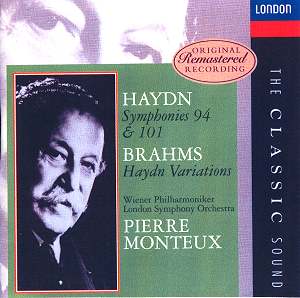

 Wiener Philharmoniker(Haydn), London Symphony Orchestra (Brahms)/Pierre Monteux
  452
893-2 [64:06]
452
893-2 [64:06]