This is Adam Fischer’s
second SACD of Haydn symphonies for MDG, following Nos. 92 and
94 recorded in 2004 (MDG 901 1325-6).
In the first movement
introduction of Symphony 88 (tr. 1) Fischer neatly contrasts
workmanlike propositions with smoother, more playful responses.
The Allegro of the main body (0:51) shows that the genial,
playful mood wins. Here’s lively and accomplished playing from
the Austro-Hungarian Haydn Philharmonic; the tone is light yet
the articulation is firm. Surround sound maximizes the clarity
of the recording in the warm acoustic of the Esterhazy Palace,
the original performance venue for most of Haydn’s symphonies.
That said, there’s still a touch of thickness in the gutsy semiquaver
passages in the lower strings, e.g. from 3:08. Nevertheless
the waywardness of the violas and cellos subverting the more
orthodox thematic presentation by the violins at the beginning
of the development (3:26) enhances the overall playful impression.
It’s good to hear the second half as well as the exposition
repeat.
The slow movement
(tr. 2) luxuriates rather in warmth and relaxation, but without
losing a discernible shape; this eases the argument forward.
The first presentation of the serene theme, on solo cello and
oboe, is finely balanced. At its third appearance (1:27) the
violins gently float above the theme; later still (3:15) that
floating has become freer and more sweet. The famous interjections
of very loud discordant passages, the first at 2:05, in which
trumpets and drums appear for the first time in the work, are
presented with an adamantine rigour.
The third movement
Minuet (tr. 3), spruce with good drum accents, seems trim and
dapper and rather on best behaviour. The Trio is sunnier with
its warm drone and well pointed violin parts. The treatment
of the sforzandi here, the sudden strongly accented notes,
is just right. Yet there’s more of an impression of neatness
than humour.
In the finale (tr.
4) the brilliance of the playing appositely matches that of
Haydn’s invention. The whole has a vivacious and virtuoso sweep
about it and there’s no holding back on the accents here either.
A fine example of a historically informed performance with a
stimulatingly pacy and blazing conclusion.
I compared the only
other recording available on SACD, that by the Concertgebouw
Orchestra/Colin Davis (Pentatone PTC 5186 126) which dates from
1975 and appears on 4 channel SACD courtesy of the original
Philips quadraphonic mastertapes. Here are the comparative timings:
|
Timings
|
I
|
II
|
III
|
IV
|
Total
|
|
Fischer 2006
|
8:22
|
5:47
|
4:12
|
3:32
|
22:03
|
|
Davis 1975
|
6:20 (8:53)
|
5:46
|
4:03
|
3:46
|
19:35 (22:08)
|
Davis’ introduction
is notably slower, taking 1:04 against Fischer’s 0:50. There’s
a bigger weight of tone from his larger body of strings and
therefore more contrast between the loud and soft elements,
more imposing on the one hand and graceful on the other. Davis’s
Allegro is more assertive and thereby humorous with more
incisive lower strings and gradations of dynamic made clear.
There’s more mystery about the opening of the development, more
dramatic contrasts of dynamic, more animated strings and a more
intense engagement with the music, though it might be argued
this is somewhat romantic. In comparison with Davis, Fischer’s
introduction seems rather nonchalant, but he is more scrupulous
about the semiquaver followed by quaver opening to all the phrases
which Davis rather evens out. With Fischer’s fewer strings Haydn’s
orchestration emerges more transparently. But the tiered crescendo
from tr. 1 1:37 is less effective than with Davis. You could
say Fischer is more neat and classical but doesn’t sweep along
with Davis’s conviction. The Davis timing looks faster because
he doesn’t make the second half repeat. In the heading I’ve
put in brackets the directly comparable time with Fischer had
he made the repeat. Paradoxically, though slightly slower, Davis
conveys more of a sense of momentum. If you think of this movement
as a carriage journey, with Davis you experience the thrill
of the drive; with Fischer you admire the mechanisms which bring
about the smooth operation.
The slow movement,
in the hands of Davis, is fuller in tone and thereby more warmly
emotive, the sforzandi respectfully measured at the emotive
peaks of the phrases and the dissonant interruptions stark.
But here I prefer Fischer’s lighter, more intimate, chamber
manner. The sforzandi aren’t so marked but still emotively
shape the phrases so the serene melody emerges with comely,
simple beauty. The dissonant passages are still clearly contrasted
with an impact from the timpani that Davis doesn’t realize,
while Fischer’s clear but less strident trumpets in comparison
with those of Davis, are closer to period instrument balance.
Fischer shows that loud presentation of the theme late in the
movement (tr. 2, 4:13) in lower register by unison first violins
and cellos can still be ‘sweet’ as marked because of the smaller
forces used than Davis. Indeed I think he actually uses soloists
at this point.
Davis’s bigger band
makes for a splendidly swaggering Minuet yet one also with playful
soft contrasts. The Trio is calmer but the accents maintain
the playfulness. Fischer’s smaller forces are less majestically
assured but provide bounce and bite. In the Trio he brings out
the drone more clearly.
Davis’s finale has
a jocular progression with racy appoggiaturas and a combination
of power, dazzle and smiling charm, with his larger orchestra
able to make more of the firm dynamic contrasts which Haydn
ranges between pp and fff. In comparison Fischer
is quieter yet still jovial. His lower strings perform heroics
in articulation of verve from tr. 4, 1:54, albeit without being
able to match the incisive weight of those of Davis.
Next on Fischer’s
SACD comes the overture to The uninhabited island and
you can feel him relishing its graphic, programmatic material.
The slow introduction is gaunt. This is what it feels like to
find yourself in unfamiliar surroundings, but its extension
(tr. 5 0:49) through sequences of the initial motif make clear
that the abandoned have a capacity for expressive feeling. The
stormy fast section in G minor (1:35) also seems to be as much
about feelings as action. The loved one feels betrayed, but
soon (2:02) is able to throw herself into action to make the
best of it, whereupon the island gets domesticated in a gracious
second theme (2:32). After more bustle there’s an even more
euphoric mood-swing to a kind of minuet in G major (4:08) for
solo violin, cello, flute, bassoon and horn. Isolation is also
shelter, or rather here’s a foretaste of the opera’s happy ending.
This turns wistful to link to a brief reprise of the stormy
fast section as coda.
I have a historic
performance for comparison, the Hallé Orchestra/John Barbirolli
at the 1954 Proms (Guild Historical GHCD 2320), only 7 seconds
slower. He uses the fuller tone of a larger orchestra to realize
a bolder opening with more sense of alarm and then dramatically
contrasting gentle expressiveness. His storm section has extraordinary
vehemence but too many violins rather weigh down the ‘minuet’.
Returning to Fischer I appreciated the more the sense of strangeness
and concern he creates at the outset and then his sensitive
shading of the response full of feeling. His fast section is
more formal than Barbirolli’s but with its phases neatly clarified.
His ‘minuet’ with chamber ensemble forces is jollier, homelier
yet also maintaining a strong forward pulse.
Fischer’s SACD closes
with Symphony 101. Its first movement introduction in poised
performance here has something of the strangeness of the preceding
overture but also more hints of light. This is confirmed by
the Presto main body (tr. 6 1:17) at first feathery then
boisterous in manner with vigorous timpani and violins threatening
to fall over each other in their quaver runs. Fischer gets across
very well that there are both carefree and manic elements which
live side by side, the more biting aspects coming to the fore
in the development (4:07).
The well paced,
that’s not too slow, Andante gives the slow movement
- its ticking accompaniment giving the symphony its name - charm
and elegance as well as humour. The marvel of this movement
is the flexibility and variation of the violins’ melodic line
and here rightly is Fischer’s focus, notwithstanding the varied
clock background. The second section of the initial presentation
(tr. 7 0:46) is freer in expression as it progresses, so an
underlying spontaneity is created which makes the D minor interjection
(2:32) stimulating - again a kind of mania, not alarming but
bravado.
The Allegretto
Minuet is also reasonably paced by Fischer so it’s both stately
and sunny with the involvement of drums and brass relished.
I like the little unmarked crescendo applied to the two-note
motif the trumpets repeat twice (tr. 8 1:52) which gives it
point and pep. The Trio has delicious soft tones contrasted
with more grand eruptions. Fischer introduces the finale theme
almost nonchalantly, but you know an exuberant stream of quavers
will soon be launched. As in the first movement the violin tricks
are seamlessly presented, virtuosity is paraded lightly, even
the double fugue (tr. 9 3:00).
I compared Fischer’s
1987 recording of this symphony with the same orchestra and
in the same location, the very first recorded in his complete
Haydn cycle on CD (Brilliant Classics 99925). Here are the comparative
timings:
|
Timings
|
I
|
II
|
III
|
IV
|
Total
|
|
Fischer 2006
|
7:24
|
6:49
|
7:24
|
4:26
|
26:10
|
|
Fischer 1987
|
8:21
|
8:17
|
8:25
|
4:31
|
29:34
|
In 1987 Fischer’s
first movement introduction is more tense, the sforzandi
more deliberate. In 2006 there’s a sense of mystery, the outcome
of which may be good, with clear yet not over-emphatic sforzandi
(tr. 6 0:57). The 1987 Presto is robust and exuberant
but the strings are less stylish and rather overwhelmed by the
brass in the full orchestra passages in the two channel sound.
It’s like witnessing the performance from towards the back of
the hall rather than, with the MDG 5.1 channel sound, being
at the heart of it. The 2006 string playing, violins especially,
is much smoother and more deft, the balance with the brass better
without denying their impact nor that of the timpani which are
magnificent. The violins have a skipping ebullience and you
never feel the effort inherent in their demanding parts. Take
the poise of the second theme (3:32) which glides from lightness
to a brief luxuriating charm to perkiness, significant because
at the opening of the development this takes centre-stage. I
also liked the way Fischer really makes the coda burnish at
the close, taking his cue from the ff marking for cellos
and double basses (7:09) and applying it generally.
Fischer’s more measured
1987 Andante is graceful but rather sleepy in comparison
with 2006. The dynamic contrasts in the second section of the
first presentation of the melody seem over deliberate, the D
minor interjection formal and stolid, as are all similar passages.
The 2006 Andante is altogether cheerier, lighter, with
the shape of the melody more appreciable, the dynamic contrasts
in the second section humorous and the return of the opening
melody (tr. 7 1:18) has the flute beautifully balanced now it’s
doubling the first violins. Vivacity is maintained in the D
minor and other interjections because of the consistent darting
rhythmic articulation.
Fischer’s slower
1987 Minuet seems comparatively stiff in its formal grandeur,
though the Trio is more relaxed and free flowing because of
its largely lighter scoring. The 2006 Minuet has more pace,
bounce, jollity and thereby also more shape and purpose to it
yet still plenty of weight from brass and drums. The Trio is
also perkier, with more startling dynamic contrasts.
Fischer’s 1987 finale
is almost as fast as 2006. It has style throughout and a hothouse
intensity in the passages for full orchestra. Nevertheless the
opening in 2006 has more warmth and character with crisper,
more humorous articulation of rhythms. The 1987 recording is
rather strings-dominated but the 2006 shows the whole orchestra
involved and thus gives a more rounded picture. The second episode
(tr. 9 2:17) is exciting without the wildness of 1987. The 2006
double fugue entries glisten more emphatically with more of
a sense of summation.
To sum up, these
are state-of-the-art historically-informed performances on modern
instruments with fine transparency of texture. However, 55 minutes
is rather short measure for a full price SACD. Three symphonies
would have been more attractive.
Michael Greenhalgh
























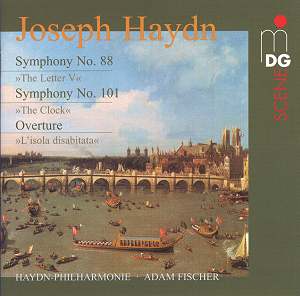

 Osterreichisch-Ungarische
Haydn-Philharmonie/Adam Fischer
Osterreichisch-Ungarische
Haydn-Philharmonie/Adam Fischer  [55:18]