Editorial Board
MusicWeb International
Founding Editor Rob Barnett Editor in Chief
John Quinn Contributing Editor Ralph Moore Webmaster
David Barker Postmaster
Jonathan Woolf MusicWeb Founder Len Mullenger
Buy
through MusicWeb
for £12.50 postage
paid World-wide. You
may prefer to pay by Sterling cheque or
Euro notes to avoid PayPal. Contact
for details
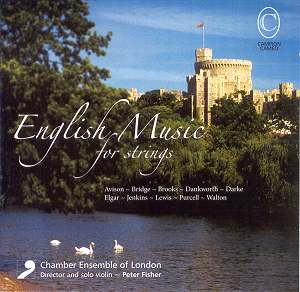
English Music for Strings Charles Avison (1709-1770) Concerto in AOp.9 No. 11 [7:17] Henry Purcell (1658-1695) Chacony in G minor for strings(realised, Britten 1947/48)
[6:37] Clive Jenkins (b.1938) Pastorale and Allegro[7:23] William Walton (1902-1983) Two Pieces for Strings from ‘Henry V’ - Passacaglia:
Death of Falstaff; Touch Her Soft Lips and Part (1943/44)
[5:24] Paul Lewis (b.1943)
Rosa Mundi (2002)[4:20] John Dankworth (b.1927) Mariposas (1996) [10:49] Harold Darke (1888-1976)
Meditation on Brother James’s Air [6:34] Nigel Brooks (b.1936) To My Love (Adagio for Strings) [5:18] Edward Elgar (1857-1934) Salut d’Amour (1888)[3:12] Frank Bridge (1879-1941) A Christmas Dance (Sir Roger De Coverley)
(1922) [4:21] Chamber
Ensemble of London/Peter Fisher (solo violin)
rec. All Saints Church, Tooting 31 January, 1 February 2006 CAMPION
CAMEO 2045 [62:16]
The headline here is that this disc represents
a fine blend of old favourites, new discoveries from the
past and contemporary explorations. There is something here
for everyone.
Chronologically, the first work is the Chacony
in G minor by Henry Purcell. This has an interesting
resonance for me – it was the very first piece of music
composed by or edited by Benjamin Britten that I consciously
heard. I was impressed all those years ago and I am still
of the opinion that this is a perfect fusion of 17th century
musicality with 20th century scholarship. It
remains one of Purcell’s most popular pieces and is given
an excellent performance. Perhaps the depth of the sound
is a little lacking. But more of that later!
Charles Avison was from the Toon. To those readers
who are not football (soccer) fans I mean he was a Geordie.
A native of Newcastle, Avison studied in London with the
Italian composer Geminiani: however the bright lights did
not hold fascination for him. Soon he was back at Newcastle
in the role of church organist at St John’s Church and later
St Nicholas Cathedral. He composed some fifty concerti, the
best known being the 12 Concerti Grosso after Scarlatti.
Avison had his time of popularity, yet he fell out of favour
and only recently is he being re-discovered after the revivalist
editorial work of Gerald Finzi in the 1940s and 1950s. His
dates straddle the Baroque and Early Classical periods.
The present Concerto in A harks back to
earlier days. It comprises four well-balanced movements that
inspire as well as please. I understand that there is a thriving
Charles Avison Society in Newcastle. One can only wish them
success in promoting this fine composer.
Sir Edward Elgar is next in the timeline with
his well known Salut d’Amour. This piece has appeared
in so many incarnations that it is hard to know what was
the original version. I guess that it was a salon piece for
fiddle and piano but it soon took on a life of its own. I
have a piano arrangement at home. I have heard it on the
organ and also played by a brass band on the sea front at
Lytham St Anne’s. The present recording is a delicious arrangement
for ‘light’ string orchestra. I have always found it difficult
to imagine how Elgar ‘heavyweight enthusiasts’ feel embarrassed
that this work comes from the same mind and the same pen
as Gerontius, the Second Symphony and the Cello
Concerto. This is great and lovely music even if it is
popular and better reflects the drawing room than the concert
hall!
There is a reasonably well known anecdote concerning
this piece which bears retelling. One night Elgar was arriving
at a concert with a certain Fred Gaisberg. “As we entered
the Artists' Entrance," Gaisberg recalled, "we
passed an itinerant fiddler giving a fairly good rendition
of Salut d'Amour. The delighted composer paused and
from his pocket produced half a crown. Handing it to the
bewildered musician, Elgar said, 'Do you know what you are
playing?' 'Yes,' he replied. 'It's Salut d'Amour,
by Elgar.' 'Take this. It's more than Elgar made out of it,'
responded the donor."
Frank Bridge is one of my top five composers anywhere,
anytime, ever. There is virtually nothing from his catalogue
that I do not admire, love and would not want on my Desert
Island. Of course he is best known for the orchestral suite The
Sea, which knocked Benjamin Britten sideways. And perhaps
Bridge cognoscenti would say that his masterpiece was Enter
Spring, or is it the string quartets or perhaps the Piano
Sonata or maybe even the Cello Sonata…
The Christmas Dance (Sir Roger de Coverley)
is a fine example of Bridge’s string writing. It uses two
old British tunes – Sir Roger is English and of course Auld
Lang Syne hails from North of the Border. The music sparkles
with ‘rustic’ dance tunes and chattering strings. This is
an excellent introduction to this great composer’s music.
I remember being at a choir practice in a place
called Stepps – a suburb of Glasgow. We were rehearsing Maunder’s Olivet
to Calvary. I recall the choirmaster, a certain Mr Jimmy
Allen announcing to the assembled choristers that Harold
Darke had just died. This was 1976. That Sunday I recall
I made a brave attempt at playing Darke’s Meditation on
Brother James’s Air as an introductory voluntary to the
morning service at St. Andrew’s Church. I know that I faked
parts of it and probably cut out one or two ‘difficult’ passages.
But the tune was clear. So it is interesting to hear the
original (?) strings version on this disc. Brother James’s
Air is a charming work – almost improvisatory in character
and here is effectively scored for strings. It is one of
those works that one cannot help wondering why it has not
been picked up by Classic FM. It would make a welcome change
to the ubiquitous Lark Ascending or Fantasia on
Greensleeves. Strangely this work is often programmed
as ‘wedding music’, To my ears it has a ‘valedictory’ feel
that does not – typically - coincide with the mood of marriage.
The last of the ‘classics’ is William Walton’s Two
Pieces for Strings from ‘Henry V’. To many people
the favourite screen version of this great play is the
one starring ‘Larry’ Olivier with Walton’s fine score.
I first came to appreciate the music by way of Christopher
Plummer’s moving account on Chandos (CHAN8892). This had
been arranged as a sequence by Christopher Palmer. Long
before this CD I remember as a child sitting with my father
watching the Olivier film. I was not impressed and announced
this fact to him – in a facetious manner! My father read
me a lecture as to what the film meant for the many men
who were to ‘roll up’ on the French coast on D-Day and
the deep debt owed to those who ‘handed in their mugs and
blankets’ during those momentous days. My father, a sapper,
was one of the first to struggle up Gold Beach on that
now far off June morning. I can never hear this music
without moist eyes. For me the highlight of this film music
is the exquisite Death of Falstaff and the equally
moving Touch Her Sweet (‘Soft’ in Craggs
and on the CD Cover!) Lips and Part. These two
miniatures for strings sum up the depth of thought in this
great masterpiece of English stage and music.
Clive Jenkins is a Plymouth man. His music tends
to have local connections. For example there is a cantata
called The Mayflower Pilgrims and a ballet derived
from an ancient Dartmoor legend. The programme notes state
that the present Pastorale and Allegro is also based
on associations with the ‘moor.’ Certainly the ‘pastoral’ element
is ‘darker’ than might be expected from the smiling fields
of the Home Counties or the Welsh Marches. The work was
originally performed in a piano version. However I guess
that it was conceived in its present form. Interestingly
the piece, although not a pastiche of any given period, makes
subtle use of a ‘theorbo’ as continuo. A ‘theorbo’ is a long
necked lute like instrument.
The Pastorale and Allegro is quite definitely
in the English string tradition of the 20th century.
Both parts of this work are well balanced and creatively
exploit the character of the string ensemble. The Pastorale in
particular is a thoughtful and reflective miniature masterpiece.
It should be pointed out that this piece would work well
without the theorbo. I cannot imagine there being a glut
of players of this rare instrument!
Paul Lewis’s Rosa Mundi is a fine example
of the genre. This is timeless music that could have been
written at any time over the past century or so. Yet there
is a lovely ‘popular’ - in the most positive and best sense
- feel to this music that defies description. Apparently
the work was written at a time of great personal sadness
for the composer. He noticed a single rose blowing on a plant
in his garden that he had believed to be dead. This is a
beautiful work that well deserves to be given wide airtime
- it has also been recorded on Volume 6 of the Naxos series
English String Miniatures (8.557753). It is moving, almost
heartbreaking, yet full of hope. A noble
work, indeed.
Sir John Dankworth is not often featured as a
composer on classical records. Yet the present work, Mariposas,
is perhaps the biggest surprise on this disc. It is to my
ear the most involved and most complex piece here - perhaps
even the greatest work. And that is a big and bold statement
to make considering the play list! It is certainly impressive
music that defies categorisation. It is based around the
violin playing styles of Stuff Smith, Joe Venuti, Stefan
Grappelli and Ray Nance. Yet this is no ‘jazz fusion’ work.
This is serious stuff. I could recommend the disc based on
this piece alone. I find it unbelievable that it is not in
the ‘mainstream’ repertoire. Too ‘difficult’ for Classic
FM I guess, but this is essential listening for all enthusiasts
of British string music - and many others too!
Nigel Brooks’ To My Love (Adagio for
Strings)broke my heart. This is the saddest
and most profound music on this disc. The composer was
born in Ilfracombe and is another Devon man who is influenced
by his surroundings. Works to his credit include an opera
based on Daphne du Maurier’s Jamaica Inn. I knew
I had heard his name somewhere before receiving this CD.
A quick ‘google’ and there it was – he is director of the
Nigel Brook Singers that regularly feature on Friday
Night is Music Night. I wonder how long it will be before the
BBC abandon that long running programme in favour of something
more ‘immediate and exciting’ like finger-cymbal music
from Nepal or ‘aleatory jazz for non-musicians’ from Java. The Adagio was
written to express the composer’s manifest grief at the
death of his beloved wife Jean. Yet, in like manner to
Paul Lewis’s piece it has a profound promise of ‘that perfect
peace which passeth all understanding’. This is a flawless
gem that demands to be put into the public domain. I understand
that it has been given a few times on Radio 2 – the ‘light’ Programme!
This CD was recorded in All Saints, Tooting and
used a natural recording technique which obviated the need
for mixing desk or digital enhancement. This allowed the
natural “acoustic of the church to capture the balance between
instruments and musicians themselves”. Only occasionally
do I feel that this has resulted in a little lack of depth
to the sound. Yet the quality of the playing is never in
doubt.
This is a brilliant CD with a well balanced programme.
The contemporary works are not, as so often, makeweights.
In fact the most impressive piece is the Dankworth and the
most moving the Brook. This recording is a fine introduction
to the glories of British, or more precisely, English String
Music. Each and every piece is, or should be, in the repertoire
of orchestras and ensembles the length and breadth of the
Classical World.
John France
Please support our advertisers below by clicking on the logos for further information.
























 for details
 Chamber
Ensemble of London/
Chamber
Ensemble of London/