Sammartini junior
– he was some five years younger than his brother Giuseppe,
who largely made his reputation in London – has had less than
entirely fair treatment from historians. Look him up and a certain
way of perceiving him, which sounds admiring but is actually
a way of not taking his music altogether seriously, is almost
universal. A few representative quotations - “Sammartini’s music
played a fundamental role in the formation of the classical
style”; “He was one of the most influential figures in the early
development of the symphony, beginning in something like the
baroque manner of Vivaldi, but going on to develop a style which
is the apotheosis of the grace and elegance of the galant
style”; “He was much respected as a teacher. Quantz made
a point of visiting him; he had a profound influence on Johann
Christian Bach and Glück was his pupil”.
Haydn famously described
Sammartini as “a scribbler”, but it is not uncommon for an artist
to rubbish one of his major influences – to listen to Sammartini’s
sinfonias is to hear unmistakeable anticipations of Haydn –
if only so that one’s own ‘originality’ might not be doubted.
But all this talk
of influence means that Sammartini has, in effect, been neatly
pigeon-holed as “a transitional figure” – a status which is
usually the kiss of death. To be a transitional figure is, by
implication, to be neither one thing nor the other, to matter
primarily, not for one’s own work but for what others made of
it; for an artist to be categorised as “a transitional figure”
is usually a sure guarantee that his work won’t actually be
looked at for its own sake.
Sammartini was the
most important composer in Milan for much of his mature life.
His best music deserves attention for its own merits, not just
for what other later composers might have learned from it. The
best of it is very fine indeed. His output includes three operas,
a considerable body of chamber music, much of it very striking,
violin concertos and some delightful sinfonias; since he was
maestro di capella for several of Milan’s major churches,
holding a number of such posts simultaneously, he also wrote
a good deal of sacred music. Only in recent years has Sammartini’s
religious music attracted any real attention. The foundation
for such study was laid by the 1979 catalogue of his work, prepared
by Bathia Churgin and Newell Jenkins. There are two important
essays on the sacred music, by Marina Vaccarini Gallarani and
Charles R. Verble, in the 2004 publication Giovanni Battista
Sammartini and his musical environment, edited by Anna Cattoretti.
This the fourth
in a series from Naxos devoted to Sammartini’s sacred music
(and some symphonies). The recordings of the sacred music are
premiere recordings. The previous volumes – Naxos 8.557431,
8.557432 and 8.570254 – all by basically the same forces, directed
by Daniele Ferrari, have had a mixed reception. They have been
generally well received in the Italian musical press, but this
has not always been so elsewhere. The division of opinion is
well represented on the pages of MusicWeb International, in
the views of Jonathan
Woolf and Patrick
Waller. It is perhaps appropriate, therefore, that my reaction
to this latest volume is rather mixed.
There is some fine
music here. The main work, Gerusalemme
sconoscente ingrata
is one of a series of Lenten cantatas which Sammartini wrote
for the very handsome Jesuit church of San Fedele in Milan,
designed by Pellegrini in the 1570s to a commission by Carlo
Borromeo, where there met the grandly titled Congregation of
the Most Holy Sepulchre of Our Lord Jesus Christ and the Solitude
of the Most Holy Sorrowing Virgin, a predominantly lay association
fully appreciative of the quasi-operatic nature of Sammartini’s
cantatas. The cantatas following a common pattern, beginning
with an orchestral introduction, followed by a series (usually
three) of recitatives and paired arias, closing with a vocal
trio. Many of the arias would not have been out of place in
the works Sammartini wrote for the Royal Ducal Theatre in Milan
(predecessor of La Scala). There is, for example, some beautifully
expressive writing in the soprano aria ‘Quel Serto, quell Manto’
and considerable dramatic power in the mezzo aria ‘Lupo crudel
rapace’.
Both of the symphonies
which close the disc are attractive pieces, that in E flat made
up of two fast movements, that in G minor of three movements
(allegro-andante-presto), the central slow movement of which
has both gravity and charm.
Only some twenty
sacred works by Sammartini are known at present. The quality
of what survives – at least the best of it – is such that I,
for one, hope that more will be rediscovered. I am very grateful
to Naxos for this very interesting series. Yet it has to be
said that the performances are not, consistently, of the very
highest standard. The orchestral playing is generally sound,
but not always as crisp or precise as one might wish. Happily,
the solo violin contribution to Gerusalemme
sconoscente ingrata
is very pleasantly played by Stefano Lo Re. The soloists
all have operatic experience, a relevant consideration in this
music. Silvia Mapelli (Maria Maddelena) copes pretty well with
the technical demands of her part, but her voice lacks variety
of tone, which limits her expressiveness; Miroslava Yordanova
(Mary Cleophas) – who some may remember as a contestant in the
Cardiff Singer of the World Competition in 2001 – sings with
power and authority, though perhaps not always with the greatest
subtlety; Giorgio Tiboni has an attractive, but decidedly light,
tenor voice, which sometimes sounds a bit lacking in impact
in this context. Certainly the contrast between his relatively
slight voice and the weight of Yordanova’s voice makes this
a somewhat ill-matched team. But such reservations shouldn’t
detract from a genuinely warm welcome for the latest issue in
an interesting, enjoyable – and important – series, even if,
finally, one finds oneself feeling that these recordings are
good enough to make one imagine how splendid the music might
sound in even better performances, rather than fully satisfying
in themselves.
Glyn Pursglove























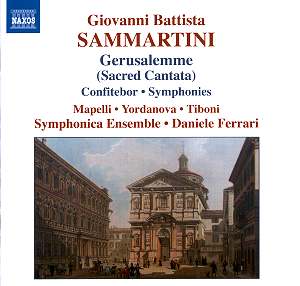

 Silvia Mapelli
(soprano); Miroslava Yordanova (mezzo); Giorgio Tiboni (tenor);
Filippo Ravizza (harpsichord)
Silvia Mapelli
(soprano); Miroslava Yordanova (mezzo); Giorgio Tiboni (tenor);
Filippo Ravizza (harpsichord)