MusicWeb is not a subscription site and it is these advertisers that pay for it. Please visit their sites regularly to see if anything might interest you. Purchasing from them keeps MusicWeb free.

Classical Editor: Rob Barnett                               Founder Len Mullenger


CD REVIEW


Online Count. There are currently : visitors. What this means.
Site Map

More Reviews

How to find a review

Classical CD Review Archive

Book Reviews

Film Music Reviews

Jazz CD Reviews

Nostalgia

Comment

Norman Lebrecht Weekly

Arthur Butterworth Writes

Phil Scowcroft's Garlands

Classical blogs

Reviewers Logs

Announcements

Don't Go Here!

Community

Bulletin Board

Web Ring

Reviewers

Helpers invited!

Resources

Quiz

British Composers

British Light Music Composers

Other composers

Indexes
   Label
   Masterwork

Discographies

On-line Music
[Download sites]

Themed Review pages

Our Classic Classics

Online books
MWI Classical
     Encyclopaedia

Gilder Dictionary of
     Composers

MWI Pop
     Encyclopedia

Other Complete Books

Programme Notes


British Music Society
Performers
The BBC Proms
Musical WWW pages
Classical Music Online

Recording Companies and Retailers
Agents and Marketing
Publishers
Non-Classical Web pages
Orchestra Web Sites
Newsgroups
Web News sites etc


Editorial Board
Classical Editor
   
Rob Barnett
Seen & Heard
Editor and Webmaster
   Bill Kenny
MusicWeb Webmaster
   Len Mullenger
Assistant Webmasters
   Patrick Waller
   David Barker

PotPourri
A pot-pourri of articles

MW Listening Room
MW Office
Helping MusicWeb
Advice to Windows Vista users  
Questionnaire    
Site History  
What they say about us
What we say about us!
Where to get help on the Internet
CD orders By Special Request
Graphics archive
Currency Converter
Dictionary
Magazines
Newsfeed  
Web Ring
Translation Service

Rules for potential reviewers :-)
Do Not Go Here!
April Fools

Would you like a hyperlinked weekly summary of the CDs we have reviewed?
Click for further details

Sample: See what you will get


alternatively AmazonUK   AmazonUS


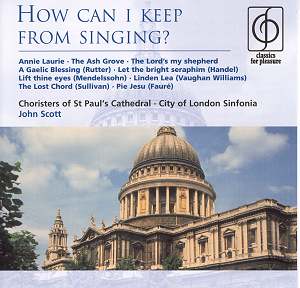
How can I keep from Singing?
Gabriel FAURÉ (1845-1924)
Pie Jesu
(Requiem) [3.25]
John RUTTER (b. 1945)
For the beauty of the earth
[3.35]
Hubert PARRY (1848-1918)
Long since in Egypt’s plenteous land
(Judith) [4.45]
Ralph VAUGHAN WILLIAMS (1872–1958)
The Call (Five Mystical Songs) [2.21]
Arthur SULLIVAN (1842-1900)
The Lost Chord
[5.13]
Stephen OLIVER (1950-1992)
How blest are they
[4.03]
Arr. John SCOTT (b. 1956)
Like a mighty river flowing [3.03]
George Frideric HANDEL (1685–1759)
Let the bright seraphim (Samson) [6.42]
Arr. John SCOTT(b. 1956)
The Ash Grove
[3.12]
James Leith Macbeth BAIN, arr. Gordon JACOB (1895-1984)
The Lord’s my shepherd
[3.45]
Ralph VAUGHAN WILLIAMS (1872–1958), arr. Julius HARRISON (1885–1963)
Linden Lea [3.07]
Arr. John SCOTT (b. 1956)
Annie Laurie [2.06]
Robert LOWRY (1826-1899), arr. John SCOTT (b. 1956)
How can I keep from singing?
[4.56]
Felix MENDELSSOHN (1809-1847)
Lift thine eyes (Elijah) [2.19]
Mark BLATCHLY (b. 1960)
For the Fallen
[5.13]
John RUTTER (b. 1945)
A Gaelic Blessing
[1.47]
Crispian Steele-Perkins (trumpet)
Andrew Lucas (organ)
Richard Moorhouse(organ)
Choristers of St. Paul’s Cathedral
City of London Sinfonia/John Scott
rec. St. Paul’s Cathedral, London, CTS Studios, Wembley, 15-17 July 1996. DDD

EMI CLASSICS FOR PLEASURE 0948 3 75942 2 3 [59.55]


The boy trebles at a Cathedral like St. Paul’s have a very active musical life. In addition to the normal round of services sung with adult altos, tenors and basses, there are also occasions when the trebles perform on their own. To this end, the choir has built up a repertoire of suitable pieces for trebles alone. 

This 1996 recording, with the choir directed by John Scott, displays the trebles in a programme of pieces either specially written for treble voices or arranged from other material. The result is a programme that is most definitely about the treble voice.

You might not always like all of the material on the disc and, more importantly, the various arrangements might not appeal, but there is no denying the superb quality of the treble voices.

The opening number, the Pie Jesu from Faure’s Requiem, is beautifully sung by soloist Anthony Way. I found it a little slow for my taste, but as an example of the art of the treble this could not be better. But you have to wait for the second track for the whole choir to sing. When they do, the results are spectacular, a fine sense of line, firm vocal tone and superb diction all combined into a thrilling whole.

But when singing John Rutter’s For the beauty of the Earth, you feel that this superb diction and disciplined line is not quite what this rather pop-inspired sacred song needs. Rutter’s piece is undeniably beautiful, but as sung here it rather outstays its welcome and you feel there is the nicest possible mismatch between the performers and their music 

Hubert Parry’s ‘Long since Egypt’s plenteous Land’ from Judith was a bit of a surprise. The melody was adapted to become the hymn tune Repton (‘Dear Lord and father of mankind’). As sung here, the original works very well but does slightly try the patience.

The Call’ from Vaughan Williams’s Five Mystical Songs is another surprisingly effective piece, with a lovely solo from treble Philip Martin. I felt that ‘The Lost Chord’ was performed too slowly, but John Scott’s arrangement of Sullivan’s popular song was ultimately very effective. 

Stephen Oliver’s ‘How blest are they’ was used in the RSC’s production of ‘Nicholas Nickleby’ but it works very well on its own. It is not as immediately appealing as the Rutter piece, but I think that ultimately it is a subtler piece and is far more suited to the chorister’s style of singing.

Oliver’s Handelian pastiche is followed by some real Handel, ‘Let the bright Seraphim’ from Samson with the whole choir singing the solo part. Inevitably the speed is a little slower than I would like, but the choristers’ achievement is remarkable.

The next group of pieces is possibly the most successful on the disc. All are either folksongs or folksong-like pieces. They are performed in straightforward arrangements which show off the choir’s sense of line and superb diction. John Scott’s arrangement of ‘The Ash Grove’ is a prime example of this artless pleasure. But equally successful are Gordon Jacob’s version of ‘The Lord’s my Shepherd’ using the tune Brother James’s air, Julius Harrison’s rather lush arrangement of Vaughan Williams’s ‘Linden Lea’ and John Scott’s reworking of ‘Annie Laurie’.

The CD’s title track, ‘How can I keep from singing’ belongs to the same category though it was unfamiliar to me. The words and music are by the 19th century American divine Robert Lowry.

For ‘Lift thine eyes’ from Mendelssohn’s Elijah the whole choir sings the trio and the recording utilises the acoustic of St. Paul’s to magical effect.

Mark Blatchly’s ‘For the Fallen’ is a setting of Laurence Binyon’s words, which are read at the Remembrance Day commemorations. Blatchly’s piece was written for the St. Paul’s choristers. But though I felt that it was appealing, it seemed to be straining for a meaningfulness that it does not quite achieve. The final piece on the disc is more Rutter, this time his attractive little Gaelic Blessing.

The disc was produced partly in order to benefit the St. Paul’s Choir School Foundation, which receives a royalty for each copy sold. So if you are interested in hearing some superb singing from one of the finest groups of trebles in the UK, then this disc is for you, as long as you don’t worry too much about the repertoire. 

Robert Hugill



Advertising Rates
Visitor stats
MusicWeb International
has over 21,000 Classical CD reviews on offer


Gerard Hoffnung Concerts &
The Bricklayer Story

Naxos Classical 

Australian Eloquence CDs on Buywell.com


New Releases

Hyperion
New Releases


Guild Music


23rd-27th May


MusicWeb sells the Polish
catalogue CDAccord
£10.50 post free W-W


MusicWeb sells the
Arcodiva catalogue
£12.00 post free W-W


Price Reduction: £11.75
post-free


Bull Horn
Price comparison Website


MusicWeb can now offer you discs from the following catalogues:
Prices include postage

[Acte Préalable £13.50]
[Arcodiva £12.00]
[Ashgate Music Books]
[Avie from £6.25]
[British Music Society £13.49]
[CDACCORD from £10.50 ]
[Hortus £14.99 ]
[Lyrita ONLY £11.75 ]
[Onyx £12.00
]
[REDCLIFFE £11 ]
[Tactus £11.50 ]
[Talent from £12.00 ]
[Toccata Classics £12.50 ]

MusicWeb Recommended Recordings 2007

DISCS OF THE YEAR 2007


Return to Review Index


Reviews from previous months
Join the mailing list and receive a hyperlinked weekly update on the discs reviewed. details
We welcome feedback on our reviews. Please use the Bulletin Board.  Please paste in the first line of your comments the URL of the review to which you refer..


You can purchase CDs and Save around 22% with these retailers: