Editorial Board
MusicWeb International
Founding Editor Rob Barnett Editor in Chief
John Quinn Contributing Editor Ralph Moore Webmaster
David Barker Postmaster
Jonathan Woolf MusicWeb Founder Len Mullenger
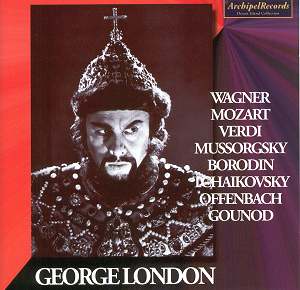
George London Wolfgang Amadeus MOZART (1756–1791) Le nozze di Figaro
1. Aprite un po’ quegli occhi [4:04] Don Giovanni
2. Là ci darem la mano [5:32]
3. Finch’ han dal vino [2:49]
4. Deh, vieni alla finestra [2:06] Jacques OFFENBACH (1819–1880) Les contes d’Hoffmann
5. Scintille diamant! [3:49] Charles GOUNOD (1818–1893) Faust
6. Vous qui faites l’endormie [2:55] Giuseppe VERDI (1813–1901) Aida
7. A te grave cagion m’adduce, Aida [8:01] Modest MUSSORGSKY (1839–1881) Boris Godunov
8. Boris’s monologue [5:47] Alexander BORODIN (1833–1887) Prince Igor
9. Prince Igor’s aria [7:40] Pyotr TCHAIKOVSKY (1840–1893) Eugene Onegin
10. Eugene Onegin’s aria [4:22]
11. Opera’s closing scene [9:33] Richard WAGNER (1813–1883) Die Walküre
12. Wotan’s farewell and closing scene [15:12] George London
(bass-baritone)
Irmgard Seefried (soprano) (2), Erich Kunz (baritone) (3),
Astrid Varnay (soprano) (7), Valerie Bak (soprano) (11)
Orchester des Wiener Rundfunks/Max Schönherr (1-3, 5, 6,
8), Orchester des Wiener Staatsoper/Karl Böhm (4), Orchester
des Bayerischen Rundfunks/Hermann Weigert (7, 9, 12); Richard
Kraus (10, 11)
rec. 18 October 1951, Vienna (1,3, 5, 6, 8); 6 November 1955,
Vienna (4); 5 October 1953, Munich (7), 3 October 1953, Munich
(9), 30 June, 5 July 1954, Munich (10, 11), 1953, Munich
(12)
trs. 2-4, 10-11 sung in German; the rest in the original
language ARCHIPEL
ARPCD0365 [71:58]
George London (1920–1985) was born in Montreal and started
out as a musical and operetta singer. He toured worldwide with
Mario
Lanza and Francis Yeend. In 1949 Karl Böhm engaged him to
the Vienna State Opera, where he made his debut as Amonasro
in Aida, a part from which we have a substantial extract
on this disc. He was Glyndebourne’s Figaro in 1951 and sang
at Bayreuth from the reopening year 1951 – Amfortas in Parsifal – until
1964. Wagner became one of his specialities: Holländer and
Wotan especially, both roles exist in complete recordings,
but his signature role was the title part in Boris Godunov.
He recorded a highlights LP in 1961 (see review)
and the year after the complete opera at the Bolshoi. Scarpia,
Mandryka and Don Giovanni were other important parts. His
was a powerful, dark-tinted bass-baritone, even though the
cover for the present disc designates him as a pure bass.
At the beginning of his career his was a pliant and glorious
ringing voice. As time went by it tended to gruffness and
with hindsight this might be related to the paralyzed vocal
cord that in 1967 ended his singing career.
On this disc he is caught ‘from the wing’ in Vienna and Munich during
the earliest years of his career. The exact provenance of
the recordings is not identified – the insert gives titles,
timings, dates and participants but no venues. The six titles
from the Wiener Rundfunk should be radio recordings, presumably
set down in a studio with an audience, but there seems to
be a great deal of acting, quite obtrusive stage noises and
since the two Don Giovanni excerpts (tr. 2, 3) include
quite extensive secco recitatives it is probably some kind
of staging. There are also heavy applause. The serenade (tr.
4), recorded with the State Opera Orchestra, ought to be
from the State Opera but there are no signs of action and
no applause. Sound quality varies a lot and there is a great
deal of distortion, overloading and the sound coming and
going, especially in the Mozart excerpts. The orchestras
are primitive sounding with thin, wiry string tone and they
are also rather distantly recorded, but the singers, and
especially London, are mostly clear and lifelike.
We also encounter some colleagues of London’s. Irmgard Seefried’s
Zerlina is enchanting (tr. 2) and Erich Kunz as Leporello
(tr. 3)
is as usual warm and lively. In the Aida duet we also
hear the great Wagnerian Astrid Varnay in the title role.
She is hardly Italianate and has her squally moments, but
this is high voltage singing from both parties and undoubtedly
thrilling. In the duet from Eugene Onegin we meet
the little known Valerie Bak as a vulnerable Tatiana.
But it is for London’s contributions that one wants this disc and readers
can rest assured that we are treated to strong, expressive
singing. There’s also excellent enunciation of the text,
whether in original languages or – in Don Giovanni and Eugene
Onegin – in German. He is a rebellious Figaro and a high-spirited
Don Giovanni but he is not very seductive even if he tries
hard. But getting his way with Zerlina is certainly hard
labour when he has to sing Reich mir die Hand, mein Leben instead
of La ci darem la mano. Dapertutto’s aria from Les
contes d’Hoffmann is gloriously sung at full volume but
the effect is reduced by the slow tempo. Mephisto’s serenade
from Faust has more life and his laughter is suitably
diabolic. His Amonasro is a formidable character but it is
Boris’s monologue from Boris Godunov that stays in
my memory. This is a rounded portrait where his singing has ‘face’.
His Prince Igor is unquestionably glorious but with so much
full-voiced singing it becomes a bit monotonous and one-dimensional.
He becomes more involved towards the end of the long aria.
His Eugene Onegin is again strong but lacking in poetry.
The final track, the end of Die Walküre, shows him
as a monumental Wotan. I greatly admired Sigurd Björling
recently in Karajan’s recording of the full third act from
Bayreuth 1951 (see review)
and London runs him close, though being more generalised.
The primitive orchestral sound is also an inhibiting factor.
Whatever the sources – the insert says cryptically “Issued from the original
sources” – it is a pleasure to hear such steady and attractive
bass-baritone singing. Admirers of this great Canadian should
give it a try. Others should search out some of his complete
recordings for – primarily – Decca. Once there also was a
Wagner recital on that label, conducted by Knappertsbusch,
which would be well worth reissuing..
Göran Forsling
Please support our advertisers below by clicking on the logos for further information.

























 George London
(bass-baritone)
George London
(bass-baritone)