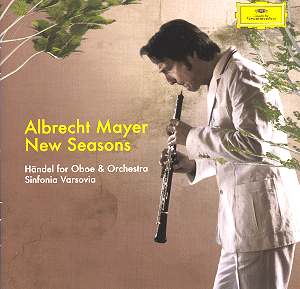
To address the main point immediately, this is beautiful music, beautifully
played. The featured soloist, Albrecht Mayer, produces a lovely,
liquid legato on his various double-reed instruments, and his
phrasing is lyrical and plaintive. The various assisting artists
are equally musical and technically accomplished - though in
track 8 I found the flutist's rubato fitful and distracting
- and the strings of the Sinfonia Varsovia provide handsomely
manicured support, with just the occasional mild gruffness in
the basses. If you enjoy polished, impeccably poised modern-instrument
Baroque, this issue recommends itself, and you needn't read
any further, though you probably will.
More historically-minded listeners, however, may well be wondering
from the headnote what exactly is on this disc. As the subtitles
of the "concerti" might suggest, Handel intended most
of this music for voices - specifically, as arias in his operas
- rather than for instruments . In his program note, Mayer explains
that these arias "captivated [him] years ago," and
he wanted to "give [them] his own voice" as an instrumentalist.
So, with the assistance of Andreas Tarkmann - who receives credit
for most of the actual arrangements - Mayer has found a way
to assimilate this music for his own use and, presumably, enjoyment.
Of course, to imagine that these new constructions can pass for "real"
Handel concerti involves a fair amount of wishful thinking.
The tripartite da capo (ABA) aria format doesn't transfer
successfully to instrumental music. After the strings' ritornello,
the soloist's immediate repetition of the same theme sounds
redundant; by the return of the opening "A" section,
so does the entire structure, especially when you string three
or four such pieces together. (And Mayer's ornaments, although
apt enough, are mushy in contour and not particularly "vocal"
in style, which can be bothersome in those arias one already
knows: his Iris, hence away wouldn't have given Marilyn
Horne any sleepless nights.) Nor is there any sense that the
movements of any one "concerto" particularly belong
together: the Water Music dance in track 12, for example,
could just as easily be a part of the Amabile beltà concerto,
on which it directly follows. The construction entitled Piagge
serene works best, simply because three of its four movements
are drawn from organ concerti rather than arias (but then whence
its title?).
Nonetheless, the custom of borrowing music, one's own or others' -
think of Bach's concerti on themes of Vivaldi - for diverse
uses was certainly alive and well in the Baroque, and these
transcriptions follow neatly in that tradition. Mayer and Tarkmann's
work here is arguably as valid as, say, Richard Stolzman's taking
over the Mozart flute concerto for his clarinet, or James Galway's
engaging in the reverse process. The musicologists wouldn't
approve - but I assume I lost them back in the first paragraph,
anyway, when I mentioned modern instruments. And the beautiful
playing is a pleasure.
The recorded sound beguiles the ear, though headphone listening betrays
a few otherwise well-concealed splices, and the bassoon assumes
an unduly pungent prominence in Piagge serene.
Stephen Francis Vasta