Editorial Board
MusicWeb International
Founding Editor Rob Barnett Editor in Chief
John Quinn Contributing Editor Ralph Moore Webmaster
David Barker Postmaster
Jonathan Woolf MusicWeb Founder Len Mullenger
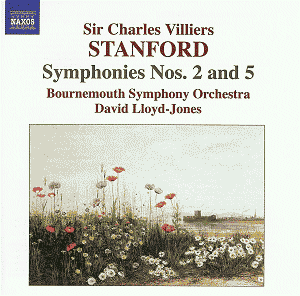
Sir Charles
Villiers STANFORD (1852-1924)
Symphony No. 2 in D minor, ‘Elegiac’ (1880) [34:46]
Symphony No. 5 in D major, ‘L’Allegro ed il Penseroso’,
Op. 56 (1894) [39:47] Bournemouth
Symphony Orchestra/David Lloyd-Jones
rec. The Concert Hall, Lighthouse, Poole, Dorset, UK, 29-30
June, 25-26 July 2006. DDD NAXOS 8.570289 [74:33]
Hot
on the heels of the first volume of the projected Naxos Stanford
symphony cycle (see review)
comes Volume Two, which again features David Lloyd-Jones at
the helm of the Bournemouth Symphony Orchestra.
The
Second symphony was premièred, under the composer’s baton,
in Cambridge in 1882 and there’s a passing link with the subsequent
première of the Fourth symphony in Berlin. In that latter concert
Joseph Joachim was the soloist in Stanford’s Suite for Violin
and Orchestra. Joachim also participated in the Cambridge concert
of 1882, playing the Brahms concerto on that occasion. Following
the first performance in 1882 there was another airing of the
Second symphony at the Gloucester Three Choirs Festival in
the following year. However, in his notes for Vernon Handley’s
1991 recording, Lewis Foreman states that he had been unable
to trace any further performances until 1990, when the Ulster
Orchestra gave it, presumably as a precursor to the Handley
recording for Chandos.
The
symphony bears the title ‘Elegiac’ and Stanford prefaced the
score with four stanzas from Tennyson’s poem, In Memoriam.
However, I’m bound to say that I find it hard to detect any
elegiac tone in the music itself. The first movement is marked Allegro
appassionato. It’s a vigorous movement in which one feels
the music is moving forward pretty constantly, culminating
in a dramatic coda.
The
main theme of the second movement, a Largo espressivo,
is rightly described by annotator Richard Whitehouse, as “both
graceful and expressive.” This is rather lovely music, which
consistently displays a singing quality. This is followed by
a genuine scherzo. The outer sections of this quite short movement
display a drive that is Beethoven-like. In between is encased
a brief lyrical trio but it’s noticeable that even here the
timpani maintain the rhythmic pulse underneath the music, albeit
quietly, for much of the time.
The
finale opens with an adagio introduction that has a decidedly
Brahmsian feel. Once the main allegro is reached that section
opens with some delightful wind writing after which the music
surges along with no little purpose. This finale has genuine
drive and momentum and it builds to a jubilant coda in which,
once again, I hear the influence of Brahms.
The
Fifth symphony dates from 1894 and Stanford drew his inspiration
from two poems by John Milton (1608-1674). He inscribed several
stanzas from each in the score and, helpfully, Naxos include
these verses in the English version of the booklet notes.
The
principal subject of the first movement, ushered in by the
woodwind at 1:45, is rather jolly. However, there had been
quite a degree of urgency to the brief introduction and this
urgency remains as a kind of background presence underpinning
the essential joviality of the movement as a whole. The music
has constant vitality and is fresh and enjoyable to hear. For
the second movement Stanford follows the precedent of Brahms
by writing an intermezzo, which bears the Brahmsian indication Allegretto
grazioso. Lewis Foreman described this movement in his
note for the Chandos-Handley recording as “a gently pastoral
minuet”. That’s not quite how it comes across in this present
performance, however. Lloyd-Jones adopts a slightly faster
speed than Handley – he takes 6:28 against Handley’s 6:56 – and
thereby gives the music quite a different character. I wouldn’t
presume to say which approach is better. To be truthful, I
think both work in their own way though I have a marginal preference
for the way the movement goes in Handley’s hands. The bottom
line is that both conductors are successful in bringing out
the genial character of the music.
The
third movement, Andante molto tranquillo, was inspired
by Il penseroso. Richard Whitehouse describes this movement
as “searching” and I agree. It begins with some fine, expansive
string writing, which is gradually enriched by the addition
of woodwind and horns. This is Stanford at his noble, expansive
best. At 3:47 Stanford introduces new material, with flute
and clarinet appropriately to the fore as he responds to Milton’s
lines about the nightingale, beginning “Sweet bird that shunn’st
the noise of folly.” This material is developed for a while
until, after a majestic passage for brass (around 6:00) the
opening lyrical material returns, but this time in even richer
guise and it’s with this that Stanford brings a most impressive
movement to a close.
There’s
a strange opening to the finale, featuring quiet, stabbing
chords. At 0:33 a restless melody in dotted rhythm appears,
first on the strings and then taken up by the winds but the
music doesn’t really seem to get into its stride until about
1:20. As the movement unfolds the tone becomes more assertive
though those stabbing chords keep cropping up. The last of
Milton’s stanzas quoted by Stanford begins “There let the pealing
organ blow” and Stanford does indeed add an organ to the orchestral
palette (at 8:10) though its initial entry is quiet, just gently
underpinning the orchestra. At 10:34 the full orchestra and
organ intone a majestic chorale and one thinks that this is
the Big Finish. Not so. The music winds down and Stanford brings
the movement instead to a rich, luminous but quiet conclusion,
which I find very satisfying and which aptly echoes Milton’s
words:
Dissolve
me into ecstasies, And
bring all Heav’n before mine eyes. It’s
not easy to place these two symphonies. Neither is the equal
of Elgar’s symphonies but they are far from negligible and
these admirable performances under the convincing leadership
of David Lloyd-Jones confirm that they do not deserve the neglect
into which they have fallen. Lloyd-Jones obtains fine playing
from the Bournemouth orchestra and, as with the previous issue
in this series, they have been accorded warm yet detailed sound.
This
is another distinguished instalment in this Stanford cycle.
Vernon Handley’s pioneering set (Chandos) is most certainly
not displaced but these Naxos recordings, and this latest one
in particular, can stand proudly shoulder to shoulder beside
them. Collectors who bought the earlier issue of the Fourth
and Seventh symphonies should not hesitate to add this companion
volume to their shelves. More please!
John Quinn
Please support our advertisers below by clicking on the logos for further information.

























 Bournemouth
Symphony Orchestra/David Lloyd-Jones
Bournemouth
Symphony Orchestra/David Lloyd-Jones