Every Italian composer of worth wanted to make
his debut at the Paris Opéra. The 1830s and 1840s were the golden
age there. With the benefit of the theatre’s facilities and
its musical standards, Auber, Meyerbeer and Halévy developed
opera with greater complexity and length and generally on a
scale previously unseen.
Verdi’s first invitation to Paris came in 1845,
shortly after the production of Giovanna d’Arco. At the
time he was fully committed in Italy and held out for two years
before accepting a definite engagement. Finally, with I Masnadieri
behind him, he signed a contract to provide an opera for the
autumn of 1847. He followed the example of Rossini and Donizetti
in modifying previous work by grafting on a new plot, composing
new numbers and adding a ballet. He considered the most suitable
of his previous eleven operas for this treatment to be his fourth,
I Lombardi, which became Jérusalem. The challenge
of Paris and its musical standards kept Verdi interested in
The Opéra, whilst Jerusalem was sufficiently successful
to keep the theatre management interested in the composer. Jérusalem
was to have been followed by a completely new Verdi work for
The Opéra. However, the dramatic upheavals and political unrest
in France, leading to the Second Empire in 1848, made that impossible.
Verdi did not return to Paris until 1852 when, during the composition
of Il Trovatore, he returned to negotiate a new contract.
The Opéra were desperate for a new Grand Opera, a work of four
or five acts with full ballet to be presented in 1855, the year
of the Grand Exposition. Fully aware of his own value in the
international market, Verdi drove a hard bargain. The full resources
of the theatre were to be put at his disposal and no other new
opera was to be performed at the theatre that year. Further,
Verdi would choose all the cast himself and there would be forty
performances guaranteed.
The composer was promised the services of Eugène
Scribe who had been librettist for Halévy and Meyerbeer for
their Parisian grand operas. This turned out to be a mixed blessing.
Verdi was hindered Scribe’s laziness and his duplicity when
the latter tried to palm the composer off with a libretto that
had been turned down by Halévy and later partially set to music
by the then ailing Donizetti as Le Duc d’Albe. Scribe
persistently failed to provide Verdi with a dramatically taut
final act. This lead to the composer demanding release from
the contract, as its terms, as originally stipulated by him,
had not been met. Eventually matters were resolved and the composer
and poet reconciled.
The plot of Les Vêpres Siciliennes is set in Palermo,
Sicily, in 1292 at the time of the French occupation and the
massacre of the occupying French troops. It was premiered at
The Opéra on 13 June 1855. Les Vêpres met with mixed reviews
in Paris although it played for the scheduled performances.
It was revived there in 1863, for which Verdi added new music,
but it was not destined to enter the charmed circle of Grand
Opera such as Meyerbeer’s Les Huguenots or Halévy’s La
Juive. It was not heard in France in its original language
after 1865. Despite problems with the censors an Italian translation
made an auspicious start in Italy with nine productions in different
theatres during the 1855-56 carnival season. The ‘Four Seasons’
ballet was eventually dropped in Italian performances. It is
in the Italian translation and under the title of I Vespri
Siciliani that the work, as in this performance, is generally
performed during the present day.
In the libretto the French Governor, Guy de Montforte,
recognises in Elèna whose brother has been executed by the French, a potential
insurgent and warns Arrigo
to keep away from her palace. Arrigo
loves Elèna and when Procida returns
to the island to raise the populace against the occupation the
three plot to kill Montforte. In a confrontation Montforte and
Arrigo realise that they are
father and son. The son saves the life of his father when the
plotters, lead by Elèna and Procida strike,
and is denounced by them. Elèna
forgives Arrigo when he reveals his paternity.
Montforte allows them all their freedom and gives his blessing
to the marriage of the lovers. It is only as they are about
to enter the church for the ceremony that Procida reveals that
the bells will be the signal for the Sicilians to rise against
their oppressors and slaughter the French.
Whilst Verdi is
renowned for his operas examining the father-daughter relationship,
Les Vêpres Siciliennes is one of the few in which
the composer focuses on that between father and son. Although
different facets of this relationship are to be found in I
due Foscari (1844), I Masnadieri (1847) and Luisa
Miller (1847), Montforte is the very first of Verdi’s lonely
figures of authority who have to weigh their love of wife, or
daughter or son alongside their duties to the state. Successors
are Simon Boccanegra (1857) and King Philip in Verdi’s
other Grand Opera for Paris, Don Carlos (1864).
My immediate thought
when coming to watch this DVD was how was an opera conceived
for the facilities of Paris’s ‘Grande Boutique’ going to be
staged in the tiny Teatro Verdi in Busseto. It has a very small
stage, a minuscule stalls area and three levels of boxes in
the usual semi-circular form. The theatre was built in Verdi’s
home-town against his wishes. At the time Verdi believed the
money should have been spent in support of an imminent war.
He later relented and sent a generous cheque and reluctantly
agreed to have the theatre named after him. Despite a box always
being available to him he never entered the building. It is
perhaps the smallest Italian theatre presenting opera. It does
so under the aegis of the Fondazione Arturo Toscanini and despite
fears over financial viability people flock to it season after
season. My worries as to presenting Grand Opera in the tiny
theatre with its small stage seemed compounded when I saw the
name of Pier Luigi Pizzi as Director, set and costumes designer.
It was he who fulfilled the same functions for the La Scala
production of 1989 - recorded on DVD Opus Arte OA LS 3008 D.
He set that production at the time of the opera’s composition,
with the French soldiery looking particularly smart. It was
in stark contrast with the production at Bologna directed by
Luca Ronconi which places the opera in its correct historical
period. This has the occupying French soldiers in chain-mail
and ‘metal’ headgear. They look rather heavy and ponderous in
the opening scene when the soldiers are supposed to be carousing
and propositioning the local women (review).
Here the problem is one of getting the French soldiers and the
watching Sicilian men in proximity to each other. Pizzi overcomes
the limitations of the size of the stage by imaginative use
of the auditorium. The Sicilian men are circled around the stalls,
sitting or standing with their backs to the lower tier boxes
all round the auditorium floor. They enter and leave by the
same door the audience uses. In the second act Pizzi extends
the stage along each side with a walkway, which Procida first
uses and then the others. Their hands nearly touch those of
the audience as they rest them on the box fronts. The video
director uses many close-ups of the singers. A slight downside
of the use of the walkway adjacent to the lower boxes occurs
during Elena’s act 5 aria Merce dilette (CH 2) when the
moustached male occupant of the box behind her, and his wife,
are as much in the picture as the soprano! At other times a
camera at the rear of the stage looks down on the participants
and out into the auditorium. This is used sparingly but to good
dramatic effect.
In this production
all the Sicilian men and the aristocrats, including Eléna and
Procida are dressed in dark blue. Arrigo’s blue uniform is hardly
distinguishable from the French soldiers. The small stage floor,
with a few steps and pillars, are all also draped in blue. The
only contrast of dress colour comes with the act 2 Tarantella
(CH 6), in the masked ball of act 3 when Arrigo thwarts the
attempted assassination of Montforte by his colleagues (Act
3. CHs 6-8) and the last act wedding scene.
In Les Vêpres
Siciliennes Verdi does not try to repeat the musical formula
of double aria and cabaletta seen in his immediately previous
great trio of Rigoletto, Il Trovatore and La
Traviata. Rather it is the first stage of the evolution
of style that he fully realised in Un Ballo in Maschera
three years later. There is a continuous flow of duets, arias
and scenes that move the story along. The orchestration is full
of drama and melody and Stefano Ranzani on the rostrum handles
the demands with aplomb helped by the Orchestra and Chorus of
the Fondazione Arturo Toscanini. But in this opera as in his
preceding three it is the singing of the soloists that makes
or ruins a performance. Whatever the budgetary limitations that
the Teatro Verdi operates under, they have managed to field
very adequate soloists in both the main roles and the comprimario
parts. Of the men, it is the Bulgarians Vladimir Stoyanov as
Montforte and Orlin Anastassov as Procida who impress most.
Each has impressive stage bearing, acts well and sings expressively.
Anastassov’s O tu Palermo (Act 2 CH 5) is sung with sonority
and excellent characterisation as well as some impressive mezza
voce. Stoyanov has a firm Verdi baritone and like his colleague
sings with variety of colour and expression. He conveys Montforte’s
character as he first realises that Arrigo is his son (Act 3
CHs 1-2) and later puts pressure on him to proclaim him as his
father, via singing as well as acting and deportment (Act 4
CHs 9-10). As Arrigo, the Venetian tenor Renzo Zilian has a
strong lyric tenor voice that he uses remorselessly. It is a
pity, as there is no spread at the top of his voice even at
full power, but characterisation, variety of modulation, colour
or expression of character are not his strengths. As a consequence,
much of Arrigo’s many emotions evident in the music go for nothing.
I am not surprised that he has gone on to sing Calaf in Turandot
and moved towards the tenore di forza repertoire. The two basses
cast as Bethune and Vaudemont, Cesare Lana and Lorenzo Muzi
both sing with sonority and character, whilst the chorus contribute
with vocal vibrancy and act with commitment.
The burden of the
singing on the female side is largely borne by the role of Eléna.
I had not previously heard Amarilli Nizza but I am mightily
impressed by her lyric soprano voice and her portrayal in this
performance. She acts convincingly and uses a wide range of
colour and expression in her singing. Add a good trill and well-controlled
vocalism in Merce dilette (Act 5 CH 2) and I was very
happy with her contribution. Of course this is a small theatre.
How she would fare in a larger auditorium I can only guess,
but on the basis of this performance she is a welcome addition
to the roster of sopranos in this repertoire. I shall look out
for her in the future.
As I have indicated,
Pier Luigi Pizzi’s direction and staging within the size limitations
of the Teatro Verdi is most impressive. The production brings
out the intimate issues and confrontations of Verdi’s creation
that can be lost on a larger stage. This is very true of the
confrontations between Montforte and his son. Pizzi handles
these with loving detail and the singers respond in their acting.
Similarly, I have rarely seen the role of Procida as so central
as is evident here; after all he is at the core of the opera
and his implacable character is vital to the dénouement of act
5. Such understanding of the music is not always evident in
producers, who far too often are concerned with concepts rather
than the music and the basics of the story. The sound on the
recording comes over remarkably well considering the challenge
of capturing voices from different parts of the theatre.
Robert J Farr












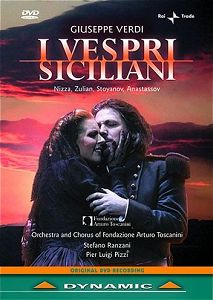

 Guido di Montforte, Governor of Sicily – Vladimir Stoyanov (bar);
Duchess El
Guido di Montforte, Governor of Sicily – Vladimir Stoyanov (bar);
Duchess El [159:00]