Editorial Board
MusicWeb International
Founding Editor Rob Barnett Editor in Chief
John Quinn Contributing Editor Ralph Moore Webmaster
David Barker Postmaster
Jonathan Woolf MusicWeb Founder Len Mullenger
Zarzuela Gerónimo GIMÉNEZ (1854–1923)
La Tempranica (1900)
1. Sierras de Granada [6:24] Federico Moreno TORROBA (1891–1982)
La Marchenera (1928)
2. Petenera (Tres horas antes del dia) [3:00] Pablo SOROZÁBAL (1897–1988)
Adíos a la bohemia (1933)
3. Recuerdas aquella tarde? [2:26] Francisco Asenjo
BARBIERI (1823–1894)
Mis dos mujeres (1855)
4. ¿Por qué se oprime el alma? [6:21] Jacinto GUERRERO (1895–1951)
La rosa del azafrán (1930)
5. No me duele que se vaya [3:30] Pedro Miguel MARQUÉS (1843–1918)
El anillo de hierro (1878)
6. Pasión del alma mia [5:30]
7. Lágrimas mias, en dónde estáis [3:17] Pablo SOROZÁBAL
La del manojo de rosas (1934)
8. No corté mas que una rosa [4:01] Manuel Fernández
CABALLERO (1835–1906)
Gigantes y cabezudos (1898)
9. ¡Esta es su carta! [5:17] Federico CHUECA (1846–1908)
and Joaquin VALVERDE (1846–1910)
La Gran Via (1886)
10. Chotis del Eliseo madrileño (Yo soy el Elisedo)
[4:28] Gerónimo GIMÉNEZ
La Tempranica (1900)
11. La tarántula (La tarántula é un bicho mu malo) [1:44] Manuel Fernández
CABALLERO
Château Margaux (1887)
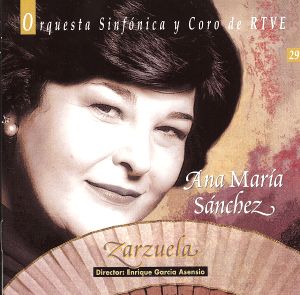
12. Siempre lo decia nuestra directora [3:41] Ana Maria
Sánchez (soprano)
Orquesta Sinfónica y Coro de RTVE/Enrique Garcia Asensio
rec. Teatro Monumental de Madrid, 12–16 July, 2004 RTVE 65225 [49:43]
I have to admit from the outset that I am not a specialist in
zarzuela. However, ever since I bought Victoria de los Angeles’ LP “A
World of Song” more than forty years ago I have been fascinated
by the genre. It was an album with songs from many countries
and in several languages, among them two zarzuela arias.
Just as Viennese operetta is quite distinct from French and
English light opera, the zarzuela is very distinctly Spanish,
which is obvious in most of these twelve tracks; not everywhere,
though. Historically the genre goes back to 1657 when King
Philip IV and his court attended a new comedy with music
by Juan de Hildago. For almost one hundred years zarzuelas
were in vogue and as late as 1786 Boccherini composed La
Clementina, which according to the real zarzuela guru,
Christopher Webber, is “a scandalously neglected masterpiece
of Spanish lyric theatre”. Italian opera took over. By the
middle of the 19th century, however, a new zarzuela
wave swept the country. Today we talk about “The Golden Age” which
lasted roughly to the turn of the last century.
Francisco Asenjo Barbieri is regarded as the most influential of these
early composers. There is one very early example of his music,
from Mis dos mujeres (tr. 4) – a lyrical aria with
a long beautiful cello solo, ravishingly played here by Suzana
Stefanovic. Particular Spanish flavour isn’t easy to detect;
it might just as well have been written by a Viennese or
Italian composer. If we move in time roughly 25 years forward,
to Pedro Miguel Marqués (tr. 6) this could be an unknown
aria by Bellini. During the early 20th century
a new generation of composers broadened and enriched the
genre. Two of the most important were Federico Moreno Torroba
and Pablo Sorozábal, both represented on this disc. They,
as well as many others often employed Spanish dances. Others,
notably Federico Chueca – often in collaboration with Joaquin
Valverde – introduced different dances: Polka, Waltz, Tango,
Jota, Mazurka, Chotis (Schottische) and March. A Chotis is
heard in the excerpt from their possibly best known work La
Gran Via (tr. 10), which strictly speaking isn’t a zarzuela
at all, rather a revista (revue) with no direct plot. It
is in effect a political satire, directed against the creation
of “La Gran Via”, Madrid’s equivalent to London’s Piccadilly
or New York’s Broadway.
Zarzuelas are composed even today. On a recent recital with Rolando
Villazon he included an aria from Luna, a zarzuela
from 1998 by José Maria Cano. While Viennese and French operetta
is played everywhere, zarzuela has never achieved much of
a foothold outside Spain. For the general non-Spanish public
it is primarily through leading Spanish singers that it has
become known at all. los Angeles, Caballé; Berganza, Kraus,
Domingo, Carreras and lately Villazon. Each has recorded
zarzuela arias and included them in their recitals. Now here
comes soprano Ana Maria Sánchez with another programme and
though there is inevitably some overlapping with other singers,
there are several things that I haven’t heard before.
Ms Sánches isn’t exactly new. She has been around since she won First
Prize in the International Singing Contest in Bilbao in 1992.
There have been appearances in many of the leading opera
houses in the world, including Madrid, Barcelona, Zurich,
Hamburg, Munich, Berlin, Florence, Venice, Buenos Aires and
the New York MET. She has a large vibrant voice of great
beauty and among her roles are Tosca, Aida and Norma, which
gives an indication of her type. Zarzuela singers are often
more light-voiced. Of course Caballé sang those roles too
but Ms Sánchez has a heavier voice, with even more heft in
reserve. ‘Reserve’ is an important qualification since she
employs her resources with the utmost discrimination and
has the ability that not all singers in the more dramatic Fach have:
to scale down the voice to proportions suitable for the repertoire.
It is true that her vibrato at forte and above can sometimes
be too generous. This is especially noticeable when one listens
to the programme in one sitting. At the same time she can
be thrillingly expressive – the aria from Guerrero’s La
rosa del azafrán (tr. 5), also recorded by Caballé, gets
a reading almost worthy a Turandot. Torroba’s Petenera (tr.
2), which is uncommonly dramatic for this genre, shows that
a voice of these dimensions pays dividends. There she is
also backed by an intense chorus. On the other hand she is
light and lively in La tarantula (tr. 11) sung with
tongue-in-cheek and almost challenging Victoria de los Angeles’ charming
recording.
The symphony orchestra and chorus of RTVE (Radiotelevisión Española)
ensure that the backgrounds are as authentic as possible.
Valencia-born Enrique Garcia Asensio, once Sergiu Celibidache’s
assistant, is one of the most experienced Spanish conductors.
He has been on the scene almost fifty years, having performed
all over the world and recorded extensively. In 1976 his
recording of zarzuela arias with Teresa Berganza and the
English Chamber Orchestra was awarded a Grand Prix du Disque
from L’Académie Charles Cros in Paris, which vouches for
his deep insight in this music.
Even though los Angeles, Caballé and Berganza still hold their own
in this repertoire, Sánchez is a thrilling alternative with
an extra dramatic frisson. She definitely requires to be
heard. I would have liked to hear a little more of her, since
the playing time is parsimonious. Interested readers should
be warned that this issue is aimed at the domestic Spanish
market. There are quite extensive biographical notes (in
Spanish only) on the singer, the orchestra and the conductor
but not a single word on the music and no texts and translations.
The brief historical background at the beginning of this
review has been compiled from an
enormously comprehensive website covering everything of interest
concerning zarzuela. Christopher Webber and friends are doing
a great job there.
Göran Forsling
Please support our advertisers below by clicking on the logos for further information.

























 Ana Maria
Sánchez (soprano)
Ana Maria
Sánchez (soprano)