Editorial Board
MusicWeb International
Founding Editor Rob Barnett Editor in Chief
John Quinn Contributing Editor Ralph Moore Webmaster
David Barker Postmaster
Jonathan Woolf MusicWeb Founder Len Mullenger
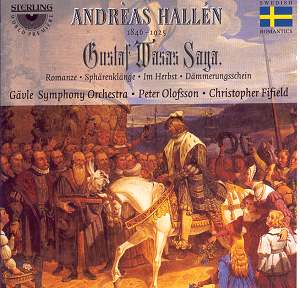
Andreas HALLÉN (1846–1925) Romanzefor violin and orchestra, Op.
16* [10:15] Gustaf Wasas Saga (1897): Das Morgenroth [6:08];Die
Vision [6:32]; Aufruhr zur Wehr [6:03]; Der
Einzug [3:46]; Per Aspera ad astra [8:03] Sphärenklänge(1895) [10:19] Im Herbst: two lyrical pieces, Op. 38:
Elfentanz in Mondeszauber [6:59]; Traumbilder in Dämmerungsschein [7:50] Dämmerungsschein, Op. 40, No. 2 [6:49] Peter Olofsson
(violin)*
Gävle Symphony Orchestra/Christopher Fifield
rec. Gävle Concert Hall, May-June 2006 STERLING
CDS 1070-2 [72:48]
Certain composers, who during their lifetime have been frequently
performed and highly regarded, tend to slip into oblivion
after their death. Others, sometimes not very successful
in contemporary musical life, grow in reputation when they
are gone.
Swedish composer, conductor, critic and teacher Andreas Hallén certainly
belongs to the former category. Born in Gothenburg on 22
December 1846 he was early recognized as a great musical
talent. He received his first musical training from the cathedral
organist in his hometown, Seldener, and was soon able to
stand in for his teacher. He then moved to Germany for more
advanced studies, where Reinecke in Leipzig, Rheinberger
in Munich and Julius Rietz in Dresden were his teachers.
After a couple of years in Gothenburg, where he re-organized
the Musical Society and formed a New Choral Society and performed
big choral works – Mendelssohn’s Elijah and Verdi’s Requiem among
them – he returned to Germany, mainly due to conflicts caused
by his terrible temper and unwillingness to compromise. During
the years 1879–1883 he worked as a singing teacher and got
to know more about current European music life than any other
Swedish composer – not least he got hooked on Wagner. On
his return to Sweden he settled in Stockholm, where, apart
from a few years in the south of Sweden, he stayed for the
rest of his life. He founded the Philharmonic Society and
was the person who, probably more than anyone else, established
Sweden as a country of choral singing. He gave the first
Swedish performances of Bach’s St. Matthew Passion.
He also served as conductor at the Royal Opera.
As music critic as well as composition teacher, where he could count
among his pupils Oskar Lindberg and Kurt Atterberg, he was
stubbornly conservative. This was after the turn of the century;
in his early years he was rather criticized for being too
modern. He is regarded as the first Swedish Wagnerian, which
is not very apparent from the music on this disc but is more
obvious in his operas where he uses leitmotifs. He composed
several operas, the first, Harald the Viking premiered
in Leipzig in 1881, conducted by Arthur Nikisch. His most
successful work was Waldemarsskatten (Valdemar’s Treasure)
in 1899, based on the medieval event when Danish king Valdemar
Atterdag plundered and burned Visby. It was played no less
than sixty times at the Royal Opera and later also in Karlruhe.
Among his other works can be mentioned a Christmas Oratorio (recorded
and available on Sterling CDS 1028-2) and a large oeuvre
of orchestral music. He wrote no symphonies but a number
of symphonic poems with influences from Franz Liszt. Other
early romantics, like Schumann and Mendelssohn, are also
important inspirations and with advanced age he also found
nourishment in Swedish folk music.
Listening to this CD one must regret that Hallén’s music mainly has
rested in the archives for so long time. It is well crafted,
has melodic appeal and his orchestration is inventive and
more colourful than practically anything written in Sweden
prior to Hugo Alfvén.
The Romanze for violin and orchestra, probably written in the
early 1880s, opens with dark brass chords, ominous even,
but then the solo violin shines through the clouds that part
to reveal a warm, Nordic landscape. After about four minutes
a fanfare announces a gear-shift to something livelier. Soon
we return to the mood of the opening. Gradually the music
grows in intensity to a climax with new, repeated fanfares
and so we end on a soft note in a lyric coda. Peter Olofsson
is a stylish soloist.
Gustaf Wasas Saga is an orchestral suite
from an extensive score for soloists, choir and orchestra,
written to tableaux by Daniel Fallström, from Gustaf Wasa’s
Saga for the celebrations of the 400th anniversary
of the birth of Gustaf Wasa, given at the Royal Opera. For
non-Swedish readers it might be appropriate with a short
history lesson:
From 1397 Sweden, Norway and Denmark were in a union, a mini-EU, where
the three countries were supposed to lead a joint foreign
policy while retaining the supremacy in domestic questions.
Although the document from the negotiations at Kalmar was
never fully ratified, it seems that in the main they tried
to follow the regulations, but not without numerous controversies
and even uprisings. At the beginning of the 16th century
this developed into actions of war. The Wasa family was one
of the more influential in Sweden and Gustaf a very active
rebellion, so much so that he was captured and imprisoned
in Denmark, from where he managed to escape and returned
to Sweden, just in time to hear the terrible news about the
Stockholm Blood-bath, where the Danish king, Christian “The
Tyrant”, had about 70 members of the most important families
in Sweden decapitated, among them Gustaf’s father and other
relatives. I should add that Christian “The Tyrant” is so
titled in Swedish history writing, whereas in Denmark he
is known as Christian “The Good”. In an attempt to effect
a rescue from the Danish invasion, Gustaf travelled north,
to the province of Dalecarlia, where the peasants were known
to be patriotic and earlier in history had taken part in
liberation activities against the Danes. After struggles
and disappointment – events that have become myth in Swedish
history – Gustaf was able to organise an army of Dalecarlian
men, who managed to defeat the Danes and liberate Stockholm.
In 1523 Gustaf was elected King of Sweden and then ruled
the country until his death in 1560, when the eldest of his
sons took over. Gustaf became a “father of his people”, the
creator of the first united Sweden. He put this hitherto
seriously under-developed country on the European map. He
ruled his people with a rod of iron and, especially during
his later years, met with disapproval and even serious uprisings.
Anyway he laid the foundation for Sweden’s rise during the
17th century to one of the great powers of Europe.
It is no wonder that his rule and his personality are surrounded
with an aura in Swedish history. In the late 18th century,
when his namesake Gustaf III was the ruler, Naumann’s opera Gustaf
Wasa became the Swedish national opera. Its revival
in the early 1990s showed that musically it has still a great
deal to offer, even though the premiere, which I attended,
was a catastrophe and was booed – which rarely happens in
Sweden. It was the fault of neither the music nor the singers – Nicolai
Gedda sang King Christian – but the staging. It quickly disappeared
from the repertory but was recorded in the studio by Virgin.
I don’t think it is available today but if it is reissued
I would advise readers to give it a listen.
Naumann’s opera deals with the occurrences around the liberation war
against the Danes, whereas Fallström’s and Hallén’s tableaux
cast the net a bit wider. The five movement suite recorded
here concentrates also entirely on the dramatic events during
the early 1520s. The first movement, “The Red Dawn of Freedom”,
depicts a spectacular sunrise followed by a pastoral morning
with prominent harp and woodwind. Little by little the sun
climbs higher and higher and the light – illustrated by the
strings – becomes brighter and brighter. “Vision” is calm,
beautiful and melodious in a kind of folk-tone. In the martial “Call
to Arms” there are fanfares en masse that in due time
develop into a theme that is more or less a direct quotation
of La Marseillaise. The fourth movement, “The Entry”,
also entitled “The Wasa March”, opens with the same theme.
This is a jubilant procession to celebrate that the Swedish
have defeated the Danes. The long concluding movement, “Through
Suffering to Renown”, takes us from the triumphant victory
that brought Gustaf Wasa to the throne, to the end of his
life, where, after more than 35 years in power, he looks
back on his career. The music very much reflects the mood
of an old man: sad, maybe disappointed but still conscious
of the great deeds he has done. Through the melancholy, light
thoughts and reminiscences brighten his mood. Brooding brass
harmonies alternate with sunny, transparent woodwind and
ethereal strings – is this a reference to the Lohengrin prelude?
Didn’t he come to save Mother Svea – the symbol of Sweden – just
as Lohengrin came to save Elsa? And weren’t they both rejected,
even though they both carried through their mission?
The same string sounds also open Sphärenklänge, which
is highly evocative music. The listener is gradually elevated
to the
spheres, carried on an orchestral fabric ever richer and
ever more harmonically luscious. The track-list states that
it was written in 1895 whereas the enormously knowledgeable
and reliable annotator Stig Jacobsson – from whose line-notes
I have drawn much of the information in this review – stated
that it was composed a full decade later. The Swedish standard
reference book Sohlmans musiklexikon confirms Jacobsson’s
statement.
“In Autumn” is the collective title of the two orchestral pieces Op.
38. The “Elves’ Dance in the Moonlight” is a gossamer light
ballet sequence, where the dancers’ feet initially hardly
touch the ground – which of course those of real elves never
should. This is depicted with such airy elegance that even
Mendelssohn in Midsummer Night’s Dream mood would
have been proud to have written it! The second piece, “Dream
Pictures at Twilight”, is certainly Nordic in character and
someone reasonably well oriented in Nordic music from a century
ago would probably at a blindfold test say Hugo Alfvén. Stig
Jacobsson goes along the same lines. It is beautiful and
melancholy!
The same mood is prevalent in “In the Twilight” for string
orchestra and here is an even more distinct feeling of Swedish
folk
song. I will definitely give my friends in the Dalecarlian
Chamber Orchestra a hint!
The sound is excellent, as always on Sterling’s records, and I would
like to praise the indefatigable Bo Hyttner, who has done
sterling - excuse the pun - service to music-lovers by rescuing
so much unjustly forgotten or neglected music. I have also
praised the Gävle Symphony Orchestra before, both on recordings
and in live reviews. Geographically they may be provincial,
musically anything but. Christopher Fifield, who besides
all his other activities is also one of my reviewing colleagues
here, ensures that this first class music is presented in
the best possible light.
Off the beaten track this may be, but anyone who for some reason has
left the main road on some occasion will know that there
are very often landscapes of enormous beauty to investigate.
This is such a landscape!
Göran Forsling
Please support our advertisers below by clicking on the logos for further information.

























 Peter Olofsson
(violin)*
Peter Olofsson
(violin)*