It
was on 17 March 1833 at Teatro della Pergola in Florence that
Parisina was first seen and heard. The libretto was written
by possibly the greatest librettist of the period, Felice Romani.
It is based on Lord Byron’s poem, to which there is a real-life
background during Niccolò III’s time; the early 15th
century. In brief the story goes as follows:
The
Duke of Ferrara, Azzo d’Este (baritone), is a hot-head, suffering
from jealous rages – a modern diagnosis might be ‘psychopath’.
He has remarried after the death of his first wife. Forced into
this marriage young Parisina is constantly sad – weeping is
second nature to her – since she is deeply in love with Ugo,
Azzo’s son from his first marriage. Azzo suspects that she is
unfaithful with Ugo and sends him away to the war, ordering
him never to return, which Ugo does anyway. At a tournament
Ugo is the winner and Parisina is the one who hands the trophy
to him. The ladies at court are amazed that she actually smiled
when she honoured him. At night Azzo creeps into her bedroom,
hears her whispering Ugo’s name and wants revenge. Ugo is thrown
in jail and decapitated and when Parisina sees his dead body
she also falls lifeless to the ground.
The
opera, Donizetti’s 36th, was a great success and
it was performed all over Europe, even reaching New York in
1850. After some decades it disappeared from the stage and wasn’t
revived until 1964. The recording issued here is from a concert
performance at Carnegie Hall a decade later, where it was mounted
as a vehicle for Montserrat Caballé, whose creamy voice was
in superb shape that evening: evenly produced, ravishing pianissimos
and a perfect trill. The role is not really in the virtuoso
class with breakneck coloratura and excursions into the stratosphere.
Instead it is bel canto in the real sense of the word
where phrasing, beauty of tone and a seamless legato are the
main ingredients. Ms Caballé never puts a foot wrong and the
audience is ecstatic during long rounds of applause, which could
have been trimmed a bit.
By
her side she has Louis Quilico as a sturdy and evil Azzo and
tenor Jerome Pruett as an ardent Ugo, light and lyrical and
with easy top notes. The young James Morris is an excellent
Ernesto, sonorous and powerful, and another relative new-comer
at the time, Eleanor Bergquist, reveals a fine bright voice
in what little she has to sing. I wonder what became of her
– the only other recording I can remember was Massenet’s Le
Cid on CBS, also conducted by Eve Queler, with Domingo and
Bumbry in the leading roles.
Eve
Queler has done sterling service in the operatic by-ways for
many years and she elicits freshness and forward movement in
her reading of a score that may not be one of Donizetti’s most
memorable. Nevertheless he is mostly reliable and there is some
inventive scoring. The chorus that opens the short third act
has a beautiful orchestral introduction and there are several
fine arias.
So
far so good then; where is the drawback? Since this is obviously
not a professionally made recording one has to be rather indulgent
about the sound. The orchestra sounds scrawny. There is some
overloading in concerted passages. The omni-present bumps and
coughs have to be contended with and, worst of all, a horrible
imbalance. The orchestral fortes tend to drown the voices –
the chorus are quite well caught, though. The soloists are so
variously recorded that some of them seem to sing off-stage.
I suspect that the recording was made from one of the front
rows in the stalls, probably acceptably centred. However, the
microphone was too directional and in the first act only Quilico
and Caballé – thank God – can be properly heard. Quilico and
Morris have a long duet scene where they seem to stand fifty
metres apart. When Ugo (Jerome Pruett) appears and has a dialogue
with Ernesto (Morris) both singers are somewhere in the wings.
Poor Eleanor Bergquist appears to be in her dressing-room. During
the interval before act 2, someone has, luckily, reshuffled
the chairs and suddenly James Morris is right on top of the
microphone allowing us to appreciate his healthy and generous
tone. On the other hand Jerome Pruett is left to his fate on
the outskirts of the stage throughout the performance.
I
used the singular form ‘microphone’ but I believe it is some
kind of primitive stereo recording. Probably an integrated stereo
microphone was employed and there’s evidence of this because
when I changed over to headphones, through which I heard most
of the opera, I got a feeling of space around the orchestra
and the singers. Even so I was not able to pinpoint directions.
It was very clear, though, that close to the right of me was
a man, seriously afflicted by laryngitis, who all through the
performance regularly coughed straight into my ear. I’m glad
I wasn’t there in person, but I could almost sense the viruses
flying around.
I
am afraid that this issue can be recommended only to die-hard
Caballé aficionados and even they have to be very indulgent.
This is a pity, since she sings so marvellously, but even though
I am a great admirer of Montserrat Caballé I will have to use
my persuasive powers quite extensively before I play it again.
The booklet, by the way, wasn’t that inspirational. A simple
tracklist, saying who sings where, but no timings anywhere.
There is a synopsis, but of the general kind that relates the
story but without specified references to the tracks; maybe
Keith Anderson at Naxos could provide a crash course?
Göran
Forsling
























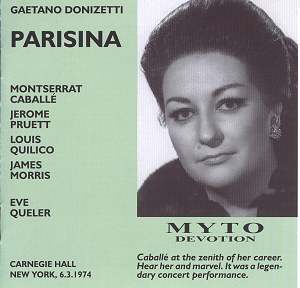

 Montserrat
Caballé (soprano) – Parisina; Jerome Pruett (tenor) – Ugo; Louis
Quilico (baritone) – Azzo; James Morris (bass) – Ernesto; Eleanor
Bergquist (soprano) – Imelda;
Montserrat
Caballé (soprano) – Parisina; Jerome Pruett (tenor) – Ugo; Louis
Quilico (baritone) – Azzo; James Morris (bass) – Ernesto; Eleanor
Bergquist (soprano) – Imelda;