Here’s an interesting
discovery, albeit one of relatively
minor proportions. I think it is safe
to say that Antoine Dard is a name unknown
to all but specialists learned in the
music of eighteenth century France.
He has no entry in Grove. Nor, indeed,
does his publication of 1759 Six
Sonates pour le basson ou violencel
avec la Basse Continuë get
even a mention in Grove’s survey of
the early repertoire for the bassoon.
Given his relative
obscurity, some biographical information
on Dard – scant as it is – is perhaps
in order here. I am indebted to the
booklet notes by Youri Carbonier for
such facts and suppositions as are summarised
in what follows.
Dard was born in the
village of Chapaize in Burgundy. Perhaps
– there is no documentary evidence –
he received his musical training at
the cathedral in Mâcon or in Dijon.
We do know, at least, that he got married
in 1734. by the end of the 1750s he
was in Paris – though how long previously
he had made his way to the capital is
unknown. In 1760 he was appointed as
5th bassoon in the orchestra
of the Royal academy of music. Fairly
quickly he rose to become section leader.
He was soon one of the musiciens
du Roi de Paris. In 1763 he bought
the position of Grand hautbois de
la Chambre et Écuries de Roi.
By the end of the 1770s his name
disappears from the list of those performing
at court and opera house.
Little of Dard’s work
as a composer survives: a few vocal
compositions, some sonatas for flute
and these sonatas for bassoon. On their
publication in 1759 they carried a prefatory
note which stated, amongst other things,
that the volume had been judged ("by
several farsighted persons") to
be "indispensable, or at least
very useful, to those who would acquire
a perfect knowledge of the Bassoon,
the only instrument for which, at present,
no other composer has written".
It wasn’t, of course, true that no one
else had written for the bassoon: some
thirty-seven concertos by Vivaldi come
to mind; Giovanni Antonio Bertoli had
published sonatas for the instrument
as long ago as 1645; Telemann’s Sonata
in F minor appeared in 1728; even in
England, Johann Ernst Galliard had published
a set of six bassoon sonatas in 1733;
in France Boismortier had published
duets for two bassoons in the 1720s;
and these were by no means the only
works written for the instrument. Still,
even if they weren’t as ground-breaking
as these "farsighted persons"
seemed to think (or as Dard thought
it sensible to pretend?), the sonatas
are of considerable interest.
They are interesting
for several reasons. The printed version
includes written-out ornamentation and
articulation marks for each note; Dard’s
prefatory note tells the possible purchaser
that "these sonatas have been supplied
with fingerings and phrasing" and
assures the reader that "nothing
has been committed to paper without
first having been played many times
on the instrument". Though Dard’s
title page may declare that these are
sonatas for bassoon or cello, they seem
very much to have been conceived in
terms of Dard’s own instrument. Dard
makes more extensive use of the instrument’s
upper register than was at all common
in the period, giving a distinctive
quality to his work. Strikingly, the
slow movements are through-composed,
making no use of repeats.
The writing for the
bassoon is often decidedly lyrical and
there is much to enjoy here. All save
the first sonata are in four movements
(the first having three). There is little
here of what the English poet Lemuel
Abbott, writing in 1765, called "the
grumbling grave Bassoon". Dard’s
writing – and the playing of Ricardo
Rapoport and Pascal Dubreuil – are far
too galant for adjectives like
"grave" and "grumbling"
to be at all apt. The gavottes in Sonata
4 and the allegro gratiozo in Sonata
2 make the instrument dance without
the slightest hint of excessive or inappropriate
gravity. Of a character in one of the
novels of Tobias Smollett (an approximate
contemporary of Dard) it is said that
"his voice resembled the sound
of a bassoon, or the aggregate hum of
a whole bee-hive". There is nothing
of the bee-hive to be heard here; Rapoport’s
tone is beautifully clear, his phrasing
utterly precise, without mere pedantry.
The decision to use only a harpsichord
for the continuo proves successful.
Rapoport explains that it allows "for
more freedom and fantasy in interpretation,
as well as transparency" and the
result justifies his claims. Rapoport’s
instrument, by the way, is a copy by
Oliver Cottet of a bassoon by Prudent
of around 1760 – just right for the
music. Dard’s prefatory note, to return
to it for a last time, speaks of the
desirability of performers bringing
to the works "the necessary lightness
and feeling". Rapoport and Dubreuil
very definitely do so.
The six sonatas are
interleaved, as it were, with four short
songs by Dard, pleasantly sung by Karine
Sérafin, accompanied by Dubreuil
(who plays an attractive sounding copy,
by Titus Crijnen of a 1624 instrument
by H. Ruckers II) and – on some tracks
– by the flute of François Nicolet.
No very great claims need be made for
the songs – they are very much of a
muchness with many other songs of their
time and place – but they are attractive
trifles and add a pleasing variety of
sonority to a very interesting CD.
Glyn Pursglove
























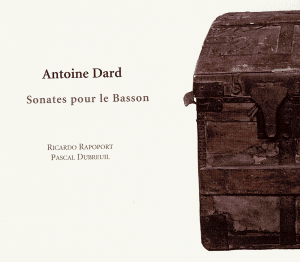
 for details
 Ricardo Rapoport (bassoon); Pascal Dubreuil
(harpsichord); Karine Sérafin (soprano);
François Nicolet (transverse flute)
Ricardo Rapoport (bassoon); Pascal Dubreuil
(harpsichord); Karine Sérafin (soprano);
François Nicolet (transverse flute)