Editorial Board
MusicWeb International
Founding Editor Rob Barnett Editor in Chief
John Quinn Contributing Editor Ralph Moore Webmaster
David Barker Postmaster
Jonathan Woolf MusicWeb Founder Len Mullenger
Robert
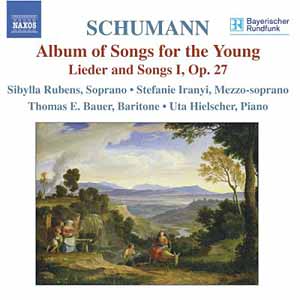
SCHUMANN (1810–1856) Lieder Edition 3 Liederalbum für die Jugend, Op. 79 (1849)
[49:15]:
No. 1. Der Abendstern [2:18];
No. 2. Schmetterling [0:51];
No. 3. Frühlingsbotschaft [0:57];
No. 4. Frühlingsgruss [1:45];
No. 5. Vom Schlaraffenland [1:52];
No. 6. Sonntag [1:50];
No. 7. Zigeunerliedchen I [0:58];
No. 8. Zigeunerliedchen II [1:35];
No. 9. Des Knaben Berglied [1:58];
No. 10. Mailied [1:07];
No. 11. Käuzlein [2:13];
No. 12. Hinaus ins Freie! [1:18];
No. 13. Der Sandmann [2:08];
No. 14. Marienwürmchen [1:35];
No. 15. Die Waise [2:10];
No. 16. Das Glück [0:52];
No. 17. Weihnachtlied [1:48];
No. 18. Die wandelnde Glocke [2:04];
No. 19. Frühlingslied [2:45];
No. 20. Frühlings Ankunft [1:33];
No. 21. Die Schwalben [1:06];
No. 22. Kinderwacht [1:14];
No. 23. Des Sennen Abschied [2:04];
No. 24. Er ist’s [1:20];
No. 25. Spinnelied [1:47];
No. 26. Des Buben Schützenlied [1:00];
No. 27. Schneeglöckchen [1:25];
No. 28. Lied Lynceus des Türmers [2:07];
No. 29. Mignon [3:34]; Lieder und Gesänge I, Op. 27 (1849)[8:49]:;
No. 1. Sag an, o lieber Vogel mein [1:40];
No. 2. Dem rotten Röslein, gleich mein Lieb [1:16];
No. 3. Was soll ich sagen? [2:53];
No. 4. Jasminenstrauch [0:48];
No. 5. Nur ein lächelnder Blick [2:13] Sibylla
Rubens (soprano) (2, 4, 10-11, 13-16, 19, 21, 24, 25, 27,
29); Stefanie Iranyi (mezzo) (10, 16, 19, 21, 25);
Thomas E Bauer (baritone) (1, 3, 5-9, 12, 17-18, 20, 22-23,
25-26, 28, 30-34); Uta Hielscher (piano)
rec. 26 – 28 January 2006, Bayerische Rundfunk Studio 1,
Munich, Germany NAXOS 8.557076 [58:04]
Liederalbum für die Jugend (Album of Songs
for the Young) was published in 1849 as a kind of sequel
to Album für die Jugend (Album for the Young) – a
collection of piano pieces. The aim and the main structure
is the same with both collections: providing young people
with music for gradual development of technical skill and
musical insight. That the Liederalbum is rarely performed
is mainly due to the fact the earlier songs are too slight
in content for grown-ups while the later ones are too testing
for young performers. In the last handful we find settings
of Mörike and Goethe that are anything but children’s music.
This notwithstanding the collection is brimful with attractive
songs, melodically appealing, that should be heard more often,
at least when sung as on this disc: simply, naturally and
with no attempts to invest more meaning than the text and
the music can bear, but all the time with immense care for
phrasing and nuances. Of course this isn’t a song-cycle and
it would not be a good idea to perform the 29 short songs
in the published order at a live recital, no more so than
playing all the 153 pieces of that other great pedagogical
work, Bartók’s Microcosmos from beginning to end.
On the other hand a judiciously picked group of contrasting
songs would no doubt be an asset to any song recital. Of
the individual songs I at once fell for the first one, Der
Abendstern, a wonderful melody, sung unaffectedly and
with warmth. Der Sandmann is another gem, just as Frühlings
Ankunft, filled with expectancy, and the messengers of
summer, Die Schwalben (The Swallows), nervously flying
back and forth. As a ‘filler’ we also get the five Lieder
und Gesänge I, published the same year. Since it seems
that the many songs written during the ‘Lieder Year’ 1840,
tend to overshadow Schumann’s remaining output. They are
also infrequently heard – the best known probably No. 4, Jasminenstrauch. But
all of them are worth hearing, especially when sung with
such exquisite shadings as here by Thomas Bauer, who is rapidly
rising to the peak of the Lieder singers’ Helicon.
He has been entrusted with the lion’s share of the songs
on this disc and what he does here is unerringly right. He
has a voice
of exceptional beauty and his mezza voce, which he employs
on a majority of these songs, is so mellifluous, yet with
an inexhaustible supply of colours. And when it comes to
songs that require more power he is just as apt. I hope he
will be the choice singer for the rest of this Schumann cycle.
Sibylla Rubens has all the attributes to go the same way
as Thomas E Bauer – whose ‘E’ has been inserted again, having
disappeared on the last disc that came my way. She has a
lyrical voice,
beautiful with an attractive vibrato, beguilingly twittering
in Schmetterling and with an ability to lighten the
tone further when needed, as in Der Sandmann, where
she sounds appropriately boyish. She also has the means to
do full justice to a dramatic and serious song such as the
Mörike setting Er ist’s, better known in Hugo Wolf’s
version.
The third singer, mezzo-soprano Stefanie Iranyi, takes part in a handful
of duets with Sibylla Rubens and hers is also an attractive
voice, which blends well with that of the soprano. The two
ladies also participate as chorus in the refrain of Weihnachtlied.
According to both the track-list and the liner-notes Spinnelied is
a trio, but I couldn’t hear the baritone.
Sonically it is up to Naxos’s normal good standards, but
in one instance, the first of the two Zigeunerliedchen (tr. 7), there
is a change of perspective, making it seem much closer. Most
of the accompaniments are quite simple but they are played
with conviction by Ute Hielscher, who is balanced on equal
terms with the singers.
There are good liner-notes by Gerhard Dietel but texts and
translations are only available as downloads, a nuisance
that has been
pointed out on more than one occasion by myself as well as
several of my colleagues, not least Chris Howell. Printing
them out one gets a nice bunch of 18 pages but these have
to be housed somewhere. Having reviewed quite a number of
Naxos recordings of operas and other vocal music, my shelves
would have sagged, had I printed everything – and I know
of no-one who enjoys following librettos on the computer
screen.
Do regard the previous paragraph as general criticism, not directed
specifically against this issue, which on all other accounts
is a winner from beginning to end. The Liederalbum für
die Jugend should ideally be sampled a few songs at a
time but I played the full 49 minutes at one sitting – plus
the Op. 27 songs – and didn’t encounter a dull moment.
























 Sibylla
Rubens (soprano) (2, 4, 10-11, 13-16, 19, 21, 24, 25, 27,
29); Stefanie Iranyi (mezzo) (10, 16, 19, 21, 25);
Thomas E Bauer (baritone) (1, 3, 5-9, 12, 17-18, 20, 22-23,
25-26, 28, 30-34); Uta Hielscher (piano)
Sibylla
Rubens (soprano) (2, 4, 10-11, 13-16, 19, 21, 24, 25, 27,
29); Stefanie Iranyi (mezzo) (10, 16, 19, 21, 25);
Thomas E Bauer (baritone) (1, 3, 5-9, 12, 17-18, 20, 22-23,
25-26, 28, 30-34); Uta Hielscher (piano)