Back
to Chapter 3
4
Starting out
The BBC Symphony Orchestra in Bristol
and Bedford. Small ‘orchestras’ in restaurants – Lyons Corner Houses
– Alfredo Campoli, Albert Sammons, Max Jaffa. Author at Royal College
of Music. Many musicians now in the armed forces provides author with
opportunity of professional experience that leads to full-time orchestra
employment
In September 1941 I was standing at
the top of the steps behind the Royal Albert Hall facing the imposing
but not unfriendly facade of the Royal College of Music. I was full
of hope, confidence, and the ignorance of youth. I was to study clarinet
with Frederick Thurston, principal clarinet of the BBC Symphony Orchestra
and an established soloist. My second study was piano, and for this
Mr Harry Stubbs was to be my kindly but unsuccessful guide. There
were to be history lectures and theory and aural training sessions,
and also the opportunity to play in one of the orchestras. As I set
off down the steps and approached the doors of the RCM I thought,
‘this is it! I’m on my way.’ I was going in the direction I wanted
to go, but, as always, I had no idea of what or where it might lead.
Early that morning I had left Bedford,
where, the BBC Symphony Orchestra had been moved and where my family
were now living, and travelled by train to St Pancras station in London.
This was a journey I would do several times a week in the coming year,
an empty first-class compartment often providing an impromptu practise
studio. The LMS (as it then was) rolling stock was no better than
the current privatised rail companies’, making embouchure control
(the subtle formation of the lips and muscles around the mouthpiece)
difficult. Still, it was possible to make up for lost time, when scales
or arpeggios had received less attention than they needed.
The BBC Symphony Orchestra were now
stationed in Bedford, then a quiet and attractive county town. In
1939, very soon after the outbreak of war, the orchestra had been
evacuated to Bristol. The BBC orchestras, resident in London before
the war, had all been relocated; the Symphony Orchestra, the Theatre
Orchestra (later renamed the Opera Orchestra, and now called the Concert
Orchestra), and the Variety and Revue Orchestras, (both disbanded
many years ago), were all sent to Bristol. At that time, before the
bombing had destroyed the oldest and loveliest part, Bristol was especially
beautiful, and even now, in my view, it remains one of the most agreeable
cities in Britain. Many years later it was, for a time, a very important
city for me.
In their wisdom the BBC chose the
CWS (Co-operative Wholesale Society) building as the headquarters
for the Symphony Orchestra, and made the top floor into their studio.
This had to be abandoned fairly soon as the frequent air-raid warnings
required the conductor and orchestra to yo-yo up and down five or
six floors, from the studio to the air-raid shelter in the basement.
For the next year or so the orchestra
used various churches for studio broadcasts, and the Colston Hall
for their season of public concerts, before relocating to Bedford,
where they remained until the end of the war. The old Hall was excellent
with good acoustics. Later I played there many times with the London
Philharmonic. It survived the bombing, but in February 1945 before
the end of the war it was accidentally destroyed by fire, (as the
original hall had been). In 1951 I played at the opening of the present
Colston Hall, in a concert given by the Royal Philharmonic, conducted
by Sir Thomas Beecham.
Playing in orchestral concerts in
the Colston Hall, or anywhere else, still lay a few years ahead, though
in fact it was to be much sooner than I could have imagined as I stood
outside the Royal College of Music on that first day and daydreamed
of things to come. A combination of circumstances beyond my control
led to me remaining at the College for only one year. After two years
of war a great many musicians had been called up and were in the Army,
Navy, or Air Force. A number of them had joined or been posted to
line regimental Military Bands, or the various entertainment units
formed to entertain the troops. Many of the best younger wind players,
had joined Guards’ Bands and the RAF Central Band, all stationed in
London. In fact the RAF Central Band attracted a number of outstanding
string players, too. It was their absence that gave me the opportunity
in 1942 to join the Wessex Philharmonic Orchestra, based in Bournemouth.
As well as the musicians in the Bournemouth
Municipal Orchestra there were a number of other musicians working
in Bournemouth. In most English towns of any size at that time there
were still musicians playing in theatres, music halls and in restaurants.
It was the custom, one that finally died out around 1950, for the
larger restaurants and cafes, serving the ‘carriage trade’, to have
a small ‘orchestra’. It was also usual for most large Department Stores
to have a restaurant with its own small ‘orchestra’. The number of
musicians would usually be between two and five, depending on the
size of the restaurant.
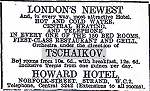
Joseph Lyons, whose world famous Corner
Houses in London were the flagships of his vast empire of Tea Shops
throughout the country, employed 500 musicians on a full-time basis
– as many as the BBC in its heyday employed on contract. In some of
the Lyons Corner House orchestras there were as many as twelve players,
and perhaps a singer as well. These orchestras played a very large
and varied repertoire, ranging from Novelty numbers, such as The
Teddy Bears’ Picnic, and The March of the Little Tin Soldiers,
to selections from popular ballets – Coppélia, Swan Lake,
or The Dance of the Hours, and operas – Pagliacci, La Bohème,
Rigoletto, and even Rienzi. The Slavonic Dances by
Dvorak, Hungarian Dances by Brahms, and some of the shorter
Classics by Haydn, Mozart, Beethoven and Schubert rubbed shoulders
with selections from The Merry Widow, The Student Prince,
and Chu Chin Chow.
When I was a child, my mother would
occasionally take me on a shopping expedition to the ‘West End’ of
London. I hated these visits. My especial hate was Oxford Street where
I trudged along, down amongst a forest of legs, seeing nothing, and
with no one to talk to. My mother and her friend would be chattering
away and enjoying the shop windows way above my head – with only Mummy’s
hand to assure me that I was not totally abandoned. There was one
redeeming feature to these dreadful visits: at some point we would
leave the horrors of the pavement to enter what seemed like an enchanted
palace. It was brightly lit and everything sparkled; there were great
columns from the floor to the high ceiling, with golden decoration,
and the walls and floor were richly coloured. Wherever you looked
there were counters laden with foodstuffs of every kind. There were
boxes of chocolate and sweets, cakes of every size and description
– piles of little cakes covered in ‘hundreds and thousands’, or with
cherries on top; birthday cakes and wedding cakes like castles. Piles
of buns, rolls, croissants, macaroons, biscuits large and small, loose
or in decorated tins and packets, all inviting and tempting. There
were counters with every sort of delicatessen – less inviting to me
– with fancy bottles, tins, and packets of roll mops, anchovies, caviar,
tongues, hams, exotic oils and sweetmeats. The display seemed never
ending.
This was one of Mr Joe Lyons’s famous
Corner Houses. We usually went to the one in Tottenham Court Road.
As in all the Corner Houses there were several restaurants of different
sizes in the same building, each with its own orchestra. We went to
the one that served afternoon tea because it was there that my Uncle
Jimmy conducted and led one of the orchestras, as his father had done
years before on the pleasure boats on the Black Sea.
A smartly dressed man or lady (one
can hardly refer to someone so grand as a ‘woman’), would direct us
to our table. We always asked for one near the band, so that we could
see and hear Uncle Jimmy – no doubt there will have been some who
asked to be as far from the band as possible! – though on the whole,
people went to a Lyons Corner House because it was special; not only
did you get excellent food, you were waited on with style and civility,
and you had musical entertainment as well, and all at a modest price.
Uncle Jimmy was considered to be good-looking,
and as was the custom ‘played to the ladies’, directing some sweet
and charming melody in their direction. The orchestra’s efforts would
generally be rewarded by discreet and genteel applause. On the one
or two occasions when my father accompanied us, he was always determined
that the band should receive greater recognition. He would clap with
considerable vigour; some of those enjoying their tea and seated nearby
would be startled; others, thinking something was going on that they
should be part of would join in. After several items the applause
had grown considerably and by the time we left it was tumultuous.
During each ‘set’ the conductor/leader
would be expected to play a couple of solos, though each and every
piece was, to all intents and purposes, a ‘concerto’, since the leader
played the first violin part on his own a very great deal of the time.
But that wasn’t enough. He (it was almost always a ‘he’, though there
were some Ladies Orchestras), would play one of the charming pieces
by Fritz Kreisler, the great violinist, or one of the popular encore
pieces – Meditation from Thais, by Massenet, or perhaps
The Flight of the Bumble-Bee. In the best groups, if he was
a really good player, he might include a movement from a concerto;
perhaps by Max Bruch, the Mendelssohn, or one by Wieniawski.
 |
|
Click
for larger picture
|
Some outstanding violinists played
in restaurants and cafés: de Groot, Albert Sandler, Alfredo
Campoli (who subsequently had a long and distinguished solo career),
Max Jaffa, and Albert Sammons, who was probably the best of them all.
Later he was to become Beecham’s first Leader, before becoming a very
successful and popular soloist. I remember his performance of the
Elgar and Mendelssohn Concertos with particular pleasure, from my
earliest days in the orchestra. He was also highly respected as a
teacher, and is fondly remembered as a professor at the Royal College
of Music.
In 1939, when the war started, virtually
all the seaside orchestras were disbanded. Even the Bournemouth Municipal
Orchestra with its long history and considerable reputation, which
unlike the other seaside orchestras employed musicians throughout
the year, was forced to severely reduce its numbers. The players who
had been made redundant by the Municipal Orchestra quickly formed
a rehearsal orchestra, so as to keep in practise. They invited some
of the best musicians who were playing in the theatres and the restaurant
and café orchestras in the town and a few of the local instrumental
teachers to join them. Two ladies living in Bournemouth heard about
this group and decided to provide the money for them to put on a concert
and appointed a young conductor, Reginald Goodall, to be its Music
Director. They named the orchestra The Wessex Philharmonic. The extra
players that were required were mostly recruited from students who
were in their final year at the Royal College and Royal Academy of
Music.
Many years later Goodall found fame
conducting at the English National Opera and the Royal Opera House.
His interpretations of the Wagner operas in particular were much admired.
He was knighted in 1986. In 1939, when the Wessex Philharmonic Orchestra
(later called the Bournemouth Philharmonic Orchestra) was formed,
he was inexperienced, profoundly musical, and technically maladroit,
as far as his control of the baton was concerned. He became increasingly
experienced, and developed into a remarkable musician. Only his stick
technique did not improve.
Whilst still in my first year at the
Royal College of Music I heard about this orchestra from one of my
fellow students, a composer/pianist, who also played percussion in
the College orchestra. He told me that he had been to Bournemouth
to play in this orchestra, and that it rehearsed on Friday evening,
had two more rehearsals on Saturday, and a rehearsal and concert on
Sunday. Sometimes this concert was repeated in a nearby town on Monday.
And you got paid! Not Musicians’ Union rates – about which I knew
nothing – but it sounded like a king’s ransom to me.
Without giving any thought to my suitability,
I asked my friend, ‘Do you think there is any chance that I could
play in this orchestra?’ ‘I’ll ask Mr Goodall,’ he said, ‘he comes
into College from time to time.’ Some weeks later my friend told me
that he had spoken to Mr Goodall who had said he would be willing
to hear me play and that I should prepare some music and be ready
to play for an audition in about ten days’ time.
I was so keen to do this entirely
on my own that I decided not to tell my father or my RCM Professor,
Jack Thurston (he was always called Jack by his friends and colleagues,
though his name was Frederick). The relationship between Thurston
and my father – both principal clarinettists in the BBC Symphony Orchestra
– had caused some tension in my College lessons. My father’s remarkable
virtuosity, especially his ability to play fast staccato passages
(involving the rapid tonguing of detached notes) was envied by Thurston,
and Thurston’s senior position as, ‘First’ principal in the section,
was resented by my father. Sometimes, when I wanted help with a technical
problem Thurston would say, ‘ask your Dad – he’s the one with the
technique!’ When I asked ‘Dad’ he’d say, ‘You’re having lessons with
Mr Thurston, ask him.’ So, though my teacher had sufficient confidence
in me to allow me to teach his daughter, I never had the sort of confidential
relationship with him that I tried to achieve with my own pupils.
On the day of the audition I was very
nervous. I remember going into the room where Mr Goodall was sitting
at the piano. I had expected a very assured and authoritarian person.
In fact, he asked rather diffidently for the piano part of the music
I was going to play, which gave me a bit of courage. I had decided
to play the Four Characteristic Pieces by William Hurlstone. They
are quite short attractive pieces by a gifted composer, now forgotten,
who died when he was only thirty. I enjoyed playing them, and they
had the added advantage of not being too difficult. I have no recollection
of how well or badly I performed as I had no idea of the standard
that was required. It must have been adequate because a month or so
later I was asked to go to Bournemouth to play in the Wessex for one
weekend. Fantastic! It seems that the second clarinet had been called
up, and Goodall, hard pressed to find anyone at short notice, thought
I might get by.
Once the initial joy and surprise
had evaporated, terror set in. My only experience until then had been
to play in my school orchestra, plus a few rehearsals and concerts
in the amateur Bedford Symphony Orchestra and two terms in the College
orchestra. Awareness of my ignorance and incompetence gradually grew
as the date of the first rehearsal approached. It dawned on me that
though I had listened to a lot of music, I had only played a handful
of works. I had no experience of even the standard repertoire, the
Mozart, Beethoven, Dvorak, and Tchaikovsky symphonies were still virgin
territory, and I still had no real understanding of what skills and
knowledge were required if I was to become even an adequate orchestral
musician.
The repertoire I had played in the
College orchestra was very small, and not particularly useful. I had
played the Overture Euryanthe by Weber, which I think I only
played once or twice again during the next thirty-five years or so,
and a violin concerto by Sir George Dyson, who was Director of the
RCM at that time. He is now remembered for his choral work The
Canterbury Pilgrims which is still played occasionally. Sir George
seemed a rather stern man to me then. I knew he had invented some
piece of equipment that improved the machine-gun of his day. But he
proved to be kind. When, a couple of years later, a corrupt management
tried to treat me badly he was very helpful. Willie Reed, who usually
conducted the orchestra, played his violin concerto. Reed was no conductor,
but he had been the Leader of the London Symphony Orchestra for many
years, and had a profound knowledge and experience of everything to
do with the orchestra. When Sir Edward Elgar was composing his wonderful
violin concerto, which had so inspired me when I was still a schoolboy,
it was to Willie Reed that he had gone for advice on the technical
aspects of the solo part.
The only works we played that I can
recall as being useful to me in later years were the César
Franck Symphony, a Piano Concerto by Mozart, and the Water Music
by Handel, in the version re-scored by Hamilton Harty, which was always
used until the 1980s. The advances of the ‘authenticity’ movement
have, for the present, banished this version and other re-scorings
to memory and older recordings. The only conductor of note for whom
I had played until then, Leslie Heward, conducted the Water Music.
He was highly respected in the music world and it was thought that
he might join Beecham and Barbirolli as another British conductor
with the imagination and charisma to raise an orchestra above itself.
I certainly enjoyed the couple of rehearsals we had with him. Unfortunately
he died too young for his promise to be realised.
At last the great day arrived when
my effrontery would be put to the test. I set off by train for Bournemouth,
excited and anxious, with my instruments, and a suitcase full of second-hand
clothes. I had had to buy a dress suit, a ‘dark’ suit (for afternoon
concerts), white shirts, a bow tie, and some black shoes and socks.
If they had not been second hand I would have used up the family’s
ration of clothing coupons for a year or so. A couple of years later,
when I had become more worldly-wise, I would resort, as so many others
did, to the black market, and buy additional clothing coupons.
When I arrived at the rehearsal venue
I made my way to the second clarinet chair and looked at the music.
I had arrived early so that I could try through some of the more difficult-looking
passages in my part. If you don’t know the music – whether the Allegros
will be fast, or the Andantes slow, or which passages are important
and which are not, you can find that you have prepared the music at
the wrong speed and wasted time practising those passages that are
completely covered by the brass. The trumpets and trombones will be
blowing away like mad – whilst you have ignored what will prove to
be exposed and unexpectedly difficult passages. It takes quite a while
before one gets the ‘feel’ of what is really important and what is
not, when looking at a piece of music for the first time.
The other members of the orchestra
gradually arrived and took their places and I was comforted to see
one or two faces that I recognised from College. But there was still
no sign of Mr James Brown, who was to play principal clarinet. I knew
his name because he had been the principal clarinet in the BBC Empire
Orchestra until it was suspended (never to be revived) shortly after
the outbreak of war in 1939. It was never certain whether this orchestra,
which broadcast to the furthest reaches of the Empire, usually in
the middle of the night (it was all ‘live’ broadcasting in those days),
had been set up to instil a love of Western European music in the
hearts and minds of our then Colonial cousins, or whether Sir John
Reith, the BBC Director General and a strict disciplinarian, believed
it would serve to keep some of the unruly citizens of our far-flung
Empire under control.
The musicians who had been employed
under contract by the BBC, but whose services were not required because
of wartime circumstances, could have whatever they earned elsewhere
made up to something like their previous BBC salary, as long as it
was considered to be work of national importance. James Brown had
found employment as a postman. Only a few minutes before the rehearsal
was to begin the news filtered through to me that Mr Brown was not
going to attend that evening’s rehearsal. It seems that he had decided
that The Royal Mail required his services more than the Wessex. Though
it is so long ago, I recall that we rehearsed Valse Triste
by Sibelius and a Beethoven Symphony.
I was therefore asked to move up to
play the first clarinet part. Fear and delight struggled for supremacy
in my ambitious breast. Throughout the rehearsal inexperience and
incompetence vied with youthful, naive musicality. My egotism undoubtedly
led me to believe that everything I had to play was as important to
the performance as it was to me. It often comes as a surprise, when
listening to a piece of music one has played many times, to find how
little of one’s efforts are actually heard. Sometimes something more
important is going on! – as the double bass player in the Paris Opera
Orchestra of many years ago discovered. Whilst convalescing from an
illness he thought he would go to the opera, something he had not
done since he was a student. The night he went they were doing Bizet’s
Carmen. After the performance he met a few of his colleagues
from the bass section.
‘How did you enjoy the show?’ one
of them asked him. ‘It was terrific! Do you know,’ he said, ‘when
we are playing tu-te-tum-te all the time, there is a marvellous tune
going on, Tum-tum-ti-tum-tum- tum-ti-tum-ti-tum!’ (the Toreador’s
song).
At that first rehearsal my efforts
would not have borne close scrutiny, but I suppose the general standard
was such that I got away with it. Sufficiently, anyway, to be invited
back again for subsequent weekends.
I had not told either my professor
or my father that I had auditioned for Reginald Goodall because, from
the moment that I decided I wanted to be a professional musician,
I was worried that I would never achieve anything without people saying
it was because of my father’s influence. I was so obsessed by this
fear that I was determined to do something without any help from anyone.
I was also aware that the family finances were not in too good shape,
and that keeping me at College, even though I had gained a small scholarship,
was an added strain on their resources.
Having survived several weekends at
Bournemouth I thought it was now time to tell them my good news. In
fact neither of them was at all pleased, even though the outcome had
been favourable. I was too young, not ready yet, and, anyway, why
had I not consulted them? – I was only just seventeen and had no right
to go off and do whatever I liked. I was self-willed, undisciplined...
and...and... And it was all true! But though I understood what they
were saying was intended for my good, I knew that what I was doing
was right for me.
The weekend concerts the Wessex gave
in Bournemouth and elsewhere attracted good audiences and were well
received. This encouraged the management to embark on a more ambitious
project, a month’s tour of some of the towns and cities of southern
England. It was to start in the last week in July, during the College
vacation, and I was invited to join the orchestra as second clarinet.
I accepted with enthusiasm, unaware that this was to be the start
of my professional life, and that I would not return to the Royal
College of Music for another twenty years.
 Chapter 5