Return to Chapter 24
25
A Time of Change
Orchestras face increasing financial
problems – reduction in recording work. Classic FM. Raymond Gubbay.
‘Classical-crossover’. Jazz – dance bands – popular singers. The arrival
of pop and rock music. World Music.
Gradually, towards the mid-1970s,
those of us who had been playing in the London orchestras during the
1940s, 50s and 60s and seen the growth of audiences for symphony concerts
and recordings became aware that all was not continuing as we would
have wished. When I was chairman of the Philharmonia, during the second
half of the 1970s, somewhat exaggerated reports of the poor audience
attendance figures for the concerts given by the London orchestras
began to appear in the press. They were accompanied from time to time
by the recommendation that a new ‘super orchestra’ should be created
by amalgamating at least two of the London orchestras. This was not
a new idea. It had been around ever since the Goodman report in 1965
and came from those who wanted to save money. Others believed it might
be possible by combining the best players from each orchestra to create
one that would be better than any of those we already had. The financial
problems the orchestras in Britain were grappling with were not improved
when in 1979 the Conservative Party was elected with a mandate to
reduce taxation. It was not long before there was a reduction in arts
funding in general. The Minister for the Arts thought that the reduction
in personal taxation would leave more money for patronage. The natural
scepticism of the members of the orchestras was in the event justified:
there was no increase in patronage.
The orchestras in London, used to
their schedule of concerts and tours being financially supported by
the many recording sessions they had undertaken over the past thirty
years, were by the early 1980s just starting to feel the impact of
the reduction in the number of sessions on offer. It was not only
in Britain that the audience for classical music was declining, though
it was to take quite a while before it became as noticeable in those
countries where there had been a tradition of permanent orchestras
and regular concert attendance. By the beginning of the 21st century
the programmes of the major orchestras in France, Germany, Italy and
the Scandinavian countries had become very similar to those in Britain.
The only orchestras that can afford to play new music fairly regularly
– it is noticeable that more often than not it is music by one of
their own national composers – remains the radio orchestras. A good
deal of contemporary music for chamber ensemble and chamber orchestra
is performed but, of course, the cost of the extra rehearsals required
is very much less than for a large symphony orchestra and their concerts
take place in smaller venues and to relatively small and rather specialist
audiences.
In 1986 the lack of sufficient financial
support nearly everywhere around the world, and the complaint by composers
and critics that the performance of contemporary music was being neglected,
led to the Wheatland Foundation conference, about which I have written
in an earlier chapter. The conference was concerned with the decline
in the audiences for symphony orchestra concerts and whether the contemporary
orchestra was, as it had been called ‘an obsolescent instrument’.
How might it evolve and change to meet the new needs of composers,
performers and audiences? The conference came to no conclusion because,
in my view, it was unwilling to face two important facts: the symphony
orchestra, able to play the symphonic repertoire from Haydn to Shostakovich,
was no longer the instrument contemporary composers required and the
mainstream audience for classical music continued to find (as twenty
years later it still does) most of the orchestral music written since
1960 not to its taste. Neither William Glock, when he was Controller
of Music at the BBC, with his declared intention in 1959 to provide
listeners with ‘What they would like tomorrow’ nor Pierre Boulez at
IRCAM in Paris, nor the effort of others to bring about what Glock
had tried so hard to achieve seem to have had any effect. Now nearly
fifty years later nothing has changed. Nor did the Wheatland conference
take into account the increase in other forms of entertainment that
had become available or the changes in social behaviour.
Today’s audiences for symphony concerts,
opera and chamber music are very different from those when the music
was written during the 18th and 19th centuries, who mainly came from
the middle and upper-middle classes. They had servants and the time
to prepare themselves for an evening’s entertainment and would have
changed out of the clothes they had been wearing during the day. Those
in the stalls and boxes will have been in formal evening dress, the
dress imitated by the members of the orchestra at that time and which
continues to be worn by the orchestras today, though the dress code
for audiences now varies from smart casual to unsuitably informal.
Until the beginning of the 20th century
and to some extent as late as 1939 and the start of the 2nd World
War, a good deal of the music played at concerts and at the opera
will have been by composers whose chamber music quite a number of
the audience will have played themselves. It was not at all unusual
for families and friends to play chamber music, trios, quartets and
piano quartets for their own pleasure and sometimes to be joined by
one or more wind instrumentalists. The chamber music of Haydn, Mozart,
Beethoven and Schubert was already standard fare and as chamber music
by Mendelssohn, Schumann, Brahms, Tchaikovsky and Dvorak and others
was published throughout the 19th century it soon became part of the
repertoire for many groups of amateur musicians. Some of them will
have been very good players though no doubt some will only have been
of a standard similar to that I have written about in reporting my
early experiences of playing the Mozart Clarinet Quintet. Until the
early years of the 20th century a lot of orchestral music and opera
was also published in piano arrangements for four hands.
The children of these families will
have heard this music from an early age without even being
aware of it. There was no need for them to attend children’s concerts
at which they would have to sit quietly and listen to music
that was unfamiliar and have it explained to them. At the many children’s
concerts I have taken part in I am sure there will have been some
for whom this will have been a wonderful experience and the start
of a lifetime love of music. A rather larger number of the young people
were quite obviously bored and often misbehaved. For them the concerts
were not a natural occasion for enjoyment but part of the school curriculum.
If children are to develop a love of classical music they need to
have the opportunity of hearing it from as early an
age as possible; not in a formal way, but as part of their environment.
They should hear it from the radio and CDs while having breakfast
and at other times when they will absorb it unconsciously. But since
the beginning of the 20th century there has been very little chamber
music suitable for the average amateur and gradually the opportunity
for children to hear music played within the home environment virtually
disappeared. In fact it is an entirely different kind of music that
has for the past many years been part of their aural background.
The decline in patronage and subsidy,
essential if a symphony orchestra is to remain solvent, already a
cause for concern in 1986, continued to decline until by 2000 it was
causing many orchestras and opera houses to restrict their programmes
and in some cases to cease altogether. It was not only in Britain
that national and local authorities responding to increased demands
on their funds and not wishing to increase taxation began to economise
by making cuts where they felt it would cause the least unfavourable
response. They recognised that symphony orchestra concerts and operas
were of interest to only a minority of their taxpayers and that this
would be the easiest place to start making economies. In some places
there were even demands that support for something of interest to
so few should not be supported by taxation from the many.
Why is it that very little classical
music composed after the middle of the 20th century is still only
able to attract a small audience? Though there had been far fewer
concerts and no recordings or broadcasts during the one hundred and
twenty-five years between 1780 and 1902, the innovative compositions
by Haydn, Mozart, Beethoven, Berlioz, Wagner and all the major orchestral
compositions by Richard Strauss had been accepted into the repertoire
in their own lifetimes. In contrast, in the first decade of the 21st
century symphony orchestra concert programmes in Europe still remain
much as they have been for a hundred years or more. With the exception
of Shostakovich, Messiaen and Britten, there are hardly any other
composers who were born after 1905 whose works have entered the repertoire
to any extent. A young musician joining an orchestra in 1892, fifty
years before I did and having a career lasting forty years would by
1932 have played a very similar repertoire to that which I played
and which the orchestras are still playing now. By 1950 the compositions
by Richard Strauss, Bartók, Stravinsky, Prokofiev Hindemith,
Walton and even Alban Berg’s atonal Violin Concerto had become accepted
and regularly performed. Many of the compositions first performed
between 1880 and 1930 that were new in style and content soon became
part of the repertoire. Even The Rite of Spring by Stravinsky,
which had been the cause of such an unprecedented uproar and scandal
in 1913, could be played at the Queen’s Hall in musically conservative
Britain in 1931 without comment. During my own time as an orchestral
musician I took part in the first performances in Britain of a number
of compositions that are now part of the repertoire, though there
are hardly any new compositions I first played after about 1965 that
have gained a place in the public’s affection.
Though the major symphony orchestras
have continued to have financial problems caused by falling audiences
and insufficient patronage or subsidy, it is evident that there is
still a considerable audience for the popular classical and romantic
repertoire, including music composed in the first part of the 20th
century. The Raymond Gubbay concerts and the Classic FM broadcasts
still continue to attract very large audiences.
The concerts promoted by Raymond Gubbay
year after year, with virtually the same programmes, fill the Royal
Albert and Barbican Halls. His ‘Classical Spectacular’ concerts, which
have attracted audiences for over 15 years – there have been about
200 performances – not only take place in London and other cities
in Britain, but are now successful throughout Europe and in Australia.
The programmes for these extremely popular concerts are much more
like those we played when I was in the London Philharmonic Orchestra
in the 1940s. There were usually between four and seven items, in
contrast to the programmes of the major orchestras in more recent
years when they seldom consist of more than three compositions, two
in the first half and one in the second, usually a work lasting between
forty minutes to an hour – sometimes longer.
At a time when television and the
computer dominate so many of our lives it seems that the eye has become
more important than the ear. Gubbay has responded by making many of
his presentations both visually and musically attractive. The ‘Classical
Spectacular’ concerts, which nearly always include the 1812 Overture
‘with Thundering Cannons and Muskets and Indoor Fireworks’, or his
‘Mozart Festival’, ‘Johann Strauss’ Orchestra, Mozart by Candlelight
and Johann Strauss Gala concerts, all have a visual element absent
from the regular symphony concerts. Whilst the symphony orchestras
agonised about whether men should continue to wear the traditional
‘tails’ and women wear ‘long black’, or if they should find some more
contemporary dress, Gubbay did not hesitate to advertise that for
his Mozart concerts the musicians would be dressed in ‘authentic 18th
century costumes’ and for the Strauss and Viennese programmes the
orchestra would be ‘directed from the violin in the traditional Viennese
manner’.
As well as his own orchestra, the
London Concert Orchestra, made up of free-lance musicians, Gubbay
also regularly employs the London Philharmonic, Royal Philharmonic,
Philharmonia and English Chamber Orchestras, often playing programmes
that include Beethoven’s Eroica or 9th symphonies and
the well known violin concertos, piano concertos and overtures.
Gubbay has also established a
large audience for ballet and opera by staging spectacular arena productions
of both genres at the Royal Albert Hall. Over the last decade his
staged events together with his concert runs, means that his company
is now the hall’s biggest annual tenant after the Proms. In 2005 over
Christmas and the New Year he presented 150 Festive Classical Concerts
around Britain, including 18 at the Albert Hall and 15 at the Barbican..
In all, the Gubbay organisation presents some 600 opera, ballet and
concert performances at major concert venues each year.
His spectacular productions of opera
or ballet, staged ‘in the round’ in the arena at the Royal Albert
Hall are more visually exciting than is possible in an opera house.
Though his concerts have rarely received any attention in the press,
the operas have been given enthusiastic notices by the critics. And,
in the same way that English National Opera bridged the gap between
opera and musical theatre when it staged Bernstein’s On the Town,
Gubbay has presented a massive in-the-round staging of Kern and Hammerstein’s
1927 Broadway classic Show Boat, directed by Francesca Zambello,
whose production for Gubbay of La Bohéme at the Royal
Albert Hall was also so well received.
The symphony orchestras and opera
houses everywhere, with various levels of subsidy, have experienced
financial difficulties, frequently going into debt. But Raymond Gubbay
who has always attracted large audiences, never employs expensive
conductors or soloists and has the minimum of rehearsals – very rarely
more than one for a concert – has actually made a profit. Clearly
it is not whether there is a ‘big name’ conductor or soloist or which
orchestra is playing that attracts so many people to attend these
events: it is what music is on the programme, what music they will
hear. Another important element is that a Gubbay concert has for many
come to stand for an event that one can trust to provide an enjoyable
night out, even if you don’t know the names of the pieces on the programme.
Simon Rattle, when he was at Birmingham, built up this degree of trust
in his audience so that he was able to put on programmes, including
contemporary compositions, that in London would have played to only
a small audience.
When Classic FM, the commercial radio
station playing recordings of classical music, first started in 1992
it was ridiculed because it was obvious that most of their presenters
were not conversant with the classical music repertoire. Musical gaffes
and mispronunciations abounded. But the informal, laid-back style
of the presentation met with approval. Within quite a short time their
presenters became more expert and the criticism disappeared. The station
which claimed to play ‘the world’s most beautiful music’ had realised
that what most listeners wanted to hear was well-known and well-loved
music. There is no doubt that BBC Radio 3, however much it denies
that the changes in its programming have not been influenced by this
new upstart classical music station, has introduced programmes that
have become increasingly more like those of Classic FM in form, though
the content has as a rule remained more serious and has been aimed
at the more informed listener. Now BBC Radio 3 broadcasts much more
‘light music’ and jazz than it did in the past.
Classic FM has from its inception
been the most listened to classical music station and has consistently
attracted a larger audience than BBC Radio 3. I have been surprised
that many of my friends and other members of the audience I meet at
concerts at the Royal Festival Hall and elsewhere tell me that they
prefer to listen to Classic FM, even with the interminable adverts,
than Radio 3, which a number of them feel tends to treat its listeners
as if they were music students and, in an effort to avoid playing
too many ‘favourites’, seek out more recherché repertoire that
sometimes might be of interest to a more specialist audience. At the
end of 2005 Classic FM was reported as having 4.1% (5.3 million) of
the national weekly share of the radio audience for classical music,
as compared with 1.2% (2.1 million) for BBC Radio 3. But, during the
same period the figures for BBC Radio1, broadcasting pop recordings
and BBC Radio 2 middle-of-the-road music, were very much larger, 9.4%
(10.3 million) and 15.6% (12.9 million). The other stations broadcasting
music (virtually all on recordings of pop music), the commercial radio
stations and BBC Local Radio had over 50% of the listening audience.
The concerts promoted by Raymond Gubbay
and the success of the commercial radio station Classic FM continue
to prove that there is a very large audience for orchestral music
composed before about 1960. But it seems that what the majority of
listeners still want more than anything else are good tunes. As he
so often did, Sir Thomas Beecham put it most succinctly. In an interview,
printed in the New York Times when he was living in the USA in 1942,
he is reported as saying ‘The only music that lives does so because
of its melodic beauty and significance, which makes it remembered.’
Compositions that stir the emotions and are not too long tend to be
most popular, as do extracts from longer works – one or two movements
from a symphony or concerto. It seems that nothing has changed very
much since Sir Henry Wood started conducting the Proms in 1895.
In September 1997 at the Klassik Komm
Conference in Hamburg, Peter Gelb, then the President of Sony Classical,
no doubt prompted by the problems his company was experiencing is
reported as saying, ‘For the classical record industry, the writing
is already on the wall’. All the major record labels were suffering
significant declines in sales of standard repertoire recordings, but
were at first very reluctant to admit or even to try to understand
the causes. By 1995 Sony had been obliged to shut down its headquarters
in Hamburg, even though it had started two high profile projects,
one with Giulini and another recording the Verdi operas at the New
York Metropolitan Opera House. It had also acquired the video productions
of Herbert von Karajan. They had been very expensive but found few
sales. Gelb went on to say, ‘had the record labels been cultivating
and encouraging greater originality and creativity from performers
and composers in recent decades, instead of passively and almost exclusively
recording standard works without consideration of popular demand,
but only at the whim of a handful of maestros eager to see their own
performances permanently documented on disc, the collapse wouldn’t
have been so sudden or dramatic. But, unlike the pop sector of the
record industry where creativity is encouraged, classical record executives
long preferred to solely play the role of curators … nothing more.
So, all they recorded were the same pieces over and over again.’
Gelb, not satisfied with lambasting
his colleagues in the record industry, then attacked the critics who
he said seemed to share a common goal, ‘to confine all new classical
music to an elite intellectual exercise with very limited audience
appeal. By their rules, any new classical composition that enjoys
commercial success is no good. To become successful new music must
be heard in concert halls, on classical radio stations and television
so that audiences have the opportunity to hear the music – and to
respond.’ He thought that the way forward lay in encouraging composers
to write works for the widest possible audience, sometimes by connecting
them to a prominent soloist or to a feature film, and by more artists
performing and recording popular, less demanding music. If the classical
record industry was to be revitalised it must develop its marketing
and recording strategies. In recommending what by then was already
being called ‘classical crossover’ he attracted some adverse criticism.
But when Peter Gelb suggested that
classical artists should take part in recordings of more popular compositions
he was only harking back to what had been commonplace in the early
days of recording. The great operatic artists regularly recorded much
lighter, more popular music as well as operas and the well-known operatic
arias. Enrico Caruso, as well as recording arias from Rigoletto,
Tosca, Otello and many other operas, recorded drawing-room ballads,
Neapolitan songs, such as O Sole Mio, and even lighter fare,
O’Hara’s ,’Your eyes have told me what I did not know’ and
the patriotic first world war favourite ‘Over There’, by the
American super-star George M Cohan, best known now for the song Yankee
Doodle Dandy. Amelia (often called Amelita) Galli-Curci, the highest
paid singer of her day (she was paid even more than Caruso), recorded
Abide with me, Mah Lindy Lou and Home Sweet Home, as
well as a wide-ranging operatic repertoire that included Rossini,
Verdi, Puccini, Meyerbeer – The Shadow Song, from his opera
Dinorah, was one of her favourites. The Irish tenor John McCormack,
another very fine artist, was immensely popular with lovers of opera
and popular music alike. He made recordings of Mozart, Donizetti,
Bizet and Puccini arias alongside Victor Herbert’s I’m falling
in love with someone, many Irish songs – Mother Machree, The
Garden Where the Praties Grow, Trottin’ to the Fair, and
his collaboration with the great violinist Fritz Kreisler in arrangements
such as the Berceuse from the opera Jocelyn by Godard
and Serenata by Moritz Moszkowski
The music that the great artists in
the first part of the 20th century were performing was still part
of a much more integrated repertoire. But after the middle of the
century very little classical music has been composed that has become
popular enough to carry on this tradition. Until the beginning of
the 1900s there had only been folk music and art or composed music.
Composed music included music for the church, the concert hall and
opera house, and chamber music, originally played in a domestic setting,
as well as the music played in the theatres, restaurants and on bandstands
and most importantly for dancing. Composers from the time of Haydn,
Mozart and Beethoven to Sibelius, Elgar and Stravinsky composed music
for many kinds of occasions – religious music, symphonies, sonatas
and short pieces of a much lighter character. In the 18th century
they were quite happy to compose marches and, in the time of the earlier
composers, dances and what was in effect ‘background’ music. The waltzes
of the Strauss family, Lanner and Waldteufel, the Savoy operettas
by Arthur Sullivan and the at one time popular compositions by Albert
Ketelbey – In a Monastery Garden and In a Persian Market,
all inhabit the same milieu.
The Parting of the Ways
But then, from about 1910 onwards
a new kind of music started to arrive from America – ragtime, blues
and jazz. This was to be the beginning of an ever-increasing divide
between popular and classical music that was to continue throughout
the rest of the century. This new music originated in the southern
states of America at the turn of the century, to a large extent in
the mixed Negro and Creole community in New Orleans, where the many
brass bands that led the parades and celebration marches would ‘rag’
or ‘jazz-up’ the music. When these bands accompanied a funeral cortege
to the cemetery it was customary to play a dirge, very slowly and
mournfully, or an old Negro spiritual such as Nearer My God to
Thee, but on returning home the band would break into a fast upbeat
version of When the Saints Go Marching In or a ragtime song
such as Didn’t He Ramble and those following the procession,
the famous ‘second line’ would strut, dance and sing. The ‘first line’
were the family members of the deceased, the hearse and the band.
This tradition still continued in New Orleans even when the style
of music changed with the brass bands continuing to improvise and
‘funk-up’ contemporary pop songs.
As well as the numerous society dances
that required skilled musical ensembles at which waltzes and quadrilles
were played – the music of the middle class – there were also the
many dance halls and brothels in the Storyville District, where the
musicians played the new syncopated, jazz music similar to that which
they played in the Parade bands.
New Orleans was the home of many of
the early jazz musicians who can still be heard on the recordings
they made: the trumpet players Joe ‘King’ Oliver and his pupil, the
great Louis Armstrong, the trombonist Kid Ory, the clarinettists –
Johnny Dodds, Jimmy Noone and Sidney Bechet – and the bass player
‘Pops’ Foster, to name only a few. The Dixieland revival in the 1940s
brought back some of the musicians who had been obliged to find other
work during the long years of the depression. It was some of these
musicians, now elderly, that I heard when I visited New Orleans in
1950 with the Royal Philharmonic. They were playing in the Bunk Johnson
band (though Johnson had died just the previous year) and Papa Celestin’s
with Alphonse Picou, by then seventy-eight, and still going strong.
In 1919 Sidney Bechet had come to
London with the Southern Syncopated Orchestra where he was heard by
the Swiss conductor Ernest Ansermet. Ansermet was enormously enthusiastic
about Bechet’s playing and the music this group played. In one of
the first serious reviews of this new style of music and playing he
wrote in Revue Romande, published in Switzerland: They are
so entirely possessed by the music they play, that they can’t stop
themselves from dancing inwardly to it in such a way that their playing
is a real show. When they indulge in one of their favourite effects,
which is to take up the refrain of a dance in a tempo suddenly twice
as slow and with redoubled intensity and figuration, a truly gripping
thing takes place: it seems as if a great wind is passing over a forest
or as if a door is suddenly opened on a wild orgy.
Not only was the music new it also
required a new kind of musician. To play this new syncopated music
the musicians needed to be more relaxed and respond to a rhythm and
style for which their training and experience had not prepared them.
To begin with the new dances were played by the same kind of bands
as before except that the wind instruments, in particular the cornet
or trumpet, were given the melody more frequently. At the same time
as the arrival of this new music the development of the improved double-sided
ten-inch record allowed a few early recordings of ragtime, dixieland,
the blues and jazz, most often recorded by military bands, to become
available in Britain. After 1918 as more recordings became available
and some of the returning soldiers reported what they had heard the
US bands playing, ballroom dancers wanted to have the new music played
more authentically.
The Original Dixieland Jazz Band (ODJB)
made what is reputed to be the first Jazz record in 1917. Two years
later in 1919 as part of their tour in Europe they played at the London
Hippodrome. Though British bands had made some recordings of ragtime
music from 1912 it was not until after the ODJB’s visit that jazz-styled
dance bands really took off in Britain. From 1920 more and more small
British bands were formed and by 1925 the bands led by Jack Hylton,
Henry Hall, Jack Payne, Billy Cotton and Debroy Somers and his Savoy
Orpheans Orchestra were playing in the best hotels in London and elsewhere.
The visits of several American bands to Britain led to complaints
by British musicians and in the mid- 20s the Musicians’ Union was
able to get a ban imposed on visiting bands that remained in force
for over thirty years. I remember how after the war ended in 1945
my non-orchestral colleagues had started complaining that they did
not have the opportunity to hear and meet the outstanding American
players. It was in fact the British jazz musicians complaints that
played a major part in the ban at last being rescinded in 1956.
 |
|
Click
for larger picture
|
However, this ban did not preclude
individual American musicians from working in Britain. One of the
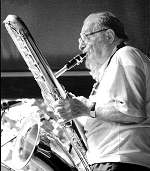
most outstanding was Adrian Rollini, a wonderful player of the rarely
heard bass saxophone. The only British player of renown who regularly
played this very large instrument was Harry Gold, who had a group
aptly called Harry Gold and his Pieces of Eight. He was a very
small man, barely taller than his saxophone. When I interviewed him
for Music Preserved’s Oral History of Musicians in Britain he was
already in his nineties. At the end of the interview he apologised
for not being able to offer me a cup of tea as he had to hurry off
to a session. When we left his flat together I offered him a lift
in my car. He refused my offer saying it would be easier by train,
and to my astonishment he hurried off to the nearby Underground station
carrying his large heavy instrument. Rollini was noted for playing
unusual instruments and invented two: one was the ‘goofus’, a sort
of harmonica. Very few were made, but a development, the melodica
can still occasionally be found. He also invented a tiny clarinet,
about 10 or 12 inches long, which the famous music firm Keith Prowse
offered for sale. It was made of ebonite and called ‘The Hot Fountain
Pen’. When I played the Eb clarinet I remember that some of the dance
band musicians I worked with called my small clarinet a Red Hot Fountain
Pen.
Adrian Rollini was one of several
white American jazz musicians who came to Britain and played at the
Savoy Hotel with Fred Elizalde, now largely forgotten but who influenced
many jazz musicians and other band leaders. Other American musicians
that came to Britain were the saxophone/clarinettist Danny Polo and
Van Phillips. I met Van Phillips at meetings of the Musicians’ Union
in the 1940s when I was only eighteen or nineteen, when he played
an important role in the Union’s development, and to some extent mine,
too. As well as being a fine musician, by then he had ceased playing
and was a theatre conductor for musicals. The Starita brothers, Al
and Ray, two more American musicians, had bands in which some of the
best young British jazz musicians played and who were later to have
bands themselves. At the same time as these musicians were coming
to Britain some British bandleaders were visiting America: Ambrose,
Spike Hughes (his book Opening Bars is worth reading by anyone
interested in the early days of jazz) and Ray Noble
next
page