Editorial Board
MusicWeb International
Founding Editor Rob Barnett Editor in Chief
John Quinn Contributing Editor Ralph Moore Webmaster
David Barker Postmaster
Jonathan Woolf MusicWeb Founder Len Mullenger
A
new "unlettered" series of
matrix numbers was begun on November
1, 1898 in London, where some 2,089
seven-inch recordings on wax-coated
zinc plates were made between that date
and May 10, 1899. These were given sequential
serial numbers from 1 to 2089, and catalog
numbers with prefixes were assigned
according to the system described above,
which remained in use until sometime
in 1921, when a simplified system was
introduced and used until the end of
the acoustical recording era. The same
information was entered into the ledgers
at the various processing plants. An
additional 2,550 recordings were made
in Europe through June 1900.
Unlettered
Series
January
12, 1899
January
13, 1899
As
early as February 1899 the Recording
Angel trademark was added to the left
of the spindle hole. Some time in early
1900 the Berliner logo, Angel trademark,
and the assigned catalog number begin
to appear raised on the record surface,
indicating that these were all entered
onto the shell or stamper, rather than
onto the original recorded plate. The
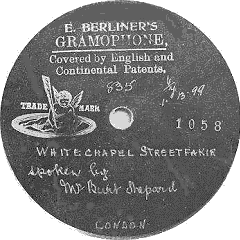
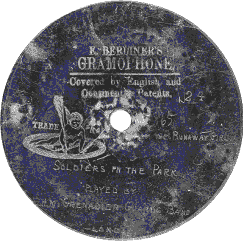
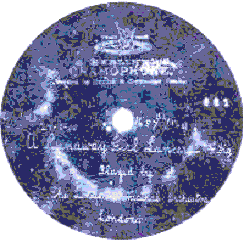
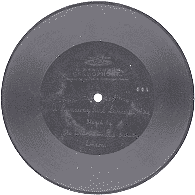
disc on the left above, Berliner 1109,
matrix 4405, was recorded on
January 12, 1899, while that on the
right was recorded one day later. The
matrix number is 835, while the
record or catalog number is 1058,
or more correctly E1058, denoting
an English language recording. Note
the difference in the handwriting, as
well as the difference in the company
logo, as well as the fact that Fred
was now entering the date in American
style. These London recordings show
an early use of the Recording Angel
trademark, which the Gramophone Company
and its successors was to use in one
form or another throughout the last
one hundred years or more. The trademark
was designed by Theodore Birnbaum, a
Londoner who was appointed Managing
Director of the Berlin branch of the
company in 1898. European discs generally
did not show the five patent dates,
but merely indicated that these existed
or were applied for.
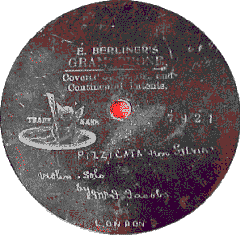
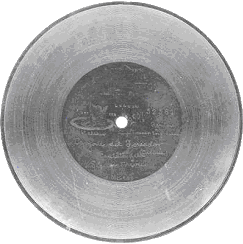
The
Berliner disc below is also from the
"unlettered" series, which
was the last series using wax-coated
zinc plates. It was recorded under the
supervision of Fred Gaisberg on April
6, 1899 by the violinist J Jacobs, who
also made the earliest known 10-inch
wax recordings in April 1901. Note that
the label area is a full four inches
in diameter. The matrix number 1855
can be seen just below the recording
date at the upper right. One can see
also a very early use of the Recording
Angel trademark, as well as the phrase
REPRODUCED IN HANOVER on the
reverse.
Berliner
7921, April 6, 1899, 102 mm.
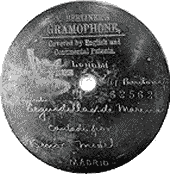
The
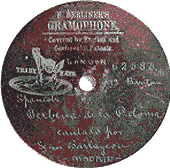
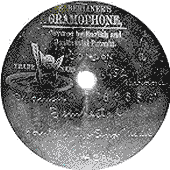
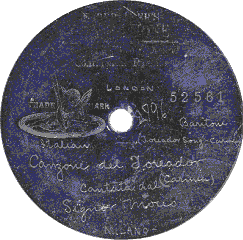
disc below, Berliner 52561, matrix
2796, was recorded by Fred Gaisberg
or William Sinkler Darby in Milan on
the first foreign tour. The three discs
below are among the last made in Madrid
by Fred Gaisberg on the first foreign
tour. The matrix numbers 3461,3498, and 3582 can just
be seen to the right of the spindle
holes. Both discs belong to the unlettered
series, and are among the first Gramophone
Company recordings to indicate the language
or region and the vocal range of the
artist on the label.
Berliner
62585
Berliner
62562
Berliner
62559
matrix
3461
matrix
3498
matrix
3852
Madrid,
August 1899
Berliner
52561, Milano, July, 1899
The
disc below, Berliner 24, from
the "unlettered" series, bears
the serial number 3865, which
may be seen to the right of the spindle
hole. Recorded in October 1899, it shows
REPRODUCED IN HANOVER on the
reverse. It seems probable that not
all of these recordings have survived
or were ever issued.
Berliner
24, October 1899
The
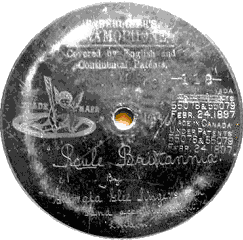
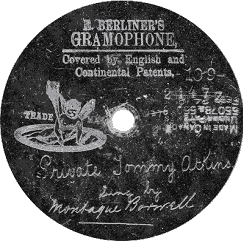
records below appear to be interesting
hybrids. Both have the Berliner imprint
generally used on London issues in the
unlettered series, and also show the
Canadian patent numbers and dates. The
label on the right shows the matrix
number just to the right of the spindle
hole. The significance of the numbers
─118─
and
─109─
is not clear.
Note that the Canadian patent number
on the right was entered upside down.
Canadian patent numbers have also been
seen on American Berliners. [Author’s
note: Montague Borwell made one of the
earliest recordings of a Gilbert &
Sullivan selection with Winifred Marwood
on November 1, 1898.]
probably
4109, matrix number 4236
Berliner
2147Z, matrix 4370
London,
early November 1899
The
disc above is an early wax tablet recording.
The high relief Angel trademark almost
completely obscures the date, showing
only 900. An extremely complex
matrix number beginning with 8
can be seen to the right of the spindle
hole. Both the company logo and the
catalog number are raised.
Berliner
50049X matrix 898
Milan,
July 1900
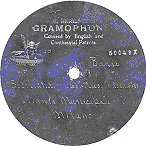
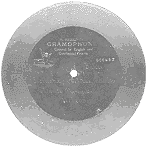
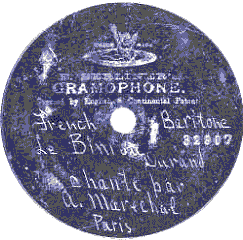
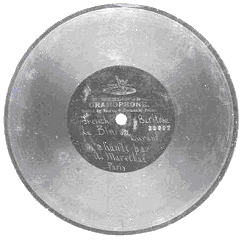
The
recording date 24-8-00 on the
upper disc below is inscribed at the
10 o’clock position to the left of the
company designation. The two figures
on the left below appear to show distinct
differences in the sizes of both the
Recording Angel and the Company designation
whereas in fact the two Angels and the
company logos are each identical in
size. The apparent difference is due
to the fact that the central area on
the upper disc is only 80 mm, while
the lower disc is 103 mm. This can be
seen more readily in the figures below.