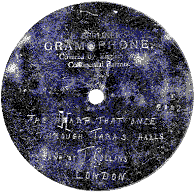
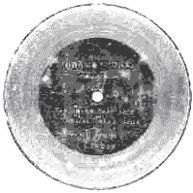
Pre-Paper
or Berliner Labels
The
pre-label period began in the United
States and Canada, where Emile Berliner
had invented the flat gramophone disc
in 1887, and had established several
recording facilities and pressing plants,
in Washington, D.C. in 1892, in Philadelphia
in 1895, and in Montreal, Canada in
1900. Early American recordings, so-called
Berliners, have been seen with the words
"Washington, D.C." inscribed
on their face. Several series of "Berliner"
discs must be distinguished. The earliest
of these was recorded in Washington
and Philadelphia by the Berliner Gramophone
Company. Over 2300 recordings were made
in the United States and issued between
1894 and 1900.
|
|
|
|
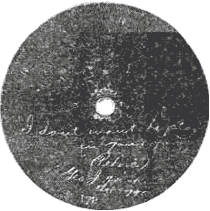
Berliner
178, October 29, 1895
|
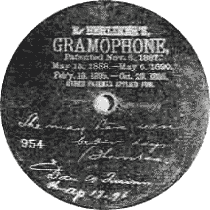
American
Berliner, April 17, 1896
showing
the five patent dates
|
The
figure on the right above shows an American
Berliner disc with the dates of Emile
Berliner’s five American patents. Not
all American Berliners carried all five
dates; some showed only four, while
some indicated only that patents had
been issued or applied for. Another
distinguishing feature is the absence
of the Recording Angel trademark (see
below) on all American discs. Close
inspection of the disc on the left,
also an American Berliner, reveals some
evidence of handwritten information
above the central hole. (from Charosh,
see Bibliography)
In
1896 Berliner established the Gram-O-Phone
Company in Montreal, Canada, and began
a second series of Berliner discs. The
Canadian Berliner Company pursued a
course quite independent of its American
and European counterparts, and eventually
joined with the Victor Talking Machine
Company in 1901, with Emile Berliner’s
son Herbert Samuel as one of the major
stockholders and Emile’s younger son
Edgar as secretary-treasurer.
|
|
|
|
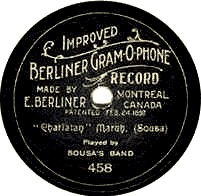
Canadian
Berliner 458
Montreal 1901
|
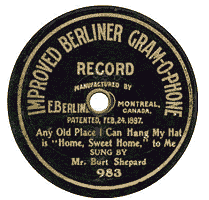
Improved
Berliner 983
usual
form around 1904
|
The
final Berliner series were made in Great
Britain and other countries of Europe,
Asia, and Africa by the Gramophone Company,
which was established in London in April
1898. Records issued by the Gramophone
Company before April 8, 1901 were recorded
on wax-coated zinc plates, also known
as matrices or recording tablets. They
were seven inches in diameter, had no
paper labels, and were embossed as E.
Berliner’s Gramophone (see below)
in both England and America, the details
being either embossed or engraved into
the central area of the matrix as described
previously. Alan Kelly pointed out some
years ago, in a Letter to the Editor
of The Hillandale News, No. 176,
October 1990, that when Berliner discs
were re-pressed with paper labels, they
were no longer Berliner discs but Gramophone
and Typewriter discs!
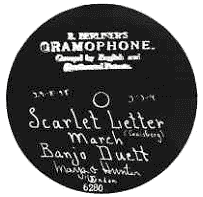
The
four figures below (courtesy of Peter
Adamson) show the changes in the format
used to provide the information in the
central area of Berliner discs during
the "original series" period,
from August 8 to October 31, 1898. Unless
otherwise stated, all Berliner discs
are assumed to be seven inches in diameter.
 |
|
|
29-8-98
|
9-2-98
(American style?)
|
According
to Adamson, on all of the discs above
except the earliest, the company designation
and catalog number are sunken, i.e.,
embossed into the zinc disc rather than
into the stamper. All other information
was inscribed by hand onto the zinc
plate, by either the recording engineer,
i.e., Fred Gaisberg, or his "secretary."
All of the discs above appear to show
Fred’s handwriting.
The
name(s) of the artist(s) and the selection(s)
were either handwritten or etched in
the lower half of the central area.
The dates often seen on these discs
may be that of the recording itself,
or of processing, i.e., from the time
the tablet arrived at the processing
plant in Hanover. It can be surmised
that the phrasing on the upper half
of both American and European Berliners
was entered at the processing plant,
probably by embossing onto the original
zinc plate. European discs were embossed
at the processing plant in Hanover,
together with the location of the recording.
The following is quoted from Alan Kelly’s
Introduction to the German Catalogue.
"In
those days the Expert made the recording
and then immediately scratched the
serial number (that which we now call
the matrix number) into the Center
portion of the disc. The disc was
then passed to an assistant whose
task was to keep the books and who
noted the Matrix Number, Artist, Title,
etc., in appropriate columns. Subsequently
either he or another hand used a stylus
to copy the details from the page
to the center of the disc, and the
details copied included the date written
at the top of the page. This date
could be anything from the date of
recording until weeks later, if the
processing had been delayed or when
the zincs were sent to Hanover for
processing."
|
|
|
|
Original
Series
E2042,
September 20, 1898
|