A Biography of Gustav Holst
Part 4: 1929-1934
by David Trippett
Later years
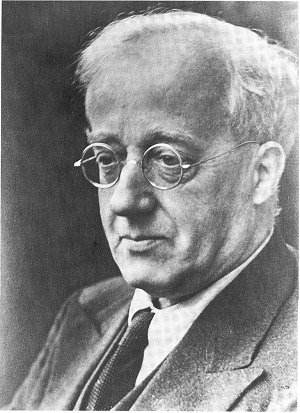
For
his holiday Holst travelled south by train via Chambéry to Genoa,
arriving in Rome on Christmas Eve. He went round the city in his customary
manner exploring by 'getting lost', and left for Naples after declaring
'Rome's no good after Greece.'(
23) In Naples he visited
the ruins of Pompeii and saw Vesuvius covered in snow, shimmering in
the winter sunshine. He travelled to such places as Taormina, Lucca,
Pisa, Ferrara, Verona, Perugia, and Ravenna before returning to England.
No sooner had he arrived, than Holst set off for America where he was
to attend the ceremony and dinner of the American Academy. He spent
most of his time in New York with his brother though travelled to Boston
to lecture at Harvard University.
On his 'second return' Holst was glad to be able to get into a routine
again after all his travelling. Characteristically though, he set about
composing once again, this time writing twelve songs to the words of
Humbert Wolfe's poetry including
The Dream City and
Betelgeuse
in which, like
Neptune, he sought to express the incomprehensibility
of space. Concerts of his music were still taking place around the country,
for example a performance of
The Golden Goose in Warwick and
The Planets at the Canterbury Festival. In terms of composition
though, Holst had finally begun his Double Concerto after Bach which
was to be in three movements that ran continuously. He wrote to Imogen
that 'Just now I am feeling that life is moderately pleasing' and soon
after had another 'field day' with VW where they both looked at the
latter's 'masque for dancing'
Job. Much later VW commented 'I
should like to place on record all that he [Holst] did for me when I
wrote
Job. I should be alarmed to say how many 'Field Days' we
spent over it.' VW was awarded the gold medal of the Royal Philharmonic
Society in March 1930 and the next month it was Holst's turn. During
the interval of the premiere of his Double Concerto at the Queen's Hall,
Holst was presented with the Gold Medal by Frederick Austin who described
he and VW as 'contemporaries, life-long friends, Arcadians both.'
A further walking tour, this time to Holland, was intended to reinvigorate
Holst after a busy term. He explored The Hague, Leiden, Haarlem, and
Amsterdam where he also heard a performance of the
St. Matthew Passion.
Later that year he performed
A Choral Fantasia and a setting
of Robert Bridge's Ode for the Bicentenary Commemoration of Henry
Purcell at the Chichester Festival.
The final years
In summer 1930 Holst began work on the much-postponed work commissioned
by the BBC for military band. It was called
Hammersmith and Holst
said of it 'As far as the work owes anything to outside influences it
is the result of living in Hammersmith for thirty-nine years on and
off…' Split into a Prelude and Scherzo, the shifting bitonal lines
of the Prelude evoke the incessant, dark flow of the river. The slow
moving ground bass with flowing counterpoint above also conjures up
images of the river while the odd triplet figure sounds like a whistling
cockney. This work was completed by the end of October and by the end
of the year Holst had completed
A Choral Fantasia,
Hammersmith,
and
The Wandering Scholar. Early in the New Year Boult conducted
a radio broadcast of
Savitri,
The Planets, and
Beni
Mora. Holst re-scored
Hammersmith for full orchestra and
revised the original version a little before sending it off to B. Walton
O'Donnell at the BBC. A new kind of commission was received when Holst
was asked to write the soundtrack for a film called
The Bells.
Although this type of commission was not considered normal for a 'serious'
composer, Holst was attracted by the idea and made some notes for the
score (it had to be completed in a month) before embarking on 'a week's
middle-aged walking' in Normandy. On his return he finished the score
and recorded it in Wembley despite his persistent neuritis. He soon
lost his earlier enthusiasm when the directors requested certain changes
and, on hearing a private run-though (using dreadful speakers) was utterly
disillusioned with the result. Imogen, who was present, recalled his
'white-faced look of dismay'. The film was eventually sold off to an
American company though it was released neither there nor in England.
Holst's passion for walking tours did not abate and he spent time in
the Cotswolds before conducting his Whitsuntide singers in Chichester,
and later travelled to Dorset visiting Blandford Forum, Dorchester,
Abbotsbury, and Chesil Beach. Later that year he conducted
The Planets
in one of the BBC Prom concerts which was broadcast on national
wavelengths. Towards the end of the year Holst received an invitation
from Harvard University to accept the post of Horatio Lamb Lecturer
in Composition for the second half of the academic session. In addition
there was an invitation from the Boston Symphony Orchestra to conduct
a concert of his own works in January. He accepted both offers and took
on an agent - Duncan McKenzie - to relieve the pressure of his being
a celebrity over there.
In the New Year, Holst boarded the S.S. Bremen at Southampton and set
off for America. After some initial sightseeing in Boston, he conducted
the Boston Symphony Orchestra on 19 January in a concert of all his
own works including
St. Paul's Suite,
A Somerset Rhapsody,
The Perfect Fool ballet music, the orchestral version of Bach's
Fugue à la Gigue, and
Hammersmith.
After travelling to New York, Holst spent time exploring the city, the
theatre, gave a talk at a meeting of the Beethoven Association, and
gave a lecture on 'England and her Music' to the National Association
of Organists. In Boston the teaching commitments of his new post were
favourable, so much so that Holst could devote several mornings a week
to composition - it was here that he taught composition to Elliott Carter,
now an eminent contemporary composer.
He greatly enjoyed teaching and composing in Harvard, and wrote to Whittaker
saying that 'They have given me delightful rooms and I find that I can
get a fair amount of writing done'.
After Harvard Holst planned to visit Canada for a lecture and concert
tour. There he lectured in Montreal on 'England and her Music' and conducted,
among other works,
Jupiter.
At the end of March Holst gave a lecture to the Library of Congress
commemorating the bicentenary of Haydn's birth and, in April, he gave
the first performance of
Hammersmith as it was originally scored
- for military band (
24). He attended a concert containing
Liszt's
Dante Symphony after which he had to walk home 'to get
over it.' On returning to Boston, he became ill and saw a doctor who
told him to go to hospital where haemorrhagic gastritis caused by a
duodenal ulcer was diagnosed. All forthcoming engagements were cancelled
and he remained in hospital for fifteen days. After having recovered
he moved back into Elliot House and returned to his teaching duties
with renewed vigour as well as continuing to work on the
Six Choruses.
Further concerts and lectures continued as his health improved and,
having first cancelled his part in Ann Arbor (music festival) he changed
his mind and went ahead with it.
An uneventful voyage brought him back to England on 2 June 1932 and
he settled into his English life once again, teaching, composing, travelling,
and walking. He accepted several conducting commitments and took up
the trombone again for a performance of VW's
Fantasia on Christmas
Carols to be performed at St. Paul's that Christmas. On 29 October
he was the guest of honour at the Annual General Meeting of the Music
Teachers' Association and, after term ended at St. Paul's, set out on
two one-day walks - the first through Southwark, Rotherhithe, Greenwich,
and Poplar to Barking; the second from Barking to Theydon Bois, returning
by train. In the New Year, however, his stamina failed him and he suffered
a relapse from which it took him several months to recover. Similarly
in March, after talking with Lionel Tertis of plans for a performance
of the
Lyric Movement in St. Paul's, Holst had to take to his
bed and engagements for the next month were cancelled.
Permission was sought by an American film company to use extracts from
The Planets on a soundtrack and Holst was asked to compose some
additional music specifically for the film. Despite his experience of
The Bells Holst agreed though nothing came of the project and
any music that was written must have been lost or destroyed.
When Archibald Davidson and his wife (friends from America) came to
London in October, Holst was eager to show them the same hospitality
that he had received while over there. He was taken ill, however, shortly
after they arrived and had to spend most of the week in bed. By December
1933 his health had not improved and he was admitted to New Lodge Clinic,
Windsor Forest, three days before Christmas. He was still in hospital
in late January when the premiere of
The Wandering Scholar was
given in Liverpool. By February his condition had not improved and he
wrote to Adrian Boult 'If my ulcer has not healed by the 22nd the doctors
suggest my leaving the nursing home and either having an operation or
leading a "restricted life"'. Later that month Elgar died and Holst
received news that his close friend Norman O'Neill had been killed in
a motor accident - Holst began to consider his own future very seriously.
He managed to hear one of his new compositions,
Brook Green Suite,
played through at St. Paul's and named after the green on which the
school stands. After this spell of activity, Holst suffered a relapse
though recovered quickly and was contented by listening to the frequent
broadcasts of his works on the BBC. He eventually decided to undertake
a major operation rather than lead a restricted life and on 23 May he
underwent such an operation for the removal of the duodenal ulcer. The
surgery went well though the hospital announced that Holst would not
be out of danger for three days. Such was the shock of the operation
to Holst's delicate health, he died of heart failure two days later
and 'passed away quietly and peacefully like a little child.'
Family and friends were shocked as they had not thought that the operation
could have had such consequences. A group of singers who were to give
a concert in Little Saxton church, Greensted, the following day had
promised Holst (who supervised some of their rehearsals) that whatever
happened they would go ahead with the concert. Despite a highly emotional
beginning when almost all the choir were in tears, the concerts went
well and Dorothy Callard recalled that 'we agreed that it was Mr Holst
who was conducting us…'
His ashes were buried in Chichester Cathedral and Isobel wrote to Bishop
Bell saying 'I am really glad now that he has passed on, because if
he had lived he would have been an invalid and he would have been most
unhappy. I was with him to the end and his going out was so peaceful
and beautiful and he suffered no pain.'
Bibliography
Holst's Music : A Guide by A.E.F. Dickinson, Alan Gibbs(Editor)
Holst : The Planets by Richard Greene (Cambridge Music Handbooks
1995)
A Comprehensive Biography of Composer Gustav Holst, With Correspondence
and Diary Excerpts : Including His American Years by Jon C. Mitchell
Not yet available
Gustav Holst by Rubbra, E. Triad press, London, 1974
Gustav Holst : The Man and His Music by Michael Short OUP
1990 Out of Print
Gustav Holst: letters to Whittaker by Short, M. (ed.) (Glasgow
University, 1974)
Heirs and Rebels by Vaughan-Williams, U. + Holst, I. (eds.) The
Cooper Square Publishers, NY, 1974)
Gustav Holst : A Biography by Imogen, Holst Out of Print
OUP 1938
The Music of Gustav Holst Imogen Holst Out of Print OUP 1951
Footnotes
(1)
On the departure of Imogen Holst for the Royal College of Music,
the composer asked his daughter: "Now whatever you do, promise me one
thing - that you will never read a textbook on harmony!"
(2)
Short, M. Gustav Holst, the man and his music (Oxford University
Press, 1990) p.2
(3)
Now called Clarence Road
(4
) Gustavus Valentin(e) was the first member of the recently emigrated
family to marry an Englishwoman.
(5)
Gustav's father felt that the trombone would be a good antidote
to his son's asthma.
(6)
See note two p. 11
(7)
During this period the asthma attacks had largely abated.
(8)
Holst spoke of having the 'shock of my life' on hearing the opening
bars of Tristan.
(9)
Parry, as head of the RCM, wrote: 'My dear Von Holst, You are not
at all likely to "give offence" to any authorities at the RCM, they
have much to good a opinion of you. I am very sorry we shall not have
the pleasure of your presence at the RCM next term, but you are quite
right to take an opportunity of the kind you tell me of.'
(10)
Holst later spoke of the benefits of learning the 'impersonality'
of orchestral playing.
(11)
Charles Stanford was to be on the Jury.
(12)
He also introduced them to Bach Cantatas.
(13)
The scoring is for double string quartet, a double bass, two flutes,
and cor anglais, with a wordless chorus.
(14)
In spite of this, Holst had to wait several years before the first
performance.
(15)
A performance took place that year of the first part of Choral Hymns
from the Rig Veda.
(16)
At this Holst remarked 'I think that I can say that since this event
I have never been quite the same man.'
(17)
There was a riot on the premiere performance!
(18)
Richard Campbell
(19)
This work was dedicated to VW.
(20)
This took place during the interval of a football match.
(21)
This is based on the first chapter of 'The Return of the Native.'
(22)
At that time the BBC had its own band.
(23)
During his YMCA days Holst had had the opportunity of exploring
Athens.
(24)
The BBC premiere had not yet taken place.