 |
|
|

alternatively
CD: AmazonUK
AmazonUS
|
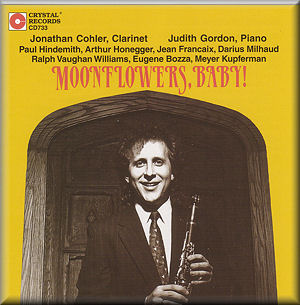
Moonflowers, Baby!
Paul HINDEMITH (1895-1963)
Sonata for Clarinet and Piano (1939) [16:42]
Arthur HONEGGER (1892-1955)
Sonatina for Clarinet and Piano, H.42 (1921-22) [6:20]
Jean FRANÇAIX (1912-1997)
Tema con variazioni (1974) [8:51]
Ralph VAUGHAN WILLIAMS (1872-1958)
Six Studies in English Folksong (1926) [7:40]
Darius MILHAUD (1892-1974)
Duo Concertant, Op.351 (1956) [6:22]
Caprice, Op.335 (1954) [2:02]
Eugène BOZZA (1905-1991)
Pulcinella (ca.1944) [2:17]
Meyer KUPFERMAN (1926-2003)
Moonflowers, Baby! (1986) [11:28]
 Jonathan Cohler (clarinet) Judith Gordon (piano)
rec. Aug 1993, Campion Center, Weston, Massachussetts.
CRYSTAL RECORDS CD733 [62:12] 
|
|
|
“Moonflowers, Baby!” is one of the three
discs recorded by Jonathan Cohler in 1992-93. The other two
were “Cohler on Clarinet” (Ongaku 024-101
- see review)
and “More Cohler on Clarinet” (Ongaku 024-102
- see review).
These two other discs constitute a small anthology of the clarinet
repertoire, covering almost two centuries and including such
staples as Weber’s Grand Duo Concertant, both Brahms
sonatas and the Poulenc sonata.
The present disc is not as all-embracing, and in my humble opinion
this is much to its advantage. For example, I was not persuaded
by Mr.Cohler’s Brahms and Schumann - they seemed too intense
for my taste. However, here on this disc the music is firmly
anchored in the 20th century. More precisely, the anchor is
placed in the witty, bright and elegant French composition school.
This music suits Cohler’s style perfectly. Here he is
also more gentle and subtle where needed - as in the RVW and
Kupferman pieces.
The program opens with Hindemith’s light and transparent
sonata. It is very characteristic of Hindemith’s style
and combines formal modernism with genuine lyrical feeling.
It receives the most warm and expressive performance. The first
movement is moderately paced and has a languid Brahmsian waltziness.
The tiny, angular second movement is something between a Prokofiev’s
march and a Benny Goodman improvisation. Then comes the slow
part, like a dark river flowing through the night. The music
reaches an expressive climax and then calms down. The swift
Rondo is cheery and playful, with a whipping whisk of
a Ravelian train-ride. Despite its size and diversity, the entire
Sonata is very coherent, and should be heard by anyone scared
away from Hindemith by rumors of his dry formalism!
The entire Honegger Sonatina is shorter than the slow
movement of the Hindemith. The music rises from the depths in
soft and dark-hued arches and branches. The slow movement is
an impressionistic panorama with bluesy reflections. The short
finale is busy and bustles with energy.
The beautiful set of Variations of the ever-youthful
Jean Françaix must be really difficult to play, but seems
to present little difficulty to Cohler. The variations are bright
and inventive, and the theme undergoes many transformations,
in character and in rhythm. From the innocent, carefree first
statement of the theme - through the joyful buzz and fuss of
the first three variations - through the heartfelt, deep emotion
of No.4 - and the Ballet of Unhatched Waltzers in No.5 - to
the syncopated, jazzy joyride of the last variation; it’s
all fun and delight. The performance is stunning, with the clarinet
sound so soft and elastic, so new at every turn.
Now we enter quite a different world - that of the tranquil
British pastoral. Ralph Vaughan Williams spent much effort collecting
and studying British folksongs. Here he took six of them as
the base for these six little essays. All except the last are
calm, wide-flowing, molto cantabile. There is this kind
of “airborne” feeling, so characteristic of pastoral
RVW, the one we know from The Lark Ascending. The sixth
study is brisk and lively, a cheerful closure. The entire set
is played with charm and deep inner feeling.
Milhaud’s Duo Concertant is in ABA form, where
the A part is a bouncy polka. Milhaud’s beloved polytonality
rules in the middle part, sweet and pastoral, though much sunnier
than Vaughan Williams. The same polytonal sweetness fills the
short Caprice. Light, transparent veils dance in the
air. Pulcinella by Eugène Bozza is a quick Scherzando,
built mostly from ornamented runs up and down, with a short
impressionistic moment right in the middle. I would not call
this a must-hear piece of music, but it provides a good showcase
for Cohler’s virtuosity.
The last stop of this fascinating journey brings us to America.
When Jonathan Cohler asked Meyer Kupferman “What is a
moonflower?”, the composer answered: “It’s
just what you imagine it might be. A flower that blooms in the
moonlight. Sensitive, subtle, beautiful, refined.” And
so is Cohler’s performance. The piece is for clarinet
solo, but this is hardly noticeable: so rich and “broadband”
is the voice of the instrument. This is much due to the fact
that the late composer was himself a first-rank clarinetist.
His intimate knowledge of the instrument’s body and soul
is apparent. There are three distinct sections with telling
markings: 1. Medium bounce; easy going. 2. Slow blues tempo.
3. Fast and smooth. At the end we return once more to the
smoky, weary blues of the slow section. The music is colorful,
moderately spiced with effects, and is very rich in changing
moods and “faces”. It is a veritable rhapsody. Cohler
plays as if he owned the piece, with deep understanding and
supreme musicality. “An absolute knockout recording”,
as the composer himself declared.
Throughout the disc, Jonathan Cohler’s clarinet is amazingly
flexible. It is powerful and vibrant on the one hand, gentle
and smooth on the other. Its sound is constantly beautiful.
What is also important, each piece has a distinct approach,
according to its character. Judith Gordon at the piano is not
a step behind, versatile and expressive. The instruments blend
perfectly, thanks to the precise balance found by the recording
engineer. The recorded sound has depth and volume. All in all,
I cannot find any weakness in this disc. I will not call it
a revelation or an eye/ear-opener. But from head to toes, this
is probably the most satisfying clarinet disc I’ve heard
in quite a time. It has a diverse and attractive program, excellently
performed and recorded. Sensitive, subtle, beautiful, refined
- a moonflower, baby!
Oleg Ledeniov
|
|
|























