 |
|
|

alternatively
CD: MDT
AmazonUK
AmazonUS
Sound
Samples & Downloads
|
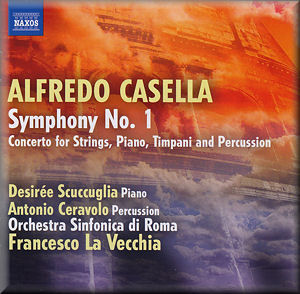
Alfredo CASELLA
(1883-1947)
Symphony No. 1 in B minor, Op. 5 (1905-1906) [44:46]
Concerto for Strings, Piano, Timpani and Percussion, Op. 69 (1943)
[21:35]
 Desirée Scuccuglia (piano), Antonio Ceravolo (percussion)
Orchestra Sinfonica di Roma/Francesco La Vecchia
rec. 5-6 April 2009, Auditorium Conciliazione, Rome (symphony),
23-27 October 2008, OSR Studios, Rome (concerto)
NAXOS 8.572413 [66:22] 
|
|
|
Starter question for 10 - can you name any Italian orchestral
composers of the early to mid 20th century? Ottorino
Respighi comes to mind, as do Gian Francesco Malipiero, Ildebrando
Pizzetti and - thanks in part to those enterprising souls at
Naxos - we can now add Alfredo Casella. This recording of the
latter’s Symphony No. 1, a world premiere, is just
part of a projected series devoted to Casella’s œuvre;
the most recent instalment - which includes Symphony No 2
- is available on 8.572414. Naxos have stolen a march on Chandos,
who have just released a recording of the latter - coupled with
Scarlattiana - featuring Gianandrea Noseda and the BBC
Philharmonic (CHAN 10605). And we mustn’t forget CPO,
whose contribution to this risorgimento includes the
Op. 63 Sinfonia - see review.
At first glance, Casella’s enrolment at the Paris Conservatoire
- Gabriel Fauré was one of his teachers - and his admiration
for Debussy might suggest strong links with French music of
the period. However, the First Symphony, which dates from 1905,
doesn’t strike me as particularly Gallic, either in sensibility
or sound world; indeed, Casella is quoted in the liner-notes,
where he dismisses the work as a potpourri of Borodin, Brahms
and Enescu. These influences may be there, but they aren’t
striking. Perhaps it’s the Italian band and conductor
who are to blame, as they add a touch of southern warmth to
this absorbing score.
True, the brooding start to the Lento seems Russianate, but
then there’s an arresting lyricism in the strings and
an orchestral blush that speaks more of Richard Strauss. As
for the Roman orchestra they sound full-bodied and precise,
climaxes expanding with plenty of weight and impact. Musically
the score may seem a tad threadbare at times, but it’s
well shaped and convincingly paced. Initial impressions suggest
this is not the youthful indiscretion it first seems; in fact,
the Adagio - reprised in the Second Symphony - is rather lovely.
After a quiet, rather unsettling theme at the outset there are
some melting string tunes - just listen to the passage that
begins at 3:44. It really is luminous, heart-stopping music,
most eloquently phrased.
The final movement, like the first, is a dark-toned Lento, the
grumble of percussion at the start thrillingly caught. And,
for the first time, there’s a real sense of nobility,
a Wagnerian amplitude if you like, the muted brass simply splendid.
Moreover, there’s a momentum here - listen out for that
recurring, jaunty little tune - and a firm sense of purpose,
which ensures that any structural weaknesses are artfully concealed.
Such advocacy augurs well for the rest of this series; indeed,
having heard both Noseda and La Vecchia’s accounts of
the Second Symphony I can assure you the latter yields little
or nothing to the former in terms of execution although, as
expected, the Chandos sound is both weightier and more spacious.
The concerto is a wartime work, written while the composer was
recovering from a serious illness. The soft edges of the symphony
are replaced here by a harder, more muscular idiom, which includes
strong, uncompromising rhythms. There’s plenty of bite
to the strings, ever-present timps commendably crisp and clear,
the Sarabande more lyrical - and inward - than one might expect.
The piano part is carefully woven into the musical fabric, which
only shows signs of fraying in the latter half of this movement.
The brisk, martial opening to the final Allegro - snare drums
very much in evidence - takes us back to the sinewy world of
the first. It’s well played and tightly argued, the muted
march coloured by the gentlest of taps on the tam-tam.
So, a most encouraging start to this new cycle which, along
with Noseda’s, will surely bring this music back into
the mainstream, where it belongs. It seems entirely right that
La Vecchia and his Roman band are leading the charge; goodness
knows, they play this music with verve and vision - and that’s
just what it needs
Nice one, Naxos.
Dan Morgan
|
|
|























