Editorial Board
MusicWeb International
Founding Editor Rob Barnett Editor in Chief
John Quinn Contributing Editor Ralph Moore Webmaster
David Barker Postmaster
Jonathan Woolf MusicWeb Founder Len Mullenger
Buy
through MusicWeb
for £13.50 postage paid World-wide.
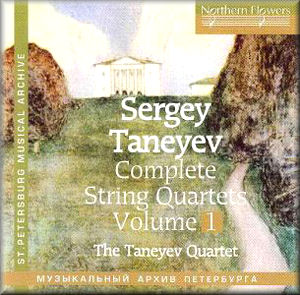
Sergey TANEYEV (1856-1915) Complete String Quartets - Volume 1
String Quartet no.1 in B flat minor Op.4 (1890) [32:38]
String Quartet no.4 in A minor Op.11 (1900) [37:44]
The Taneyev Quartet
rec. 1977, St. Petersburg Recording Studio. ADD. Stereo
NORTHERN FLOWERS NF/PMA 9933 [70:22]
The Taneyev quartets are one of the many areas of the repertoire where Naxos have recently offered an alternative to the single choice that has long been on the market. The Naxos Carpe Diem Quartet recordings offer lithe, supple readings whereas these earlier Taneyev Quartet recordings are more in the traditional Russian vein of concentrated, focused and passionate playing. In terms of price, Naxos have the upper hand, but in all other respects these earlier recordings hold their own well in the face of the competition. Volume 1 was recorded in 1977, but you’d hardly know that to listen to it. I can’t say exactly how much cleaning up was done in the digital transfer process, but the sound is remarkably good for its time: clear, immediate and always involving.
Taneyev is a bit of a conundrum, and these works are in many ways representative of his art in that they are filled with paradoxes. Structure was Taneyev’s guiding principle, yet his music always lives for the moment. Like Tchaikovsky, Taneyev was a cosmopolitan rather than a nationalist, yet folk music intonations regularly colour the textures of these works. And how does one pin down the trajectory of his career? Whatever opus number is attached to a work, it always sounds mature and consummate, as if the music is the distillation of a lifetime’s work.
In the case of the First Quartet, both the number 1 and the low opus number (4) are misleading. He may have only been in his mid-20s when he wrote it, but he had already completed four string quartets that he had declined to publish. Given the name that the Taneyev Quartet chose for themselves, we can assume that this music was at the core of their repertoire, and they certainly sound like they know it intimately. The rubato and phrasing give the music a palpable sense of inner life, which elegantly balances the composer’s obsession with balanced structure. That into-the-string Russian sound is everywhere apparent. But it never disturbs the balance, nor does it diminish the wide dynamic range. Much of the music is in the lower register of the instruments, and the players achieve a rich, woody tone, which affords these passages an almost tactile quality. Soaring violin lines don’t come off quite as well; tuning is usually fine in the upper registers, but lightness of touch is at a premium. On the other hand, this slight coarseness with the lighter music often lends an attractive rustic quality. The opening of the finale, for example, comes across as a kind of village dance in the spirit of Dvorák. But even here the phrasing and dynamics are skilfully controlled to both structure and propel the music.
If there is one aspect of Taneyev’s art that can be perceived to develop and mature over the course of his career it is his use of form. Taneyev was unusual among Russian composers in planning the structure of works in advance, weighing sections and lengths, and finely adjusting the proportions of works until an exact structural balance was achieved. The five movement form of the First Quartet is interesting in this respect, as the fourth movement Intermezzo is clearly a later addition intended to balance the structure. It works magnificently, but also exposes the workings of Taneyev’s structural thinking. The Fourth Quartet was written ten years later, and is based on a much more cogently planned format. It’s in a relatively traditional four movements, although the first is an Adagio. Its tight structure is based on the continuous reinvention of the opening motif. The motif returns unadulterated to open the finale, retrospectively confirming the listener’s suspicions that it has been there in the background throughout the preceding three movements. But for all the structural ingenuity, this too is a work based on a paradoxical mix of cosmopolitan sophistication and rustic charm. The Taneyev Quartet never lose sight of the latter, especially with their heavy bowing, creating a rich, earthy sound from their lower strings.
I suspect there is room for many different kinds of interpretation with this music, but these readings have much to commend them: commitment, focus, passion, and a palpable connection with the composer and his milieu. And as I say, I’ve no qualms about the sound quality. The Taneyev Quartet really have their fingers on the pulse of this music, and the quality of these readings fully justifies their reissue onto the digital market.
Gavin Dixon
Please support our advertisers below by clicking on the logos for further information.
























 The Taneyev Quartet
