Elgar’s 1st
Symphony will always have a special
place in the repertoire of the Hallé
Orchestra for it was that orchestra
which premièred the work under
the direction of Hans Richter at the
Free Trade Hall in Manchester. During
rehearsals, Richter, to whom the work
was dedicated, said, "[it is] the greatest
symphony of modern times, written by
the greatest modern composer — and not
only in this country." At the time this
might have appeared somewhat extravagant
but, with hindsight, we know that he
was right. Although there were British
Symphonies prior to this – Cipriani
Potter (c10), George Macfarren (9) and
William Sterndale Bennett (5) – there
was no precedent for a work of such
scale in the Land ohne Musik.
The 1st
Symphony isn’t as opulent, nor as
complicated, as the 2nd,
but even so it is richly scored, what
a master of the orchestra Elgar was!,
and there is an element of fantasy about
the working out of its themes, so close
attention is necessary in order to follow
the argument. The whole work is held
together by a motto theme, heard at
the outset, which binds the music together
and returns at the very end to bring
the Symphony to a triumphant conclusion.
The Symphony has been recorded
many times, by, just to mention my favourites,
Bryden Thomson, Bernard Haitink, Vernon
Handley, George Hurst, not to mention
three each by Boult and Barbirolli and,
best of all, by the composer himself
in 1930, so any new recording has a
major challenge on its hands in the
face of such stiff competition. It’s
most satisfying to report that Mark
Elder and his orchestra rise to the
challenge and give a very fine performance
indeed.
Beginning very quietly
with the motto, the Symphony
begins decisively, yet with a withdrawn
air and after two statements of the
motto – one quiet, one loud – the music
launches into a full bloodied allegro
and the main body of the movement gets
under way. And what a movement it is!
A vital first subject, more restrained
second theme, and a working out of some
complexity. There’s many felicitous
touches of orchestration – the muted
horns at the start of the development
section, the back desks of the strings
playing the motto at the end of the
movement – and when the full orchestra
is called for, such as at the climactic
moment, Elgar unleashes a sound of such
power that we are rivetted to the spot
with the overwhelming authority of his
vision.
The scherzo, second,
movement starts with scurrying violins
over a rolling accompaniment. Martial
music fills the air until the trio which,
Elgar said, should be played like something
you hear by the river and the delicate
interplay of solo violin and flutes
is delectable. A reprise of the scherzo
and the music slows down and leads,
without pause into the slow movement
which is based on an idea made from
the same notes as the scherzo but slowed
down so as to be unrecognisable. This
Adagio is both the heart of the
Symphony and the heart of Elgar himself.
It is a noble utterance, controlled
and majestic, and spends its time musing
on two basic ideas.
The finale begins in
gloomy times, bass clarinet and bassoons
giving two ideas and there appearing
to be no obvious way for the music to
go. But just as we think that Elgar
might have got lost, as in the first
movement fast music tears across the
landscape and rushes away. A quieter
middle section, with a recollection
of the motto and off we go again until
the coda brings back the motto in full
orchestral garb, with swirling violins
and brass resplendent. It’s a fitting
and truly magnificent ending to any
symphonic work and Elgar’s peroration
is quite something to behold.
Elder and the Hallé
perform like men possessed, giving their
all to Elgar and producing a performance
of great intelligence and passion. The
recording is a bit distant so you will
need to turn up the volume to get the
full effect of the performance, but
this allows for a very wide dynamic
range. This performance can easily take
its place beside the performances I
listed earlier and, while I wouldn’t
put it above Barbirolli’s two performances
with the same orchestra – the 1956 recording
is available on BARBIROLLI
SOCIETY CDSJB 1017, and a live performance,
the last performance he gave of the
work from the King’s Lynn Festival,
on 24 July 1970, four days before his
death, is available on BBC LEGENDS BBCL
4106-2 coupled with Introduction
and Allegro from the same concert
– or Boult’s 1949 account with the London
Philharmonic which is available on TESTAMENT
SBT1229, coupled with a cracking In
the South, and his final Prom performance
of the work, from 28 July 1976, was
issued as a free disk with the BBC Music
Magazine in August 2006, Volume
14 no.12, and this is well worth looking
out for – it can more than hold its
own.
This Elgar 1 is good,
but In the South is even better!
There’s a magnificent sweep to this
performance and Elder gets to grips
with the music from the outset – this
work is rather diffuse in its argument
so it needs a strong hand at the helm
– especially impressive is the section
depicting the "relentless and domineering
onward force of ancient Rome" and
the In Moonlight section is wistful
and has a lovely viola solo, played
by Timothy Pooley. This is one of the
best accounts of this work I have ever
heard. The recorded sound is fuller
than the Symphony and there’s
lots of presence and a very wide dynamic
range.
To end, the song that
Elgar made from the In Moonlight
section of the Overture. It’s a negligible
piece – Elgar’s songs are not amongst
his best achievements - and I shan’t
be returning to it in an hurry.
Apart from my usual
whine of why aren’t the fillers put
first so we can enjoy the main event
without hindrance of something following
it, this is a very good disk and well
worth having for, if not better than
Barbirolli and Boult, it certainly complements
them. There’s also a short essay by
Michael Kennedy in the booklet and he’s
always worth reading.
Bob Briggs










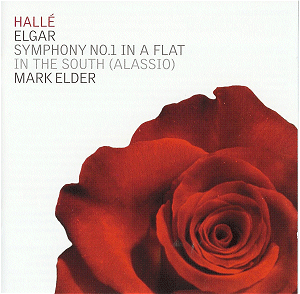
 Christine Rice (mezzo), Mark Elder (piano);
Hallé Orchestra, Mark Elder
Christine Rice (mezzo), Mark Elder (piano);
Hallé Orchestra, Mark Elder 











