Editorial Board
MusicWeb International
Founding Editor Rob Barnett Editor in Chief
John Quinn Contributing Editor Ralph Moore Webmaster
David Barker Postmaster
Jonathan Woolf MusicWeb Founder Len Mullenger
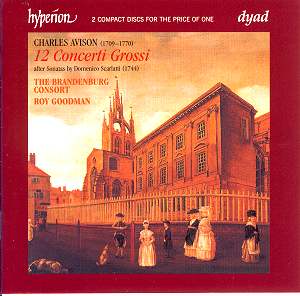
Charles AVISON (1709-1770) Twelve Concerti Grossi after Domenico
Scarlatti (1744) CD1
Concerto Grosso No. 1 in A major [12:55]
Concerto for harpsichord, No 2 in G major [14:11]
Concerto Grosso No. 3 in D minor [10:35]
Concerto Grosso No. 4 in A minor [15:29]
Concerto Grosso No. 5 in D minor [9:30]
Concerto Grosso No. 6 in D Major, Op. 6/6 [13:06] CD2
Concerto Grosso No. 7 in G minor [10:58]
Concerto Grosso No. 8 in E minor, Op. 6/8 [9:14]
Concerto Grosso No. 9 in C major [13:15]
Concerto Grosso No. 10 in D major [6:41]
Concerto Grosso No. 11 in G major [17:24]
Concerto Grosso No. 12 in D major [15:48] The Brandenburg
Consort/Roy Goodman
rec. 10-12 January and 7-9 February, 1994. DDD HYPERION DYAD CDD22060 [76:34
+ 74:05]
This two-CD set - now offered for the price of one - was
originally issued by Hyperion on CDA 66891/2 in the mid-1990s;
it’s good to have the collection available like this and
it can be thoroughly recommended.
The Concerto Grosso was originally developed in the 1670s
and 1680s by Corelli and Stradella in Rome as a way to exploit
spaces for polychoral effect. It had become a particularly
English form by the 1740s, when these sprightly and varied
pieces by Avison were written. Indeed it was actually more
popular outside Italy, where it had first been transformed
into a concertino form with two violins, cello and continuo
for more secular performances. It was then abandoned altogether
in favour of the more virtuosic three-movement concerto.
The original centre of gravity for the Grand Concertos,
as they came to be called, was London; here Handel’s Opp.
3 and 6 and the influential Geminiani sets, Opp. 2 and 3,
fuelled a demand that even provincial composers found hard
to meet. It was on this tide that these works by Avison rode.
Living in Newcastle for almost all his life, Avison visited
London during the 1730s and will have heard much such music.
For provincial musicians including Avison the Concerto Grosso
provided appealing material for local music-making. Professionals
were usually hired to manage the more demanding parts that
were out of the reach of regular local orchestral players.
Organist of St John’s church from 1735 and of St Nicholas
- now the cathedral in Newcastle - the following year, Avison
was soon asked to direct a series of subscription concerts
of his own. These were also extended to venues in Durham.
It was for these series that much of Avison’s orchestral
music was written.
Having put out feelers for likely uptake a year before
with an earlier version of the sixth concerto, Avison gathered
over 150 subscribers for the set we hear on these CDs. He
published them himself in 1744. It was Thomas Roseingrave’s
edition of 42 Scarlatti sonatas in 1739 that created a real
appetite for Italian sonatas in general. And for Scarlatti’s
harpsichord music in particular. Interest in them soon assumed
the proportions of a cult … ‘The Lessons of M. Scarlatti
were in style so new and brilliant, that no great or promising
player acquired notice of the public so effectually by the
performance of any other music’ wrote Burney. A character
in Sterne’s Tristram Shandy is even likened to ‘the
sixth of Avison’s Scarlatti’!
Of the fifty movements that comprise these dozen Concerti
Grossi, only twelve have not been traced to works by Scarlatti;
they may have been composed by Avison himself. This is entirely
consistent with one of Avison’s purposes in writing this
music – to render accessible to his public what he considered
extremely difficult music to play: Scarlatti’s keyboard sonatas,
that is. This even though said sonatas were originally composed
for Scarlatti’s young pupil, Maria
Barbara, the daughter of Portuguese King João V, to whom
Scarlatti was appointed music master in 1720. In fact, the
difficulties that Avison perceived were rather ones of what
we might call obscurantism or over-embellishment, than technical. What’s
more Avison had to go beyond the Roseingrave publication
for a significant number of slow movements.
The
Brandenburg Consort play period instruments here and play
them with delight and style, although there are some ‘mixed’ moments … the
opening movement of the tenth concerto is anything but ‘grazioso’ being
rather sluggish in tempo, for example. The musicians under
the compelling direction of Goodman have, in compensation
for other somewhat drooping tempi, the great virtue of bringing
out the music’s immense variety. That quality, ever present
in Scarlatti’s ‘originals’, is evident here and carries the
listener along. Not that these are arrangements or realizations
of Scarlatti – although you will not fail to recognize some
strikingly familiar motifs – the first movement of the eleventh
Concerto Grosso for example.
The
change in the sonatas’ character with full instrumental colour
is instructive, not curious. These works are lively, melodious
and richly-painted canvasses in their own right in which
Avison has accentuated his own creativity and palette of
sounds. Quite rightly, that is the starting point for the
Brandenburg Consort – to promote colour, lively rhythmic
structure and the fresh essence of the concerti, all but
the last of which are in four movements, slow-fast-slow-fast.
The
accompanying booklet is clear and informative and the recorded
acoustic good, although be prepared for longer than usual
gaps between tracks. There is no other extant recording of
this repertoire – indeed Avison is woefully under-represented
on CD in general – so you can buy with confidence.
Mark Sealey
Please support our advertisers below by clicking on the logos for further information.

























 The Brandenburg
Consort/Roy Goodman
The Brandenburg
Consort/Roy Goodman