Editorial Board
MusicWeb International
Founding Editor Rob Barnett Editor in Chief
John Quinn Contributing Editor Ralph Moore Webmaster
David Barker Postmaster
Jonathan Woolf MusicWeb Founder Len Mullenger
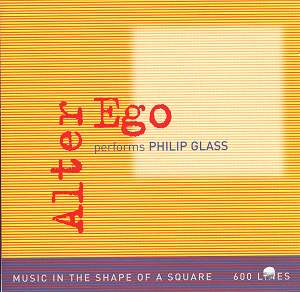
Philip GLASS (b.
1937) Music in the Shape of a Square CD1 Music in Similar Motion (1969) [12:38] Strung Out (1967) [14:28] Piece in the Shape of a Square (1968) [11:27] Gradus (1968) [10:19] Music in Contrary Motion (1969) [28:35] CD2 600 Lines (1968) [40:13] How Now (1968) [20:14] Alter Ego:
(Manuel Zurria (flute); Paolo Ravaglia (clarinet); Francesco
Peverini (violin); Francesco Dillon (cello); Oscar
Pizzo (electric keyboard); Gianluca Ruggeri (marimba); Giuseppe
Pistone (electric guitar); Fulvia Ricevuto (vibraphone, marimba)
rec. Motevarchi, 16-17 December 1999; Piccolo Regio, 16 September
2002. DDD ORANGE
MOUNTAIN MUSIC OMM0034 [77:27 + 60:27]
Even
though he is still alive, and has had a profound effect on
a generation of composers, many of Philip Glass’s early works
have been lost. They were not regularly performed and, in
many cases, were never recorded. Thus it is a great pleasure
to see Alter Ego helping to rectify this situation with a
dual disc set of material written between 1967 and 1969.
These often unfamiliar pieces were written for Glass’s New
York-based ensemble. Even where they are not totally unfamiliar
the instrumentation is different here than in more commonly
encountered recordings. This would seem to beg the questions:
are these works poorly regarded and thus intentionally ignored
as substandard and in what manner does the altered instrumentation
change the music?
The
music on the first disc epitomizes early minimalism. Each
work is designed to evolve slowly, allowing the mind to relax
and the sound to wash over the listener’s consciousness.
The music was intended to be performed with an indefinite
number of repetitions allowing the music to grow organically.
This approach has always met with mixed success. For instance, Strung
Out for solo amplified violin seems to drag on endlessly.
On the other hand Piece in the Shape of a Square for
two flutes is among Glass’s best early works. The two flutes
interact in such a variety of ways with the multi-meters
moving in and out of phase with each other that there seems
to be a nearly infinite number of variations.
Music
in Similar Motion is among
the better works here. In performance it can range between
6 and 25 minutes in length and was designed for any combination
of instruments so long as they play in appropriate ranges.
There are four basic lines, the first entering on a single
instrument followed by a second pitched a fourth above.
The third and fourth lines then enter, each time building
the sense of drama and intensity.
Gradus is here performed by bass clarinet, which is in many ways an improvement
over the original instrumentation of solo soprano-saxophone.
The clarinet seems more expressive and has a broader variety
of timbre than the originally intended instrument. The piece
still feels a bit too long, but not painfully so. It has
interesting melodic lines and implied harmonies. If the performer
had chosen to explore them over 8 minutes rather than 10
the result would have been truly outstanding.
Music
in Contrary Motion for ensemble
is an interesting work. It is more familiar in its keyboard
or organ format. This format is definitely more expressive
and impressive. Glass wrote it in so called “open form”,
meaning that it could theoretically continue forever. It
does not build at the beginning. Rather it begins all at
once, barrelling through the soundscape for nearly half
an hour before suddenly ending. The music does a fine job
of taking the listener on a journey and is probably the
best and most mature work on the first disc.
The
second CD contains two long works that happen to be the first
compositions written for the Philip Glass Ensemble. They
are both interesting from the musicological perspective,
as they show how a young Glass approached the problems of
playing these epic repetitive pieces without definite meter.
Both are listenable, though immature. 600 Lines is
largely performed with the ensemble in unison or octaves,
creating a somewhat jarring juxtaposition between modern,
almost Afro-Cuban, rhythms and a nearly plainchant character.
Clearly this was a work composed to explore the new musical
vocabulary that Glass wanted to call his own. Its downside
is that it lacks the assuredness that it would work when
contrasting parts were introduced.
How
Now is the better piece. It is here performed with an emphasis on tonal
percussion instruments like the vibraphone and marimba.
Its multiple musical thoughts and sensibility provide sustenance
over a twenty minute span. It seems at times to be music
suited to a film score. While it is definitely early Glass
it has a mature sensibility.
Overall
then, this collection is solid but not spectacular. For the
collector it offers many works that are not otherwise available,
and some of those are among the best early Glass. Additionally
both Music in Similar Motion and Music in Contrary
Motion are excellent and worth exploration even if you
already have other recordings. On the other hand 600 Lines and Strung
Out could easily have been omitted to the benefit of
the entire collection.
This
set is worthy of exploration, though probably not the best
entry point for someone unfamiliar with either Glass’s work
or minimalism generally.
Patrick Gary
Please support our advertisers below by clicking on the logos for further information.

























 Alter Ego:
(Manuel Zurria (flute); Paolo Ravaglia (clarinet); Francesco
Peverini (violin); Francesco Dillon (cello); Oscar
Pizzo (electric keyboard); Gianluca Ruggeri (marimba); Giuseppe
Pistone (electric guitar); Fulvia Ricevuto (vibraphone, marimba)
Alter Ego:
(Manuel Zurria (flute); Paolo Ravaglia (clarinet); Francesco
Peverini (violin); Francesco Dillon (cello); Oscar
Pizzo (electric keyboard); Gianluca Ruggeri (marimba); Giuseppe
Pistone (electric guitar); Fulvia Ricevuto (vibraphone, marimba)