Editorial Board
MusicWeb International
Founding Editor Rob Barnett Editor in Chief
John Quinn Contributing Editor Ralph Moore Webmaster
David Barker Postmaster
Jonathan Woolf MusicWeb Founder Len Mullenger
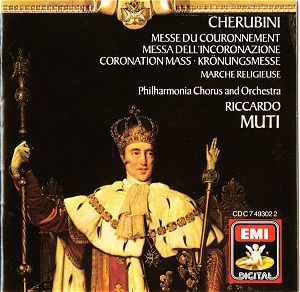
Luigi CHERUBINI (1760-1842)
Coronation Mass (1825) [50:47]
Marche réligieuse (1825) [5:11] Philharmonia
Chorus
Philharmonia Orchestra/Riccardo Muti
rec. 1985. DDD.
Texts and Translations included. EMI CLASSICS 49302 [56:00]
Listen
to this superb performance and you will surely understand
the admiration of this composer expressed, at various times,
by such as Beethoven, Schumann, Brahms and even Berlioz.
I say ‘even’ Berlioz because in his Memoirs Berlioz
paints such an uncomplimentary picture of Cherubini. Cherubini
was in his late sixties and a notoriously grumpy old man
when Berlioz, as a passionate young student, had dealings
with him. For Berlioz, Cherubini, head of the Conservatoire,
represented the musical establishment to which he was simultaneously
opposed and desirous of admission. Chapter Nine of the Memoirs contains
the grotesquely humorous episode - and again there is an
obvious symbolic dimension - in which Berlioz is chased from
the library of the Conservatoire by a porter and Cherubini, “his
face more cadaverous and basilisk-eyed, his hair bristling
more angrily, than ever”. That (mis)representation of Cherubini,
and the kind of language used in it, contrasts very vividly
with some of the things Berlioz actually said about Cherubini’s
music. Here he is, for example, on the Marche réligieuse,which
gets a rapt performance on this CD:
“The Marche
réligieuse represents mystic expression in all its
purity, in all its contemplation and Catholic ecstasy.
It breathes only divine love, faith free of doubt, serenity
of spirit before the Creator. No earthly sound disturbs
its transcendental calm which brings tears to the eyes
of the listener. But such sweet tears that one is borne
away beyond the simple artistic idea, any memory of the
present-day world, and left almost unaware of one’s own
emotion. If ever the use of the word ‘sublime’ needs to
be justified, it surely can be when applied to Cherubini’s Marche
réligieuse”.
In
Chapter Twenty Two of the Memoirs Berlioz writes of
the same piece, enthusing over “those exquisite long-drawn
notes on the wind instruments which induce in the listener
a strange ecstasy, the marvellous interweaving of flutes
and clarinets”.
The Marche
réligieuse was written to be played while Charles X
took communion on the occasion of his coronation in the
cathedral of Rheims on 29 April 1825. This was a thoroughly
lavish occasion, designed to reaffirm the sacred nature
of the monarchy. Charles sought to return to the old absolutist
ideal of monarchy – a vision out of tune with the times
and one of the reasons for his being overthrown only five
years later in the July Revolution of 1830. For a king
with such ideas of himself and his position, the Coronation
had to be, to put it mildly, a grand affair. The music
Cherubini composed for the Coronation Mass was certainly
grand.
The
Mass, indeed, is a kind of apotheosis of ceremonial music;
it is positively monumental. Yet it is also genuinely moving
and is far from merely pompous or rhetorical. The music is
quite startlingly beautiful in places – as in the Credo,
whether at the exquisite setting of “Crucifixus etiam pro
nobis” or the brass-fuelled blast of triumph at “Et resurrexit
tertia dia”. There are more than a few moments in this remarkable
Mass when it is impossible not to think across, as it were,
to Beethoven’s Missa Solemnis, written some seven
years earlier. Though there are many stylistic differences – as
well as a few resemblances – the sheer power and meaningful
scale of Cherubini’s choral and orchestral writing makes
such a comparison perfectly proper.
Riccardo
Muti has done - and continues to do - great work for the
reputation of Cherubini. Here his conducting is masterly,
the control of dynamics and phrasing wonderfully expressive,
his sense of the music’s theatricality - it might be better
and fairer to speak of the music’s dramatic qualities
- perfectly judged, never merely showy and always in the
service of the larger design of the whole. The work of the
Philharmonia Chorus and Orchestra – whether in hushed and
delicate passages or in grand climaxes – is exemplary throughout.
For
all the efforts of Muti – and a few others – Cherubini is
still seriously underestimated. Only a few areas of his output
are heard with anything approaching regularity nowadays,
and some never at all. A reissue such as this is surely a
persuasive argument for further investigation.
Glyn Pursglove
Please support our advertisers below by clicking on the logos for further information.

























 Philharmonia
Chorus
Philharmonia
Chorus  [56:00]