Editorial Board
MusicWeb International
Founding Editor Rob Barnett Editor in Chief
John Quinn Contributing Editor Ralph Moore Webmaster
David Barker Postmaster
Jonathan Woolf MusicWeb Founder Len Mullenger
Buy
through MusicWeb
for £11.00 postage
paid World Wide. Try
it on Sale or Return You
may prefer to pay by Sterling cheque or
Euro notes to avoid PayPal. Contact
for details
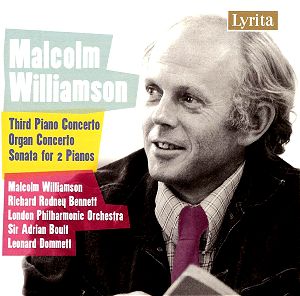
Malcolm WILLIAMSON (1931-2003)
Concerto for Organ and Orchestra (1961) [27:02]1
Piano Concerto No.3 in E flat (1962)2 [32:19]
Sonata for Two Pianos (1967)3 [7:36] Malcolm Williamson
(organ of Guildford Cathedral1, piano2,3),
Richard Rodney Bennett (piano)3
London Philharmonic Orchestra/Sir Adrian Boult1, Leonard
Dommett2
rec. 1Guildford Cathedral, January 1974; 2Kingsway Hall,
London, February 1974; 31972,venue and exact date not
stated. ADD. LYRITA
SRCD.280 [67:02]
I recently
bemoaned the neglect of another musical Malcolm, Malcolm
Arnold, the Naxos reissue of whose complete symphonies I
was pleased to recommend. The works of Malcolm Williamson,
late Master of the Queen’s Music, suffered an even greater
neglect both during the latter part of his lifetime and since.
Though he was a prolific composer, by my count there are
presently available fewer than ten CDs wholly or largely
devoted to his music, including the current one.
Even Naxos
and Chandos, those great advocates of twentieth-century British
music, have made only partial amends, the former with a CD
of his choral music, 8.557783, recommended on Musicweb with
minor reservations by Hubert
Culot and even more wholeheartedly by Gary
Higginson. Rob Barnett welcomed Volume 1 of Chandos’ Williamson
recordings on CHAN10359;
the second volume is available on CHAN10406, containing the
First and Fifth Symphonies and some shorter works. Rob also
reviewed ABC’s
complete piano music set in 2003.
In Australia,
the land of his birth, ABC have issued a number of CDs which
contain works by Williamson, including a recommendable version
of his Concerto for Two Pianos, with Williamson himself as
one of the soloists, coupled with other Australian Concertos
(Eloquence 426 483-2). This bargain-price CD appears not
to be readily available in the UK but may be ordered online
from Buywell in Australia.
Paul Conway
wrote a 70th Birthday
Tribute to Williamson for
this website: those unfamiliar with Williamson’s music could
do much worse than to read that article, which refers,
amongst other matters, to the Lyrita LP, SRCS79 – never before
released on CD, to the best of my knowledge – from which
the two orchestral works on the current disc have been reissued.
Since that article contains a detailed analysis of the Organ
Concerto and the Third Piano Concerto – an analysis which
I found useful in listening to these works, unfamiliar with
them as I was – it would be superfluous to repeat the information.
I would, however,
draw the reader’s attention to the implications of some of
the facts contained in the article. Elizabeth Lutyens and
Erwin Stein, one of Schoenberg’s ex-students, were among
Williamson’s composition teachers, which means that it is
hardly surprising that he experimented with 12-tone serial
technique. I make this point to warn off those who, seeing
that Sir Adrian Boult was the dedicatee and conductor of
the Organ Concerto, assume it to be a work of the so-called
English pastoral movement. Williamson did write light music – was,
indeed, a night-club pianist for a time – but the works on
this CD are emphatically neither pastoral nor light.
While there
may be some echoes of the pastoral school in the peaceful
slow movement of the Organ Concerto, the hectic outer movements
sound more like Boulez than Vaughan Williams, unless it be
the more frenzied sections of the latter’s Job. Even
in the slow movement there are echoes of Boulez’s mentor
Messiaen – and Messiaen at his sharpest – to whose mystical
Catholicism Williamson was drawn on his conversion to Rome.
This may not be ‘easy’ music but the finale, in which all
the stops are pulled out - metaphorically and, I imagine,
literally - is hard to resist.
After this
finale, the rather angular opening of the Third Piano Concerto
comes as something of a shock, though the more lyrical second
subject makes amends. This, too, is music which repays repeated
hearing, a large-scale concerto in four movements. As a lover
of Messiaen who finds most of Boulez unpalatable, I am thankful
to find more of the former than the latter in this work.
As the first movement develops, a jazz-like rhythm, with
just a hint of Copland – or perhaps it’s the wide-open spaces
of his native Australia, rather than those of the US – makes
the work even more approachable. In the Scherzo, the
tuneful and the sterner aspects of Williamson’s music alternate
like the two aspects of his personality which Schumann expressed
in his music – or like those moments in the Late Quartets
where Beethoven moulds the most exquisite tune only for it
to break down almost at once. In the slow movement gentle
elegy and impassioned grief or rage alternate – here, too,
Chopinesque glissandi are punctuated by staccato interruptions – before
the joyful resolution of a finale which might have been taken
from one of Williamson’s film scores. Shades even of Ibert’s Divertissement.
The Sonata
makes a worthwhile, if rather angular, addition to the contents
of the original LP.
If this is ‘difficult’ music
for the listener, it is also difficult for the performers.
Williamson’s presence as soloist in the Concertos and as
one of the duettists, with Richard Rodney Bennett, in the
other work, acts as a kind of imprimatur. Poets and
composers are not always the best interpreters of their own
works – for me, T. S. Eliot reads his own poetry with all
the feeling of someone reciting a shopping list – but Williamson
negotiates the difficult solo parts with feeling and the
accompaniments and recording do him full justice. As the
Organ Concerto was commissioned for the Proms, it was presumably
written with the Albert Hall organ and acoustics in mind,
but Guildford Cathedral and its Rushworth & Dreaper instrument
make excellent substitutes. In no sense is the re-mastered
analogue recording inferior to a modern digital recording.
Though not
one of the obvious gems in Lyrita’s growing catalogue of
reissues, this CD may be confidently recommended. The music
may not make an immediate impression, but it certainly repays
the persevering listener. The notes in the booklet, by composer
himself, add to its value.























 for details
 Malcolm Williamson
(organ of Guildford Cathedral1, piano2,3),
Richard Rodney Bennett (piano)3
Malcolm Williamson
(organ of Guildford Cathedral1, piano2,3),
Richard Rodney Bennett (piano)3