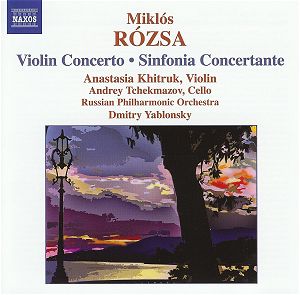
Miklos Rózsa arrived in Hollywood in 1940 after
study in Leipzig and a stint in Paris where Arthur Honegger
encouraged him to compose music for films. In California he
found a strong community of expatriate composers including Stravinsky,
Schoenberg and Korngold, and some of the finest instrumental
soloists then active, including Heifetz, Rubinstein and Piatigorsky.
By the time he renewed his contract with MGM in 1952, his reputation
was such that he was able to demand an unprecedented three months
off per year to compose concert music. The first fruits of this
arrangement came in the form of a violin concerto, written for
Jascha Heifetz. Although the work was completed in the summer
of 1952, Heifetz would not play the premiere until 1956 in Dallas.
Enthusiastically received, it would soon be recorded by RCA,
and this recording was to remain alone in the catalogue for
nearly forty years.
Unlike the concerto by his colleague Erich Wolfgang
Korngold - also written for Heifetz - Rózsa’s work is far more
harmonically adventuresome, though not without considerable
episodes of soaring lyricism, particularly in the elegant and
airy second movement. Korngold, whose music tended toward an
ultra-romanticism à la Richard Strauss, eschewed some of the
tangier dissonances employed by Rózsa. One can perhaps attribute
the difference in style to the fact that Rózsa grew up in Hungary,
whose folk music tradition was considerably more rustic than
that of Korngold’s Vienna. Regardless of his sources, Rózsa
creates an austere, almost wintry landscape with his music,
music that is tautly composed, carefully structured and gracefully
assembled. Even in the rather aggressive and stark final movement,
Rózsa spins one colorful melody after and other around a punchy
and rhythmic accompaniment long on brass interjections and percussive
effects from all sections of the orchestra, drums included.
Anastasia Khitruk is an able successor to Heifetz,
exhibiting both ample virtuosity and a warm singing tone that
is both thrilling and engaging. She plays passionately and yet
always in firm control over her emotions, bring the listener
often to the edge of his chair without ever dumping him on the
floor. Dmitry Yablonsky leads a finely tuned and rhythmically
precise Russian Philharmonic Orchestra. The refined brass playing,
not often a hallmark of Russian orchestras is not only refreshing
but highly exhilarating. Balance between soloist and orchestra
is fine, and the recording has the perfect combination of rich
tone and clarity.
The composer’s experience with his Sinfonia
Concertante was not nearly as happy. Originally proposed
by Piatigorsky, the completed work was considered unsatisfactory
by the performers - particularly Heifetz - and the two dedicatees
played only a considerably reworked second movement. The work
would not see a full performance until some time later in Chicago,
where it was deemed over-long and again met with a number of
revisions before reaching the form that is heard in this recording.
Considerably richer in texture than the violin
concerto, the composer’s Hungarian roots are very evident in
the melodies with their angular rhythms and acerbic harmonies.
One can almost taste the goulash in the wonderfully pungent
theme and variations, and yet, when the music needs a moment
of repose, Rózsa weaves in a lush romantic theme worthy of any
of his film scores. The work concludes with a heavy brass and
percussion laden finale, set out in contrast to the fleet passage
work of the soloists.
Ms. Khitruk is joined by an able and expressive
partner in Andrey Tchekmazov whose thick-fingered tone and versatile
range of expression serve the music well. There is a good deal
of audible sniffing and snorting from the soloist(s) in this
work that is not present in the Violin Concerto, a habit that
this writer has always found unnecessary, distracting and indeed
downright annoying. Mr. Yablonsky delivers the same kind of
tight ensemble playing, coupled with a warm unified string sound
that he gave in the Violin Concerto.
To summarize, these are works of high artistic
merit and one can hope that they will appear more often in the
concert halls of the world, particularly the violin concerto.
Kevin Sutton